
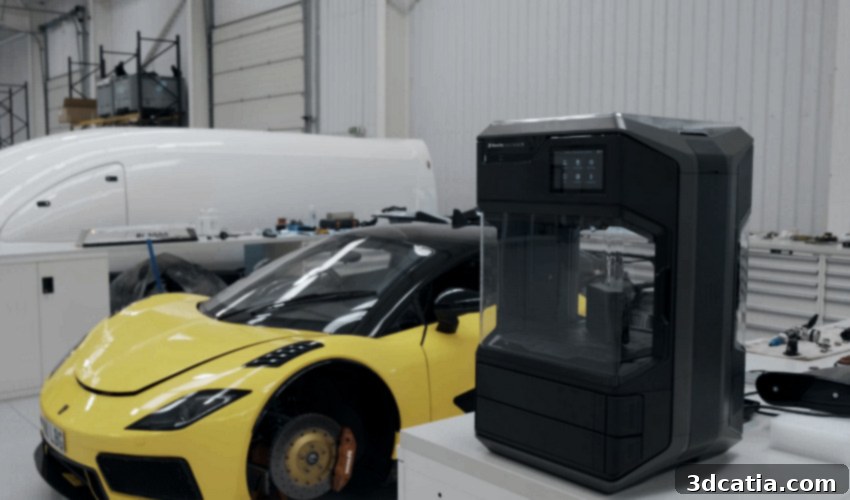
Revolutionizing Hypercar Production: Arash Motor Company Drives Innovation with MakerBot 3D Printing and Carbon Fiber
In the fiercely competitive world of elite automotive manufacturing, where speed, performance, and groundbreaking design are paramount, UK-based hypercar manufacturer Arash Motor Company is setting new benchmarks by strategically integrating the efficiencies of 3D printing into its car factories. This innovative adoption of additive manufacturing (AM) is not just about making parts; it’s about fundamentally accelerating vehicle production cycles and enabling unprecedented design freedom. While Arash has maintained a long-standing partnership, utilizing MakerBot 3D printers for numerous years in various developmental stages, the company has recently elevated its AM strategy. They have now introduced advanced materials, specifically nylon carbon fiber composites, for direct use in the production of components for its newest fleet of high-performance vehicles, signaling a significant shift towards industrial-grade applications of desktop 3D printing technology.
This forward-thinking approach leverages the versatile capabilities of various MakerBot METHOD X 3D printers within the Arash production facility. By utilizing a diverse range of filaments, including MakerBot Nylon Carbon Fiber and ABS, the skilled Arash team has successfully 3D-printed crucial production-ready parts. These components are designed for direct integration into their vehicles, moving beyond mere prototyping to encompass functional, end-use applications. The ability to print strong, lightweight, and complex parts on-demand dramatically streamlines their manufacturing processes, allowing for rapid iteration and deployment of cutting-edge designs. This move underscores a growing trend in the automotive sector where AM is transitioning from a tool for conceptualization to an indispensable method for creating finished vehicle components, particularly in the low-volume, high-value hypercar segment.
The advanced manufacturing environment at Arash Motor Company boasts an impressive array of MakerBot 3D printers, including the robust Replicator 2, the large-format Replicator Z18, and the industrial-grade METHOD X. This comprehensive suite of additive manufacturing machines empowers the Arash engineering team to meticulously test and implement performance improvements across critical vehicle systems. The application extends to the development of sophisticated composite structures, optimized engine and electric motor components, and groundbreaking aerodynamic designs. Indeed, 3D printing has been instrumental in achieving the sleek, aerodynamically superior aesthetic and functional efficiency for the company’s latest electric hypercar project. This represents a monumental leap from their previous, often laborious, prototyping methods. Prior to their deep integration with MakerBot, the Arash team was accustomed to the time-consuming and cumbersome process of fabricating prototypes using traditional aluminum methods, which involved extensive stages of cutting, bending, welding, and manual shaping. The contrast in efficiency and capability is stark.
Arash Farboud, the visionary founder and lead designer of Arash Motor Company, eloquently articulates the transformative impact of this technology: “The MakerBot 3D printer series dramatically reduces the time required to transition from a conceptual design on a computer screen to a tangible prototype, allowing for immediate tactile evaluation. This speed and direct feedback are incredibly valuable. Sometimes, in the design phase, you might overlook a small detail like a hole alignment or a fixture placement. While a CAD model helps, having a physical print allows you to physically check and verify these nuances instantaneously.” This ability to rapidly iterate and physically validate designs not only saves invaluable time and resources but also significantly enhances the precision and quality of the final vehicle components. The direct digital-to-physical workflow minimizes errors and accelerates the entire development lifecycle, enabling Arash to push the boundaries of hypercar performance and design with unprecedented agility.
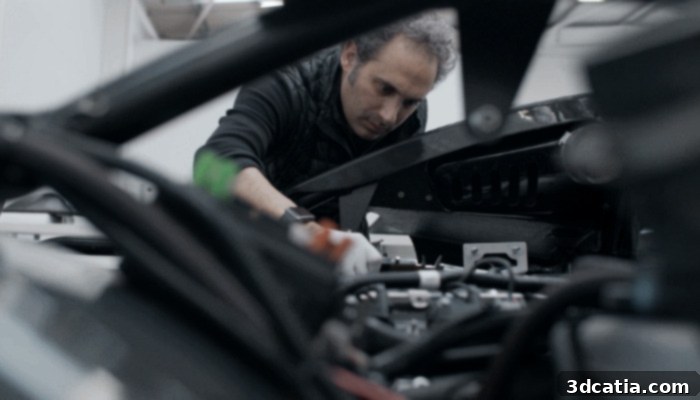
Innovating the Next Electric Hypercar from Arash with Advanced 3D Printing
The application of 3D printing has recently become a cornerstone in the design and production of several high-performance vehicles across the automotive industry, with notable examples from luxury manufacturers like Bugatti and McLaren. These industry leaders, much like Arash, recognize that additive manufacturing brings unique and indispensable advantages to the creation of incredibly fast and efficient vehicles. A primary benefit is the significant reduction in overall vehicle weight, directly contributing to improved power-to-weight ratios and enhanced acceleration. Furthermore, 3D printing excels at increasing complex aerodynamic properties. This is achieved through the technology’s unparalleled ability to optimize internal and external geometries for strength and weight, creating intricate structures that are impossible or cost-prohibitive with traditional manufacturing methods. These optimizations are critical for reducing drag and generating optimal downforce, essential characteristics for any true hypercar.
For Arash’s ambitious new electric hypercar project, the MakerBot Replicator Z18, known for its large build volume and reliability, played a crucial role. This machine enabled the Arash design and engineering teams to conceptualize and develop both the complex chassis structure and the sophisticated aerodynamic elements. The inherent flexibility afforded by 3D printing technology allowed for the seamless integration of groundbreaking new design techniques. This included rapid prototyping and testing of innovative suspension geometries, intricate wing designs that actively manage airflow, detailed wishbone suspension checks, and precise hub and center lock fitments. Moreover, the capability to quickly produce accurate scale models of structural parts facilitated comprehensive visual and functional assessments, ensuring every component met the rigorous demands of hypercar performance and safety. The ability to iterate on these critical components rapidly and cost-effectively is a game-changer for accelerating development cycles and achieving peak performance.
While the aesthetic and functional design advantages of additive manufacturing are significant, they represent only one facet of the profound impact AM has on automobile makers. The expansive and continuously growing choice of materials, coupled with innovative ways to utilize them, also plays a pivotal role in pushing automotive engineering boundaries. In the context of Arash’s hypercar development, the choice of Nylon, also commonly known as Polyamide (PA), has proven particularly advantageous. Nylon is a widely used and highly versatile polymer in additive manufacturing, finding applications across numerous industries due to its robust properties. The primary characteristics of Nylon filaments include their exceptional flexibility, remarkable resistance to impact, and high abrasion resistance – qualities that are critical for components exposed to dynamic forces and environmental stressors within a high-performance vehicle.
Taking these properties a step further, Arash has strategically adopted Nylon that is reinforced with carbon fiber (specifically PA12 carbon fiber). This composite material becomes incredibly durable, exhibiting enhanced mechanical properties that enable it to effectively replace traditional materials like aluminum and other metals in certain applications. This is primarily due to its outstanding high strength-to-weight ratio, which contributes to vital weight reduction, coupled with superior stiffness and excellent heat resistance. These attributes make carbon fiber-reinforced nylon an ideal choice for demanding automotive parts where performance and durability are non-negotiable. As one can imagine, these unique material properties make such advanced composites especially popular and increasingly indispensable within the high-stakes automotive and hypercar industry, where every gram and every degree of resistance matters.
Arash Farboud addressed a common misconception surrounding 3D printing materials in a statement to the press, reinforcing the industrial application of their chosen filaments: “Most people still hold the perception that 3D printing filaments are not strong enough for functional use, or that 3D printing is solely reserved for creating models or prototypes. However, we are actively utilizing these advanced 3D printed parts directly on our production cars. These components are not only accurate but also robust enough for our most demanding applications.” This declaration underscores Arash’s pioneering spirit, demonstrating that with the right materials and technology, 3D printed parts can indeed serve as reliable, high-performance components in the most extreme automotive environments. For those interested in delving deeper into Arash Motor Company’s visionary work and their stunning vehicles, more information can be found on their official website HERE.
The implementation of industrial-grade 3D printing within the Arash manufacturing ecosystem represents a broader trend towards agile and localized production. For low-volume, high-value vehicles like hypercars, the ability to produce highly customized parts on demand, without the need for expensive tooling or long lead times associated with traditional manufacturing, provides a significant competitive advantage. This not only speeds up development but also allows for unparalleled personalization and optimization for each vehicle. The sustainability benefits are also considerable, as additive manufacturing typically produces less waste than subtractive methods, and parts can be designed to maximize material efficiency. Arash’s adoption of this technology showcases a powerful vision for the future of specialized automotive production.
What are your thoughts on Arash Motor Company’s innovative use of the MakerBot METHOD X and advanced materials like Nylon Carbon Fiber for direct production in their hypercars? Do you see this as the future of high-performance automotive manufacturing? We’d love to hear your insights in a comment below or join the conversation on our Facebook and Twitter pages. Don’t forget to sign up for our free weekly newsletter to stay informed with all the latest news, innovations, and developments in the fascinating world of 3D printing, delivered straight to your inbox!
Cover Photo Credit: MakerBot