
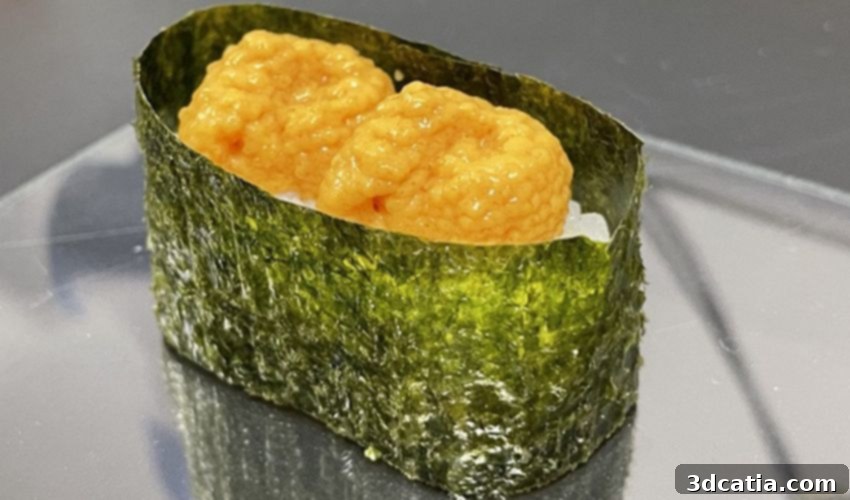
3D Printed Sushi: Revolutionizing Space Dining for Future Astronauts and Tourists
In an age where technological advancements continuously push the boundaries of human achievement, the convergence of 3D printing, culinary arts, and space exploration presents a fascinating frontier. For years, additive manufacturing has found diverse applications, from industrial prototyping to medical implants and even architectural design. More recently, its potential in food production has become increasingly evident, promising customized nutrition and innovative dining experiences. Now, a groundbreaking initiative is bringing together the realms of advanced food technology and orbital tourism: the development of 3D printed sushi designed for space tourists.
This ambitious project is the result of a collaborative effort between renowned Japanese institutions and a leading dispensing technology expert. Engineers at IHI Aerospace, a prominent aerospace manufacturer, and Yamagata University, a hub of academic research and innovation, have partnered with Nordson EFD Japan, a specialist in precision fluid dispensing. Their collective goal? To create exquisite, 3D printed sushi that could one day be served to paying passengers embarking on journeys to low Earth orbit, offering an unparalleled dining experience far above our planet.
The Culinary Challenge of Space: Why 3D Printed Sushi?
The advent of space tourism marks a new era of exploration, making orbital travel accessible to civilians – albeit at a premium. With current offerings ranging from a quarter-million dollars for a brief suborbital flight to astronomical figures for extended stays in space, it’s clear that these experiences are exclusive and meticulously curated. Given the extraordinary nature and cost of such endeavors, it’s only fitting that every aspect of the journey, including the culinary experience, should be equally exceptional and innovative. This is precisely where the concept of 3D printed sushi takes center stage.
IHI Aerospace and Yamagata University identified 3D printed sushi as a perfect solution for several compelling reasons. Firstly, sushi boasts immense global popularity, transcending cultural barriers to become a universally cherished delicacy. Its intricate artistry and diverse flavors make it an ideal candidate for an elevated dining experience, even in the unique environment of space. Secondly, and critically for space travel, 3D printing offers significant advantages in terms of weight reduction and resource optimization. Every gram counts when launching anything into orbit, and traditional food preparation often involves heavy equipment and bulky ingredients. 3D food printing, conversely, allows for the precise creation of meals from concentrated, lightweight ingredients, dramatically reducing the payload burden.
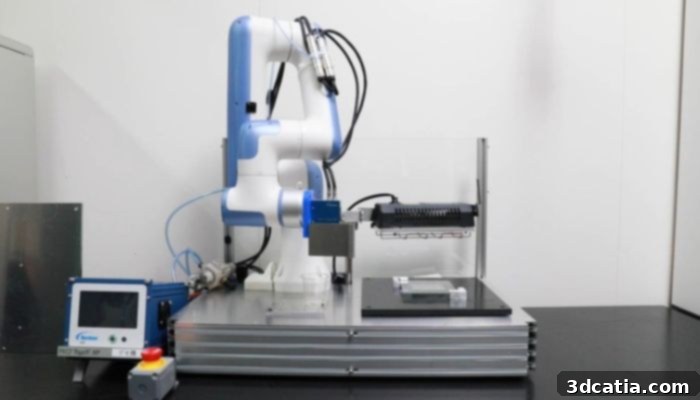
The prototype solution used to 3D print sushi, showcasing the precision engineering involved.
Innovating Sushi for Zero Gravity: The Science of Paste-Based Proteins
Adapting traditional sushi for the microgravity environment of space presents numerous challenges. The familiar pillars of sushi-making—the expertise of specialty chefs, the precision of sharp knives, and the vast array of fresh fish and seafood—are difficult, if not impossible, to replicate in orbit. The need for weight efficiency and extended shelf-life also necessitates a radical rethink of ingredients and preparation methods. Recognizing that every gram and every inch of storage space is precious in orbit, the collaborative team embraced a new approach. They focused on maintaining the essence of sushi: fresh ingredients, balanced flavors, and an appealing presentation, but reimagined its form.
The solution devised by IHI Aerospace and Yamagata University involved creating proteins in a paste format. This method moves away from whole, perishable fish and seafood, allowing for greater control over texture, flavor, and nutritional content. Paste is a well-established material format in the realm of food 3D printing, utilized in various projects worldwide due to its versatility and ease of extrusion. In this particular application, the team drew inspiration from uni (sea urchin) paste. Uni, in its natural form, has a very short shelf-life, making it impractical for space travel. However, transforming it into a paste not only extends its stability but also provides a precedent for creating other shelf-stable, palatable seafood alternatives.
While the concept of using paste offered a viable path forward, the actual implementation posed technical hurdles, particularly concerning the precise deposition of these pastes. Achieving the delicate balance required for sushi, where different ‘fish’ layers would sit atop a bed of rice, demanded exceptional accuracy and control. This is where Nordson EFD Japan, with its expertise in high-precision fluid dispensing systems, became an indispensable partner. Their specialized technology was crucial in transforming the conceptual paste into beautifully formed sushi pieces.
Precision Dispensing: Nordson EFD’s Role in Perfecting Space Sushi
The overarching goal of this innovative program was to successfully produce four distinct types of 3D printed sushi: uni, white fish, crab, and shrimp. A critical requirement for the 3D printing solution was its ability to seamlessly switch between these different ‘flavors’ or ingredient pastes without any cross-contamination or residual taste. Furthermore, the system needed to deposit these pastes with such meticulous precision that it would not disturb the delicate, pre-formed bed of rice upon which the “fish” would sit. This level of control is paramount to replicating the aesthetic and structural integrity of traditional sushi, even with novel ingredients.
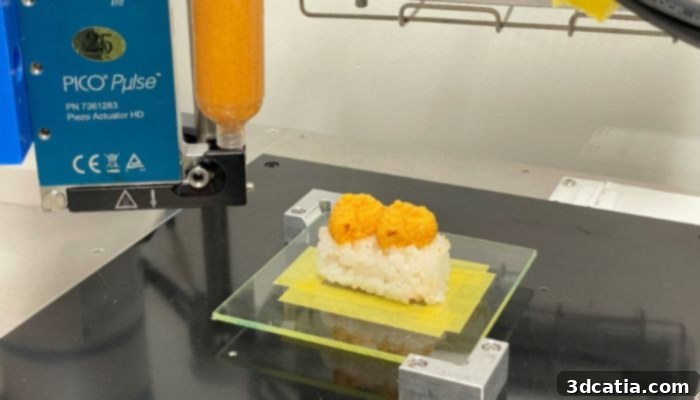
The 3D printed sushi immediately after production, demonstrating its visual appeal and structural integrity.
Nordson EFD’s contribution was pivotal in achieving these stringent requirements. They deployed their advanced PICO Pulse jet valve system, a state-of-the-art technology renowned for its precision dispensing capabilities. This system utilizes a piezoelectric actuator, which allows for incredibly smooth, accurate, and repeatable dispensing of various fluids, including the high-viscosity pastes developed for the sushi. The piezoelectric principle enables rapid and precise control over droplet size and placement, ensuring that each layer of “fish” paste is applied flawlessly. This core technology was integrated with a sophisticated Touch valve controller, providing intuitive and precise operational command, and a robust fluid reservoir to ensure a consistent supply of materials. The final touch was a specially designed flat nozzle with an exceptionally fine 300-micron orifice, enabling the intricate detail and clean lines necessary for aesthetically pleasing sushi.
From Prototype to Potential: The Future of 3D Printed Food in Diverse Environments
The meticulous engineering and collaborative spirit culminated in a highly successful prototype. The resulting 3D printed sushi not only met the technical specifications but also excelled in its presentation. Observers noted that the end product was remarkably artistic and consistent, even across multiple test runs and different sushi types. This success was not merely confined to laboratory settings; the 3D printed sushi was even showcased and served to dignitaries at a major Japanese trade show, garnering significant attention and demonstrating its potential beyond theoretical application.
Beyond the immediate goal of space tourism, the IHI Aerospace and Yamagata University team envisions broader applications for their innovative 3D printed food technology. They have highlighted its potential use in various terrestrial settings, particularly those where customized nutrition, ease of consumption, and food safety are paramount. Hospitals, nursing homes, and long-term care facilities could significantly benefit from 3D printed meals. This technology allows for the precise control of texture, making food easier for patients with dysphagia (swallowing difficulties) to consume, while also enabling exact nutrient tailoring to meet individual dietary needs. Furthermore, the ability to create visually appealing meals could enhance appetite and improve the overall dining experience for vulnerable populations.
While the initial story broke with considerable excitement in 2024, it’s important to acknowledge that, for now, this remains a visionary concept. To our knowledge, there have been no concrete steps taken to implement this plan on any operational spacecraft or for commercial space tourism flights. However, the rapidly expanding space tourism industry, with companies like SpaceX, Blue Origin, and Virgin Galactic pushing boundaries, suggests that the demand for novel and luxurious experiences in space will only grow. As the industry matures, sophisticated culinary offerings like 3D printed sushi could very well become a standard feature, differentiating services and enhancing the passenger experience.
Indeed, this project stands as a testament to the versatility and transformative power of 3D printing. It transcends mere utility, blending advanced manufacturing with a cherished culinary tradition to address complex challenges in extreme environments. The ability to create customized, visually appealing, and shelf-stable food in space opens up a universe of possibilities for future long-duration missions, lunar bases, and even Martian colonization, where fresh ingredients and traditional cooking methods will be severely limited. 3D printed sushi is not just a cool application; it’s a peek into the future of gastronomy, both on Earth and beyond.
What do you think of this pioneering 3D printed sushi? Would you be eager to try it on a future journey to orbit? Do you believe 3D printed food holds the key to sustainably feeding space tourists and astronauts in space? Let us know your thoughts in a comment below or connect with us on our LinkedIn, Facebook, and Twitter pages! Don’t forget to sign up for our free weekly Newsletter here, to receive the latest 3D printing news straight to your inbox! You can also find all our compelling videos on our YouTube channel, featuring more innovations in additive manufacturing.
*All Photo Credits: Nordson EFD, showcasing the development and outcome of this impressive 3D printing technology.