

Revolutionizing Home Humidity: The Energy-Free 3D Printed Print Clay Humidifier
In an era increasingly defined by environmental consciousness and the urgent need for sustainable solutions, the Print Clay Humidifier emerges as a beacon of innovative design. This groundbreaking device, conceived by visionary designer Jiaming Liu, offers a compelling alternative to conventional humidifiers by operating entirely without electricity. Drawing profound inspiration from nature’s most efficient systems – specifically, the way trees hydrate themselves – this 3D printed marvel represents a significant leap forward in eco-friendly product development. Its strikingly unique form and operational mechanism are not only aesthetically pleasing but are also made possible solely through the advanced capabilities of additive manufacturing, positioning it as a first-of-its-kind solution in the market.
The Dawn of Energy-Efficient Humidification
The creation of the Print Clay Humidifier began as a graduate project by Jiaming Liu at the prestigious Folkwang University of the Arts in Essen, Germany. This endeavor was more than just an academic exercise; it was a near-perfect demonstration of intelligent, environmentally conscious design principles put into practice. The project successfully marries low-cost, traditional materials with cutting-edge high-tech manufacturing techniques to deliver tangible value to the user. Its effectiveness and ingenious operation stem precisely from this thoughtful combination of ancient wisdom and modern innovation. Unlike typical humidifiers that rely on energy-intensive motors or ultrasonic vibrations, the Print Clay Humidifier harnesses fundamental physical principles, making it an entirely passive yet highly effective device.

The Print Clay Humidifier’s innovative material composition makes it lightweight and versatile, allowing it to be effortlessly placed on any surface or piece of furniture without concerns about energy connections.
At the heart of this humidifier’s design lies a profound appreciation for natural processes. Jiaming Liu eloquently describes the intricate connection to botanical systems: “The bottom water storage part is like the ground and soil, providing a stable reservoir. The extension curves, thoughtfully integrated within the water container, function much like the roots of a tree, efficiently absorbing water through capillary action. The main part then carries this water upward and outward, mirroring the vital role of tree trunks and branches in distributing moisture.” This meticulously designed evaporation process is conceptually identical to how traditional earthenware water containers naturally cool their contents – a time-tested, natural phenomenon that elegantly eliminates any need for electrical power. By embracing these biological and historical principles, the Print Clay Humidifier offers a silent, sustainable, and truly energy-independent solution for maintaining optimal indoor humidity levels.
Inspired by Nature: Mimicking the Tree’s Ingenuity for Optimal Humidification
The core principle driving the Print Clay Humidifier’s effectiveness is biomimicry – the emulation of nature’s best ideas to solve human problems. Trees, through their intricate systems of roots, xylem, and leaves, are masters of water absorption and transpiration. The humidifier replicates this through its multi-component design. The unglazed porous clay acts as the ‘roots’ and ‘trunk,’ drawing water up from the reservoir (the ‘soil’) through capillary action. This natural process allows water to slowly permeate the clay structure and evaporate into the surrounding air, passively increasing humidity. This method is remarkably efficient because it utilizes the inherent properties of the material and the environmental conditions, rather than relying on external energy input. The expansive surface area, maximized by its unique 3D printed geometry, further accelerates this natural evaporation, making it a powerful yet gentle humidifier.
Innovation in Manufacturing: The Creation Process and Sustainable Materials
Advanced 3D Printing with Sustainable Clay Materials
The realization of the Print Clay Humidifier was made possible through the innovative application of 3D printing technology, specifically using an FDM (Fused Deposition Modeling) clay printer. This choice of manufacturing method was pivotal not only for achieving the device’s complex, organic shapes but also for its commitment to sustainability. The material composition itself is a testament to eco-conscious design: recycled ceramic powder was meticulously blended with traditional clay in a precise 1:3 ratio. This composite material was not chosen arbitrarily; it significantly enhances both the strength and, crucially, the water absorption capabilities of the device. Furthermore, embracing such recycled content ensures that, at the end of its long and useful life cycle, the Print Clay Humidifier can be easily recycled and repurposed as clinker, closing the loop on material consumption and minimizing waste. This approach sets a new standard for sustainable product design, where materials are chosen for both their performance and their environmental footprint.
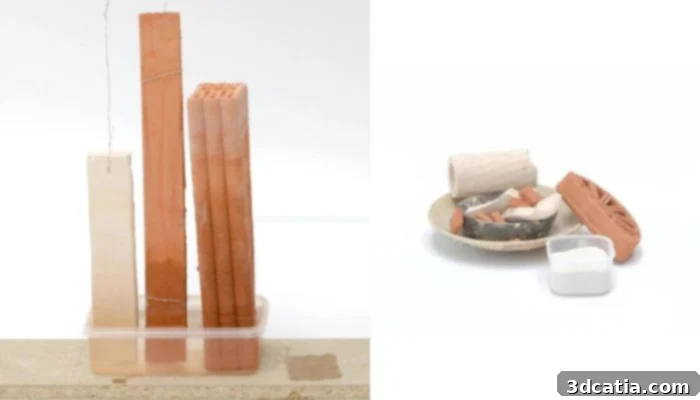
A visual comparison illustrating the superior water absorption capabilities: 1. Clay without any additions; 2. Clay enriched with 30% recycled ceramic powder; 3. Clay with 30% recycled ceramic powder, further enhanced by a specially designed texture, showcasing its heightened effectiveness.
The distinctive, geometrically complex shape achieved through 3D printing is absolutely fundamental to the humidifier’s unparalleled operational efficiency. According to designer Jiaming Liu, producing such an intricate structure would be virtually impossible using conventional manufacturing techniques like hand-molding or injection molding. This is where additive manufacturing truly shines, allowing for the creation of intricate internal channels and a maximized surface area that are critical for optimal performance. Liu elaborates, “Compared to other humidifiers currently available on the market, its unique 3D printed structure enables it to absorb and evaporate water far more effectively. Moreover, the clay’s inherent micropores are exceptionally proficient at releasing water vapor into the atmosphere, leading to a significantly higher evaporation rate – absorbing more water and achieving faster humidification.” This synergy between material science and advanced manufacturing techniques is what propels the Print Clay Humidifier beyond its predecessors, offering superior functionality through smart design.
The meticulous design also extends to the structural integrity and functionality of the device’s components. The creator ingeniously molded the three essential parts of the humidifier into a single, cohesive piece. The base, which serves as the water storage compartment, is capable of holding a substantial 500ml of water. Crucially, this external surface of the water reservoir is enameled, a traditional technique that prevents liquid from seeping out or evaporating prematurely from the base itself, thus ensuring efficient water storage. In stark contrast, the internal ‘roots’ and the upper ‘trunk’ sections are deliberately left unenameled. This specific treatment is vital for their optimal function, as these porous, exposed surfaces must be in direct contact with both the water and the surrounding air to facilitate the continuous absorption and evaporation process. This thoughtful differentiation in surface treatment highlights the precision and functional understanding embedded in every aspect of the Print Clay Humidifier’s design.
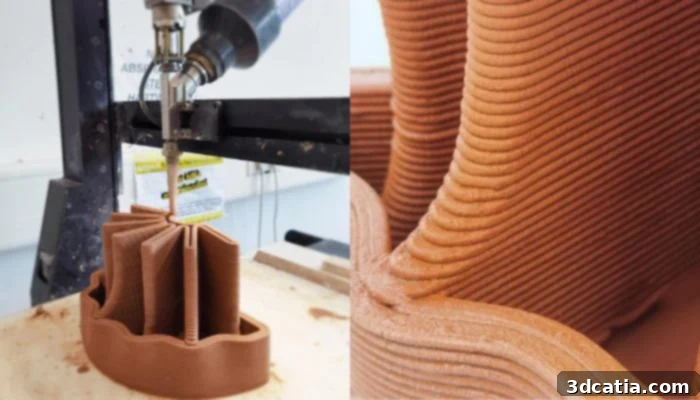
The intricate process of the humidifier being created layer by layer through advanced 3D printing technology.
Addressing Global Challenges with Smart Design
In the throes of a global energy crisis and escalating environmental concerns, simple, intelligent inventions like the Print Clay Humidifier offer much-needed hope and practical solutions. By leveraging traditional materials and age-old principles in conjunction with contemporary manufacturing techniques, this device presents a novel paradigm for designing and producing end-use parts that are not only readily available but also exceptionally usable and beneficial for consumers. This entire innovation, from conception to tangible product, is made possible and significantly enhanced by the transformative capabilities of 3D printing technologies. Beyond its immediate function, it serves as a powerful example of how design thinking can lead to products that are both high-performing and environmentally responsible, moving us closer to a circular economy.
The impact of 3D printing in sustainable art and design is rapidly expanding, with the Print Clay Humidifier being just one inspiring example. Similar pioneering projects include the creation of eco-friendly benches in Italy, meticulously crafted from recycled plastic waste, showcasing how waste materials can be transformed into durable and aesthetically pleasing urban furniture. Furthermore, the fashion industry is embracing additive manufacturing for sustainable innovation, with designers producing 3D printed shoes that offer enhanced customization, reduced material waste, and improved recyclability. These diverse applications underscore 3D printing’s potential to revolutionize various sectors by enabling the creation of complex geometries, optimizing material usage, and facilitating the integration of recycled and sustainable components, thereby pushing the boundaries of what is possible in design and production for a greener future. For more in-depth information about the Print Clay Humidifier and its design philosophy, you can explore the designer’s dedicated project page HERE.
What are your thoughts on this remarkable project? Do you see yourself incorporating one of these innovative, energy-free humidifiers into your living space? We invite you to share your insights and opinions in the comment section below, or engage with us on our social media platforms: LinkedIn,Facebook, andTwitter. Don’t miss out on the latest advancements and news in the 3D printing world – be sure to sign up for our free weeklyNewsletter to receive fresh updates straight to your inbox! Additionally, you can explore all our engaging video content on our dedicatedYouTube channel.
*All Photo credits: jiamingliu.design