
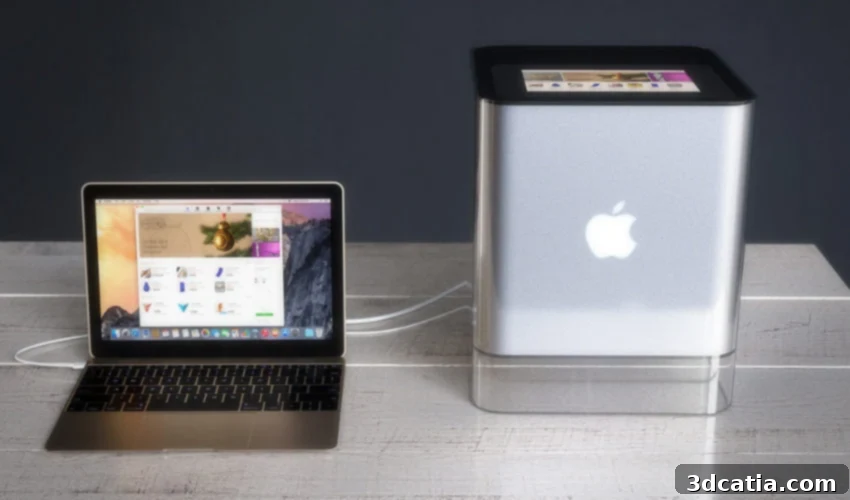
Apple’s Full-Color 3D Printing Ambitions: Unpacking Patents and Future Potential
Apple, a global technology leader renowned for its innovative products and seamless user experiences, recently secured a batch of 44 new US patents. Among these significant grants was one that has particularly captured the attention of the additive manufacturing world: a patent for a “method and apparatus for three-dimensional printing of colored objects.” This highly anticipated development points directly towards Apple’s potential entry into the full-color 3D printing market, suggesting the advent of an official Apple 3D printer capable of producing vibrant, multi-hued objects. This isn’t Apple’s first foray into the realm of color 3D printing; as far back as 2015, the company was granted a patent for an FDM (Fused Deposition Modeling) 3D printer that promised full-color capabilities, akin to what companies like XYZprinting have already achieved with their color FDM offerings. These repeated patent filings underscore a persistent and growing interest from Apple in the transformative potential of additive manufacturing.
Is an Apple 3D Printer on the Horizon? Tracing Apple’s Additive Manufacturing Journey
While the recent patent grants have fueled speculation, Apple’s engagement with 3D printing is far from a new phenomenon. The Cupertino-based technology giant has, for some time, been actively involved in the 3D printing ecosystem, albeit in less direct ways. For instance, Apple’s online stores have featured Ultimaker 3D printers, marketing them as ‘iPhone accessories’ to facilitate the printing of 3D models. This move, while seemingly minor, demonstrated an early recognition by Apple of the synergy between its core products and the growing accessibility of 3D printing technology for creative and practical applications. However, Apple’s deeper journey into the additive manufacturing market truly began to materialize in May 2014, when the company filed its first substantial 3D printing-related patent application. This pioneering application detailed an innovative dual extruder system, distinguishing itself by proposing a setup where one printhead would be responsible for precisely depositing the filament material, while a separate, dedicated printhead would handle the intricate task of coloring it. This design hinted at a sophisticated approach to integrating color into the FDM process, aiming for greater control and fidelity than conventional single-extruder systems.
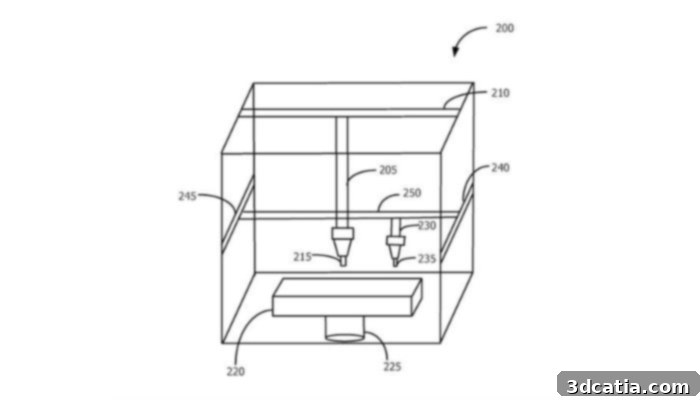
Technical drawings from an Apple 3D printer patent application, illustrating the conceptual design of dual extruders for material deposition and integrated coloring.
Furthermore, the 2014 patent meticulously outlined Apple’s proposed methodologies for coloring the filament material. The document described two primary approaches, each offering distinct advantages. The first method involved dynamically coloring the filament *during* the printing process itself. This real-time coloring technique would allow for highly precise color application, potentially enabling intricate gradients and complex patterns directly as the object is being built layer by layer. The second approach focused on coloring the object *after* the printing process had concluded. This post-processing coloring could offer greater flexibility in material selection and potentially achieve more uniform color saturation or specialized finishes. Crucially, in both processes, the color information would be intricately encoded within the 3D CAD model itself. This emphasis on digital integration suggests Apple’s commitment to a streamlined workflow, where design software would dictate not only the geometry but also the exact color scheme, ensuring a seamless translation from digital design to physical output. This level of integration is paramount for an ecosystem company like Apple, aiming for a cohesive user experience.
Beyond Printing: Apple’s Holistic Vision for Additive Manufacturing, Including 3D Scanning and Systems
Apple’s recent patent authorizations reveal a vision that extends far beyond merely creating a standalone 3D printer. The company has secured patents encompassing entire 3D printing systems, hinting at a comprehensive ecosystem rather than just a single device. More strikingly, patents related to advanced 3D scanning systems, designed to capture and map images in three dimensions, have also been granted. This indicates Apple’s intent to immerse itself across the entire additive manufacturing value chain, from initial digital capture and design to final physical production. Such a holistic approach aligns perfectly with Apple’s historical strategy of controlling both hardware and software to deliver integrated, intuitive user experiences. Imagine the synergy: capturing a real-world object with an iPhone’s advanced LiDAR scanner, refining it in a specialized Apple-designed CAD application, and then directly printing it in full color on an Apple 3D printer.
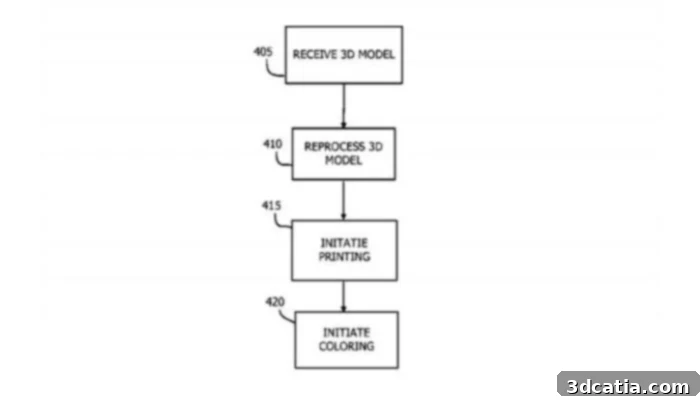
Another conceptual drawing extracted from Apple’s patent application, illustrating components of their FDM full-color 3D printer system.
In a twist of what might be considered cruel irony, Apple recently found itself in the spotlight within the 3D scanning industry, though for reasons it likely preferred to avoid. The infamous incident involved Vietnamese cybersecurity experts from Bkav, who successfully bypassed the iPhone X’s Face ID security system using a meticulously crafted 3D printed mask. This event, widely publicized, highlighted both the incredible fidelity achievable with 3D printing and a critical vulnerability in Apple’s biometric security. You can delve into our comprehensive article on this incident here. This past experience, however, might serve as a powerful catalyst for Apple. It’s plausible that Apple’s renewed and deepened involvement in 3D scanning technologies, as evidenced by their recent patents, includes a strategic focus on enhancing the robustness of their face scanning security features. By mastering the very technology that exposed a flaw, Apple could prevent future PR challenges and significantly solidify its biometric authentication systems, leveraging internal additive manufacturing capabilities for R&D and quality assurance.
The Promise of Full-Color 3D Printing: Technical Innovations and Market Impact
The concept of full-color 3D printing is a game-changer for numerous industries. While existing technologies, such as binder jetting and material jetting, have offered multi-color capabilities for years, Apple’s focus on an FDM-based system, potentially enhanced with their unique coloring methods, could democratize this feature. FDM printers are generally more accessible and affordable, and if Apple can bring robust, high-fidelity color to this segment, it could unlock new avenues for designers, educators, and even general consumers. Current full-color FDM printers often rely on mixing colored filaments or applying external dyes, but Apple’s patent, particularly the dual-extruder system and the method of encoding color within the CAD model, suggests a more integrated and precise approach. This could lead to objects with richer, more consistent colors and complex patterns that are difficult to achieve with current FDM technologies.
An Apple 3D printer, especially one with full-color capabilities, would not just be another device in the market; it would likely be a meticulously engineered product designed for ease of use and seamless integration into the Apple ecosystem. Such a printer could significantly impact various sectors: industrial designers could rapidly prototype concept models with accurate color representation, eliminating the need for painting; educational institutions could create engaging, colorful teaching aids; and even consumers could personalize household items, toys, or fashion accessories with unprecedented creative freedom. The potential for Apple to introduce user-friendly software for 3D design and color management, integrated with its existing macOS and iOS platforms, could lower the barrier to entry for many who find current 3D printing workflows overly complex. Apple’s brand power and commitment to design aesthetics could elevate the perception of 3D printing from a niche industrial tool to a mainstream creative and functional technology.
Looking Ahead: Apple’s Redefinition of Additive Manufacturing
Apple’s increasing patent portfolio related to 3D printing and scanning technologies paints a clear picture: the company is not merely dabbling in additive manufacturing but is actively positioning itself to become a significant player. By focusing on full-color capabilities, integrated systems, and potentially leveraging its expertise in user experience design and software development, Apple has the potential to redefine how people interact with 3D printing. Whether this leads to a consumer-grade desktop printer, a professional prototyping solution, or a broader enterprise-level manufacturing strategy remains to be seen. However, given Apple’s history of innovation and market disruption, their entry into the full-color 3D printing space could usher in a new era of accessibility, creativity, and integration for additive manufacturing. The implications for the industry are profound, promising not just new hardware, but a completely reimagined ecosystem for turning digital ideas into tangible, colorful realities.
For those interested in the finer technical details, the full patent document can be accessed by clicking here. The evocative cover image for this article was thoughtfully created by Martin Hajek.
What are your thoughts on Apple’s deepening involvement in the 3D printing industry? Do you foresee them launching a full-color 3D printer that could revolutionize the market? Share your insights and predictions in a comment below, or join the conversation on our Facebook and Twitter pages! Don’t miss out on the latest advancements and news from the world of additive manufacturing; make sure to sign up for our free weekly Newsletter, delivered straight to your inbox.