
Revolutionizing the Future: The Top 10 3D Printing Innovations of 2017 You Need to See
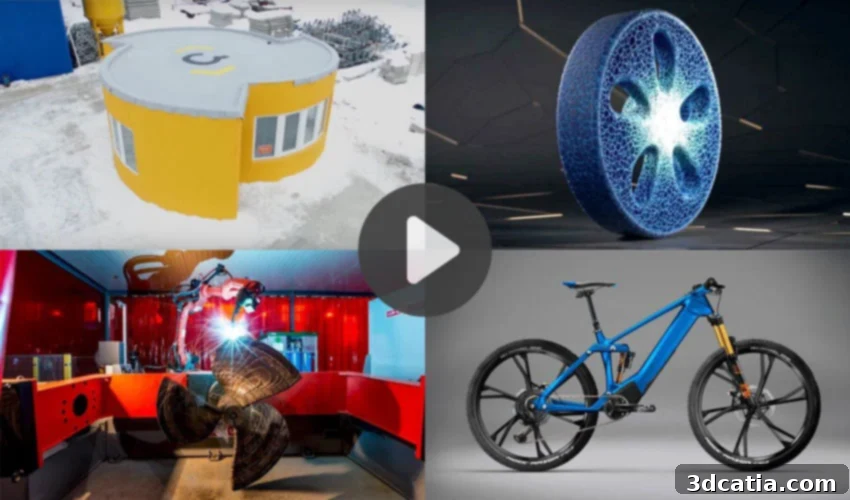
The year 2017 proved to be a pivotal period for the 3D printer industry, marked by a surge of groundbreaking innovations that pushed the boundaries of additive manufacturing. From the rapid construction of 3D printed houses to the development of cutting-edge technologies and the creation of breathtaking art, the sector demonstrated its immense potential across a diverse range of applications. Fortunately, many of these significant achievements were documented through captivating videos, allowing us to revisit and celebrate the Top 10 3D printing videos of 2017. These showcases feature collaborative efforts from major industry players like HP, Michelin, and Renault, illustrating the transformative power of 3D printing and 3D scanning, and offering a compelling glimpse into how these technologies can benefit humanity in the years to come.
1. Apis Cor Builds a House in 24 Hours
One of the most astonishing feats of 2017 was achieved by Russian company Apis Cor, which successfully 3D printed a 38-square-meter house in a mere 24 hours. This incredible demonstration showcased the potential for rapid, cost-effective construction using additive manufacturing. Apis Cor developed a unique mobile 3D printer featuring a removable arm that can rotate 360 degrees, allowing it to cover an impressive area of up to 132 square meters. The machine’s design enables it to be set up on-site in just 30 minutes and, as the video vividly demonstrates, it can operate efficiently even under challenging weather conditions. This innovation carries profound implications for the construction industry, promising to revolutionize affordable housing initiatives, disaster relief efforts, and the overall speed of building projects. By significantly reducing construction time and labor costs, Apis Cor laid the groundwork for a new era in home building. You can read the full article here.
2. Michelin’s Visionary 3D Printed Tire
Michelin unveiled a groundbreaking concept in 2017: a 3D printed, biodegradable, and seemingly indestructible tire named the Concept Vision. This biomimetic tire, drawing inspiration from natural structures, features an ingenious reprintable tread that can be adapted to various weather conditions, offering unprecedented flexibility and safety for drivers. Its innovative honeycomb structure not only contributes to its exceptional durability and reduced weight but also earned it recognition from Time Magazine as one of the best innovations of the year. The biodegradability aspect highlights Michelin’s commitment to sustainability, envisioning a future where tires are part of a circular economy. This visionary concept promises to redefine the future of mobility, making tires more environmentally friendly, adaptable, and long-lasting. It undoubtedly deserves its prominent place in our ranking of 2017’s top innovations. For more details, explore the full article here.
3. Adidas FutureCraft 4D: Personalized Performance Footwear
In a monumental collaboration, Adidas partnered with pioneering 3D printing company Carbon 3D to produce 100,000 pairs of their revolutionary FutureCraft 4D sneakers. This ambitious production scale underscored the maturity and industrial viability of 3D printing for consumer goods. These innovative sneakers were manufactured using Carbon’s Digital Light Synthesis (DLS) technology, an advanced process that precisely projects light through an oxygen-permeable window to continuously harden liquid resin layer by layer. This method, often referred to as CLIP (Continuous Liquid Interface Production), allows for incredibly intricate lattices and structures previously impossible with traditional manufacturing. Adidas’s vision was to offer a shoe truly adapted to the unique biomechanics of each athlete, optimizing movement, stability, cushioning, and overall comfort through a customizable midsole. The FutureCraft 4D project marked a significant step towards mass customization in footwear, promising a future where performance shoes are tailored to individual needs. Discover more about this collaboration here.
4. RAMLAB’s Pioneering 3D Printed Boat Propeller
RAMLAB, a cutting-edge manufacturing facility situated at the Port of Rotterdam, Europe’s largest port, made significant waves in 2017 with its dedication to producing critical spare parts for ships using additive manufacturing. With invaluable assistance from Autodesk, RAMLAB achieved a remarkable feat: the 3D printing of a full-scale, 400 kg boat propeller. This propeller, meticulously crafted with 298 layers of specialized material, underwent an intensive nine-month period of rigorous tests and trials to ensure its durability and performance under harsh marine conditions. The successful approval of the WAAMpeller (Wire Arc Additive Manufactured propeller) paved the way for its imminent release, marking a significant milestone for the maritime industry. This innovation addresses the logistical challenges of obtaining spare parts for large vessels, promising reduced lead times, minimized inventory, and the ability to produce on-demand components. The project highlighted the immense potential of large-scale metal additive manufacturing for complex, high-stress industrial applications. Read more about this engineering marvel here.
5. HP Multi Jet Fusion: Accelerating Industrial 3D Printing
US tech giant HP officially entered the additive manufacturing market in 2012, but 2017 was the year its Multi Jet Fusion (MJF) technology truly made its mark. MJF is a powder-bed fusion additive manufacturing technology that revolutionized the speed and cost-effectiveness of producing functional plastic parts. Unlike traditional laser-based powder bed systems, MJF utilizes a unique combination of a thermal printhead to apply fusing and detailing agents across a powder bed, followed by an energy source to solidify the material layer by layer. This innovative approach allows for the printing of complex geometries and intricate details at speeds up to 10 times faster than competing technologies. HP’s Multi Jet Fusion offered unparalleled productivity, consistent part quality, and lower operational costs, making industrial-grade 3D printing more accessible to businesses across various sectors. The technology’s ability to produce highly functional parts with isotropic mechanical properties significantly impacted manufacturing workflows, enabling faster prototyping and the production of end-use parts. Learn more about HP’s foray into metal 3D printing and MJF’s capabilities here.
6. The Voodoo Manufacturing Skywalker Project: Lights-Out Production
Voodoo Manufacturing, a dynamic New York-based micro-printer factory, showcased a pivotal step towards highly automated, scalable 3D printing with its “Skywalker Project” in 2017. Specializing in the mass production of plastic parts, Voodoo Manufacturing addressed one of the key bottlenecks in 3D printing: post-processing and continuous operation. The Skywalker Project integrated a robotic arm into its printer farm, enabling it to autonomously remove finished print trays and load new ones. This innovative automation system allowed for continuous, lights-out printing, drastically increasing throughput and overall productivity without constant human intervention. By creating an automated workflow, Voodoo Manufacturing demonstrated a viable model for distributed manufacturing and on-demand production, making custom and small-batch manufacturing more economically feasible. This project was a testament to how robotics and artificial intelligence could be seamlessly integrated with additive manufacturing to unlock greater efficiencies and scalability in production. Dive deeper into Voodoo Manufacturing’s pioneering startup journey here.
7. Project X at the University of Melbourne: Rocket Engine Breakthrough
A team of visionary engineers from the University of Melbourne achieved an extraordinary feat in 2017, designing, 3D printing, and rigorously testing a functional rocket engine in an astonishing four months. This rapid development cycle for an Aerospike engine, dubbed “Project X,” was made possible through the application of Direct Metal Laser Sintering (DMLS) technology. DMLS allowed the team to create the complex, intricate geometries inherent to the Aerospike design, which significantly improves propulsion efficiency and reduces gas consumption at lower altitudes compared to traditional bell-nozzle engines. The engineers emphatically stated that such a groundbreaking result, combining complex internal channels for regenerative cooling with an optimized external shape, would have been unattainable without the precision and design freedom offered by additive manufacturing. This project highlighted the transformative role of 3D printing in aerospace, enabling faster iteration, lighter components, and more efficient designs crucial for future space exploration and cost-effective satellite launches. Discover more about Australia’s 3D printed rocket engine here.
8. The 3D Printed Soft Heart of ETH Zurich
In a monumental step for medical research, engineers at ETH Zurich successfully created a functional 3D printed soft heart from silicone in 2017. Weighing approximately 390 grams, this artificial organ managed to achieve 3,000 beats, demonstrating its initial pumping capabilities. The design incorporated two ventricles and a separate chamber that inflates due to atmospheric pressure to effectively pump fluid, mimicking the rhythmic contractions of a biological heart. While this pioneering creation is not yet a viable alternative for human transplantation, these results were immensely promising for advancing the field of artificial organ development. This soft, elastic heart provides an invaluable tool for researchers to better understand the mechanics of the human heart, test new medical devices, and potentially serve as a model for drug development. The project underscored the vast potential of 3D printing and soft robotics in addressing complex biological challenges and paving the way for future biocompatible and implantable medical solutions. The full article can be found here.
9. Renault’s Formula 1 Car Concept: The RS 2027 Vision
Renault captivated the automotive world in 2017 with the unveiling of their RS 2027 Vision concept car, a bold glimpse into the future of Formula 1 racing, featuring a cutting-edge 3D printed cabin. This visionary concept envisioned an F1 car designed to be the manufacturer’s most powerful, boasting a staggering power output of one megawatt while maintaining an ultra-lightweight chassis of just 600 kilograms. Renault emphasized that the 3D printed cabin would incorporate recycled materials, showcasing a commitment to sustainability, and would be fully customizable to the driver’s specific needs and preferences. The integration of additive manufacturing in such a high-performance vehicle underscores its critical role in achieving extreme lightweighting, optimizing aerodynamic efficiency, and enabling rapid design iterations—all crucial factors in competitive motorsports. This concept demonstrated how 3D printing could allow for unprecedented customization, performance enhancements, and sustainable practices in the automotive industry, pushing the boundaries of what is possible on and off the track. Explore more about the Renault RS 2027 Vision here.
10. Kinazo’s Electric Bike: The e1 Redefining Cycling
The Slovakian company Kinazo, in collaboration with Volkswagen, introduced its innovative first 3D printed electric bike, the Kinazo e1, in 2017. This groundbreaking bicycle was meticulously designed and manufactured using advanced metal 3D printers, specifically those from Concept Laser. The Kinazo e1 is powered by a sophisticated battery system and controlled via an intuitive mobile application, integrating smart technology with cutting-edge manufacturing. Additive manufacturing played a crucial role in its development, allowing for the creation of parts with highly complex geometries and optimized internal structures that significantly reduced the bike’s overall weight while maintaining exceptional strength and rigidity. This design freedom enabled Kinazo to integrate functional components directly into the frame, resulting in a sleek, efficient, and technologically advanced electric bike. The Kinazo e1 exemplified how 3D printing is transforming the sports equipment industry, offering unparalleled design possibilities for lighter, stronger, and more personalized products. This project showcased a future where performance and aesthetics are enhanced through the limitless potential of additive manufacturing.
The year 2017 undeniably marked a period of explosive growth and unprecedented innovation in the 3D printing sector. The advancements highlighted in these top videos, from construction and automotive to medical and consumer goods, underscore the transformative power of additive manufacturing across diverse industries. These breakthroughs not only showcased the immense capabilities of the technology but also set a clear trajectory for its future development, promising more efficient, sustainable, and personalized solutions for a wide range of global challenges. The integration of 3D printing with robotics, advanced materials, and smart technologies is continually redefining what’s possible, paving the way for a truly revolutionized manufacturing landscape.
Did you find this article interesting and insightful? We’d love to hear your thoughts! Let us know in a comment below or connect with us on our Facebook and Twitter pages. To stay updated with the very latest in 3D printing news and innovations, be sure to sign up for our free weekly Newsletter here, delivered straight to your inbox!