
Revolutionizing Construction: Carbon-Capturing 3D Printed Concrete for Sustainable Buildings
The construction industry, a cornerstone of global development, is undergoing a profound transformation, largely driven by the advancements in 3D printing technology. This innovative approach has already paved the way for a myriad of projects, ranging from rapid-built residential homes to expansive commercial structures like shopping malls, demonstrating its versatility and efficiency. Beyond mere structural creation, the industry is now focusing on addressing its significant environmental footprint, particularly concerning carbon emissions. In this global pursuit of sustainability, a groundbreaking project from Nanyang Technological University (NTU Singapore) is capturing considerable attention: the development of a novel concrete 3D printing technique specifically engineered to capture and sequester carbon dioxide.
This pioneering innovation by NTU Singapore researchers heralds a new era for sustainable construction, opening vast possibilities for substantially reducing the ecological impact of building practices worldwide. The timing of this breakthrough is particularly significant, arriving just months after researchers at the University of Virginia successfully formulated a 3D printable concrete that achieved an impressive 31 percent reduction in carbon emissions. These parallel efforts underscore a powerful, concerted global drive towards making construction 3D printing not just efficient, but fundamentally eco-friendly and regenerative.
Published in the esteemed Carbon Capture Science & Technology journal, NTU’s new technique promises to redefine the environmental paradigm of the construction sector. The global production of cement, a primary component of concrete, is notoriously carbon-intensive, accounting for approximately eight percent of worldwide CO2 emissions. This alarming statistic highlights the urgent need for sustainable alternatives. By integrating carbon capture directly into the manufacturing process, this advanced 3D printing method offers a compelling solution to mitigate this critical environmental challenge. Furthermore, the approach optimizes material usage, significantly accelerates construction timelines, and substantially reduces labor requirements, diminishing the necessity for traditional, resource-intensive methods such like reinforced concrete. Let’s delve deeper into the mechanics of this innovative process and understand how it works.
Eco-Friendly and High-Performance 3D Concrete Printing: A Game Changer
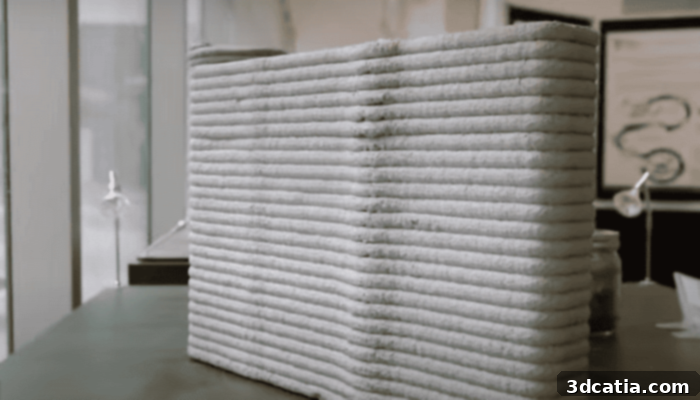
The core of this groundbreaking 3D printing method lies in its ingenious integration of CO2 and steam. These substances, often recovered as industrial by-products from various manufacturing processes, are directly incorporated into the concrete mix during the printing operation. This innovative process facilitates the permanent fixation of CO2 within the concrete’s structure, effectively transforming a harmful greenhouse gas into an integral part of the building material. Crucially, this not only sequesters carbon but also remarkably enhances the concrete’s mechanical performance, surpassing that of conventional 3D printing methods.
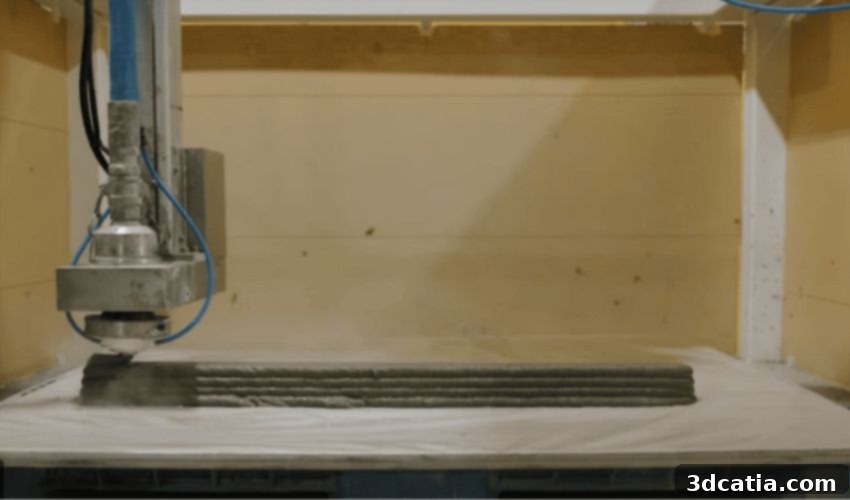
To achieve this, the NTU team meticulously designed a sophisticated system wherein the 3D printer is seamlessly connected to specialized CO2 pumps and a controlled steam jet. As the concrete is extruded layer by layer during the printing process, the injected CO2 actively reacts with the concrete components, initiating a chemical reaction that contributes to its solidification and strength gain. Simultaneously, the precisely calibrated steam jet plays a pivotal role by significantly increasing the concrete’s capacity to absorb CO2. This dual action of carbon reaction and enhanced absorption results in a final structure that is not only robust and durable but also fundamentally more environmentally friendly. This method essentially turns waste CO2 into a valuable resource, embedding it within the very fabric of our built environment.
Professor Tan Ming Jen, a leading figure from NTU’s School of Mechanical and Aerospace Engineering (MAE) and the Singapore Center for 3D Printing (SC3DP), emphasized the critical importance of mitigating greenhouse gas emissions within the construction sector, widely recognized as one of the world’s most significant contributors to pollution. He articulated the profound impact of this research, stating, “Our newly developed 3D concrete printing system offers a carbon-reducing alternative by not only improving the mechanical properties of concrete but also contributing to reducing the sector’s environmental impact. It demonstrates the possibility of using CO2 produced by power plants or other industries for 3D concrete printing. Since traditional cement emits a lot of carbon, our method offers a way to plow back CO2 through 3D concrete printing.” This statement powerfully underscores the dual benefit of NTU’s innovation: enhanced material performance coupled with direct climate action.
Rigorous testing has consistently validated the superior performance of this new technique, producing concrete that is remarkably stronger and more durable than its conventional counterparts. Specifically, comparative analyses revealed that the resulting carbon-capturing concrete supports an astonishing 37 percent more weight and exhibits nearly 45 percent greater flexibility before fracturing, a crucial factor for seismic resistance and structural resilience. Beyond these impressive mechanical attributes, the process stands out for its environmental stewardship, capturing a remarkable 38 percent more CO2 compared to traditional concrete production methods. This represents a significant leap forward in creating construction materials that actively contribute to atmospheric carbon reduction.
The researchers are not resting on their laurels; they are actively pursuing further refinements to optimize the technique’s efficiency and broaden its applicability. A key area of future exploration involves the utilization of recycled industrial gases, rather than pure CO2, in the 3D printing process. This would further enhance the environmental credentials of the method by leveraging existing waste streams and reducing the need for purified gas inputs. Such advancements could make the technology even more accessible and cost-effective for widespread industrial adoption.
The implications of NTU’s carbon-capturing 3D printed concrete extend far beyond individual building projects. This innovation has the potential to fundamentally reshape the entire construction supply chain, offering a pathway to significantly decarbonize one of the world’s most energy-intensive industries. Imagine a future where buildings are not merely structures but active participants in mitigating climate change, literally locking away carbon within their very foundations. This technology could lead to a paradigm shift, where sustainable practices become economically viable and environmentally imperative. It could also accelerate the adoption of modular construction, enabling faster, more precise, and even more automated building processes with a reduced environmental footprint. Furthermore, by improving material strength and flexibility, it opens up new architectural possibilities for more intricate and structurally ambitious designs that were previously challenging or impossible with traditional methods.
This development underscores a broader trend in advanced manufacturing and materials science: a pivot towards circular economy principles and integrated sustainability. By transforming industrial waste into valuable resources and improving the inherent properties of construction materials, NTU Singapore is setting a precedent for how innovation can address complex global challenges. The widespread adoption of such technologies, supported by policy incentives and industry collaboration, will be crucial in realizing a truly sustainable built environment for future generations. It demonstrates that the future of construction is not just about building bigger or faster, but about building smarter, greener, and with a profound respect for our planet.
What are your thoughts on this revolutionary concrete 3D printing method and its potential to transform sustainable construction? We invite you to share your insights and comments below, or engage with us on our LinkedIn, Facebook, and Twitter pages! Don’t forget to sign up for our free weekly Newsletter here, ensuring you receive the very latest 3D printing news directly to your inbox. You can also explore all our videos and in-depth content on our YouTube channel for more cutting-edge developments.
*All Photo Credits: NTU Singapore