
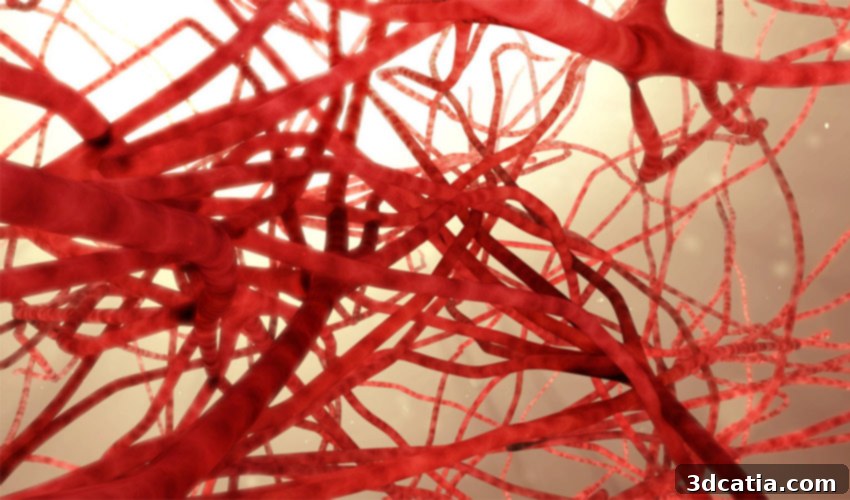
Revolutionizing Regenerative Medicine: 3D-Printed Blood Vessels for Enhanced Tissue Implantation
The future of regenerative medicine is being reshaped by groundbreaking advancements in 3D bioprinting, and a recent innovation from the Israel Institute of Technology, Technion, stands at the forefront. Scientists there have successfully created a sophisticated network of 3D-printed blood vessels, designed to deliver essential nutrients and oxygen directly to implanted tissues. This pioneering project, while still in its research phase, promises to profoundly impact human tissue implantation. By ensuring immediate and robust vascularization, this technology could lead to significantly better assimilation of transplanted tissues by patients, dramatically reducing the critical risk of rejection and improving long-term graft survival. Furthermore, the inherent customization capabilities of 3D printing offer a personalized solution for each individual, paving the way for more effective and tailored medical operations.
The potential impact of this research is immense. The developed blood vessel network has already demonstrated remarkable success in preliminary tests on a rat model, an encouraging step that validates the core principles of the technology. The immediate objective for the research team is to scale up their efforts, moving towards testing on larger animal models such as pigs, a crucial stage before any potential human trials. This progression underscores the scientific rigor and long-term vision behind Technion’s work, aiming to bridge the gap between laboratory innovation and clinical application.
The Critical Challenge of Tissue Vascularization in Transplantation
One of the most significant hurdles in tissue and organ transplantation has always been the challenge of vascularization. When a new tissue is introduced into a patient’s body, it requires an immediate and continuous supply of blood to survive, grow, and integrate with the host. Without adequate blood flow, the implanted tissue quickly starves of oxygen and nutrients, leading to cell death and ultimately, graft failure. Traditionally, surgeons face the complex task of ensuring this vascular connection. Often, new tissue must first be implanted in a “healthy”, highly vascularized area of the patient’s body, allowing it to establish its own blood supply over time, before being surgically relocated to its final intended site. This multi-step process adds considerable complexity, extends recovery times, and inherently increases the patient’s exposure to risks, including infection and additional surgical trauma. It also introduces a significant delay, which can be detrimental for tissues with high metabolic demands.
The absence of a robust, pre-vascularized structure is a primary reason why many tissue engineering efforts and transplant procedures encounter limitations. Technion’s breakthrough directly addresses this fundamental challenge by providing a ready-made vascular network, engineered to seamlessly integrate and sustain the implanted tissue from the moment of transplantation. This direct approach could eliminate the cumbersome intermediate steps, streamlining the process and significantly improving patient outcomes.
3D Bioprinting: Advancing Regenerative Medicine Beyond Limits
The field of additive manufacturing, particularly 3D bioprinting, is rapidly transforming medical research and clinical applications. Scientists worldwide are leveraging this technology to reproduce complex biological structures, including entire organs, intricate blood vessel networks, realistic tumor models, and various tissues. These bio-printed constructs serve multiple purposes: they enable a deeper understanding of diseases, facilitate the development of more effective treatments, and significantly reduce the risks associated with conventional transplants. For instance, the University of California at San Diego has pioneered 3D-printed scaffolds that precisely guide the creation of new blood vessels, aiming to enhance the efficacy of treatments for cancerous tumors by ensuring better drug delivery and nutrient supply. In a similar vein, the innovative team at Technion is harnessing this powerful technology to revolutionize tissue transplants, striving to achieve immediate vascular integration and unparalleled success rates for patients.
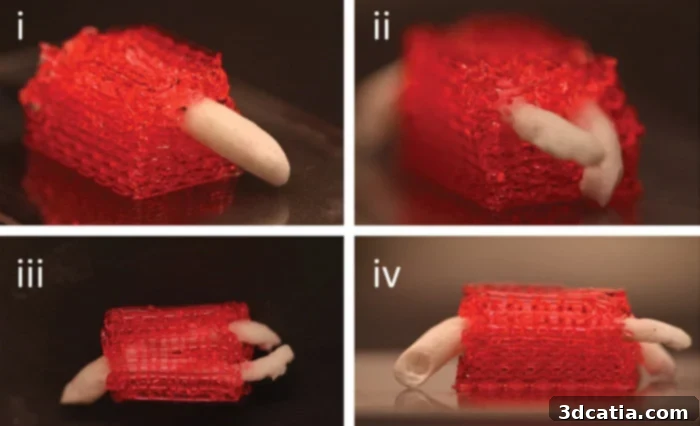
The researchers first 3D-printed a scaffold covered with a 3D printed hydrogel. (Photo Credit: Advanced Materials)
Technion’s Innovative Approach: Building a 3D-Printed Blood Vessel Network from Collagen
The core of Technion’s innovation lies in its ingenious method of creating a functional, pre-vascularized tissue construct. Addressing the aforementioned challenge of ensuring immediate nutrient and oxygen supply, Technion scientists have devised a ground-breaking 3D-printed solution that directly feeds the new tissue upon implantation, bypassing the traditional, complex, and time-consuming process of waiting for the patient’s body to vascularize the graft naturally. This direct vascularization approach significantly accelerates the integration process and minimizes the window of vulnerability for the transplanted tissue.
The Materials and Methodology Behind the Network
At the heart of this intricate network is human collagen, a vital structural protein naturally found in the body, known for its biocompatibility and ability to support cell growth. This specific collagen was developed by Collplant, a company at the forefront of regenerative medicine materials. Technion’s team utilized this advanced collagen to 3D-print a foundational scaffold, meticulously designed to mimic the complex architecture of a large blood vessel. The scaffold’s design is ingeniously tube-shaped, featuring strategically placed openings along its sides. These openings are critical, serving as connection points for smaller, branching vessels, thereby facilitating the creation of a comprehensive and interconnected vascular tree.
Once the primary scaffold was precisely printed and ready, the scientists carefully surrounded it with a proprietary tissue, also fabricated using collagen through advanced 3D bioprinting techniques. This layered approach ensures structural integrity and biological compatibility. To complete the vascularization process, the entire construct was then meticulously covered with endothelial cells. Endothelial cells are crucial; they naturally line the interior surface of blood vessels and play a pivotal role in regulating blood flow, forming new vessels, and preventing clotting. Their inclusion is fundamental for the functional success of the artificial network.
Witnessing Vascular Formation and Interconnectivity
The next phase involved a critical period of incubation, during which the scientists closely monitored the bio-printed construct. Over time, they observed a remarkable phenomenon: tiny, nascent blood vessels began to spontaneously form and extend within the collagen tube. This inherent biological response, guided by the scaffold’s architecture and the presence of endothelial cells, demonstrated the scaffold’s ability to promote natural vascular development. After just one week of carefully controlled incubation, the researchers confirmed that the bio-printed scaffold had successfully established intricate connections with these newly formed small vessels. The result was not merely isolated vessels but a fully realized, branching vascular network, designed for efficient communication and nutrient distribution throughout the engineered tissue. This achievement represents a significant leap forward in creating truly functional bio-printed tissues.
Successful Pre-Clinical Validation: From Rat to Human Horizon
To rigorously assess the functionality and efficacy of this newly engineered vascular network, the Technion team conducted a crucial pre-clinical trial. They surgically attached the 3D-printed blood vessel network to the femoral artery of a transplanted rat. This strategic placement allowed for direct observation of blood flow dynamics within the bio-printed construct and its integration with the host’s circulatory system. The results were highly encouraging: blood was observed to flow freely and efficiently from the rat’s native arterial system into the 3D-printed network and subsequently perfuse the implanted tissue. Critically, the researchers reported absolutely no leakage, indicating the structural integrity and biological compatibility of the engineered vessels. This successful integration and sustained blood flow signify a monumental step towards the clinical viability of such bio-printed tissues.
Building on this success, the research team is now focused on advancing their work to the next stage. Their immediate goal is to print larger, more complex vessels and networks to facilitate testing on larger animal models, such as pigs, whose physiological systems are more akin to humans. This progression is essential for understanding how the technology performs under more demanding conditions and for refining the bioprinting parameters for human application. The ultimate objective remains steadfast: to develop a robust, safe, and effective vascularized tissue solution that can be seamlessly implemented in human patients, potentially transforming transplantation medicine and enabling the creation of functional, replacement organs. The comprehensive details of this pioneering study are openly available HERE, inviting further scientific scrutiny and collaboration.
The Promise of Personalized Regenerative Medicine
Technion’s innovation represents a significant stride towards truly personalized regenerative medicine. The ability to 3D print patient-specific vascular networks means that tissue transplants could be precisely tailored to an individual’s unique anatomy and physiological requirements. This level of customization is expected to further minimize immune rejection risks, expedite the healing process, and ensure the long-term success of implants. Imagine a future where complex organs, not just tissues, can be bio-printed with their intrinsic vascular system, ready for immediate integration into the human body. This research moves us closer to a reality where the scarcity of donor organs becomes a challenge of the past, and debilitating conditions requiring tissue repair can be addressed with unparalleled precision and efficacy.
Furthermore, the implications extend beyond transplantation. This technology could facilitate the creation of highly accurate disease models for drug testing, reducing reliance on animal experimentation. It could also play a pivotal role in repairing damaged tissues in situ, providing a scaffolding for the body’s natural regenerative capabilities while supplying vital nutrients. The synergy of advanced materials, sophisticated 3D printing techniques, and biological engineering promises a new era of medical interventions that are more effective, less invasive, and deeply personalized.
What are your thoughts on Technion’s revolutionary 3D-printed blood vessel network and its potential to transform regenerative medicine? Share your insights and predictions in the comments section below, or join the conversation on our Facebook and Twitter pages. Stay updated with all the latest breakthroughs in 3D printing and medical technology by signing up for our free weekly newsletter, delivered straight to your inbox!
Cover Photo Credit: Adobe Stock