
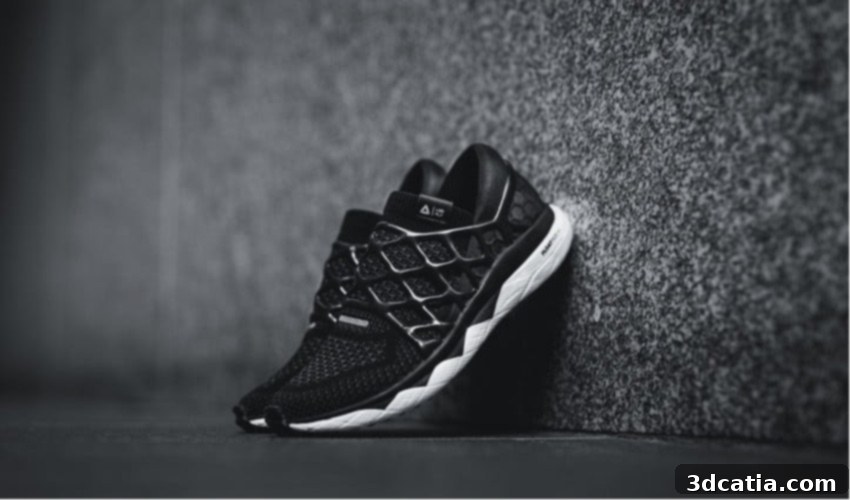
Reebok Redefines Footwear Innovation with 3D Printed Liquid Floatride Run Sneakers
Reebok, a pioneering force in athletic footwear, initially made waves in the additive manufacturing space with the debut of its 3D printed Liquid Speed sneakers back in 2016. Since that groundbreaking announcement, the industry and consumers alike have eagerly awaited the brand’s subsequent advancements in 3D shoe technology. That anticipation has now been met with the unveiling of their latest innovation: the Liquid Floatride Run. This new generation of athletic footwear is built upon the same revolutionary “Liquid Factory” technology that first impressed us two years prior, further solidifying Reebok’s commitment to pushing the boundaries of shoe manufacturing.
The integration of 3D printing continues its robust expansion within the global footwear market, driving unprecedented levels of innovation and product development. New initiatives are emerging frequently, with prominent companies like ECCO manufacturer already having transitioned to mass production of their own lines of 3D printed sneakers. In this dynamic landscape, Reebok’s announcement of the Liquid Floatride Run is a significant step, showcasing their unique approach to leveraging additive manufacturing for performance and design. The renowned US manufacturer has reportedly refined its proprietary 3D printing process, which utilizes a specialized liquid polyurethane material developed in close collaboration with chemical giant BASF. This strategic partnership underscores the importance of advanced material science in realizing the full potential of 3D printing for consumer products. Reebok asserts that this innovative process enables a remarkable 20% reduction in the overall weight of the sneakers, while also introducing two distinctive and highly functional features: “liquid laces” and an enhanced high-adhesion outsole. These advancements not only highlight the technical prowess of the Liquid Factory but also promise a new level of comfort and performance for athletes and everyday wearers.
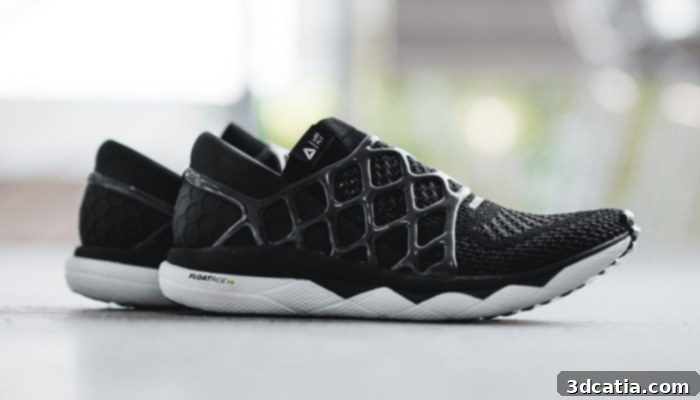
Revolutionary Design: No Traditional Laces and Superior Grip for these 3D Printed Shoes
One of the most striking innovations featured in the Liquid Floatride Run is the introduction of “liquid laces.” These aren’t traditional laces in any sense; instead, they are stretchy, liquid-printed structures that are directly integrated into the shoe’s upper, effectively eliminating the need for conventional lacing systems. This groundbreaking design not only streamlines the shoe’s aesthetic but also offers practical benefits for the wearer. The liquid laces have been meticulously engineered to incorporate specific pressure points across various parts of the shoe. This allows the wearer to effortlessly slip their foot in and out, providing unmatched convenience without compromising on crucial stability and support. The precise application of these liquid laces ensures a snug, adaptive fit that cradles the foot, offering a sensation of personalized comfort and security that traditional laces often struggle to achieve consistently. This approach represents a significant leap forward in footwear design, blending form and function in a truly innovative manner.
The second distinguishing characteristic of the Liquid Floatride Run focuses on the shoe’s grip and, more specifically, its outsole. Engineered for optimal performance, the outsole is composed of intricately designed stripes that are precisely 3D printed from the patented liquid material. This sophisticated patterning is not merely for aesthetics; it is functionally crafted to deliver superior grip and traction across a variety of surfaces. Traditionally, the rubber outsole is often identified as the heaviest component of a running shoe, directly impacting its overall weight and, consequently, a runner’s efficiency. By leveraging their liquid material and advanced 3D printing capabilities, Reebok has managed to significantly lighten this critical part of the shoe. The result is an outsole that is not only robust and highly adhesive but also considerably lighter, contributing directly to the shoe’s overall 20% weight reduction. This innovative approach to outsole design demonstrates a holistic understanding of performance footwear, where every component is optimized for maximum benefit without compromise.
Interestingly, Reebok appears to be charting a distinct course compared to some of its major competitors, such as Adidas or Nike, in its application of 3D printing. While other brands have extensively explored 3D printing for the production of midsoles, Reebok has made a deliberate strategic choice not to 3D print the midsoles of the Liquid Floatride Run. Instead, these innovative sneakers are equipped with Reebok’s well-regarded, patented Floatride soles. This decision underscores a commitment to integrating proven, high-performance technologies with cutting-edge additive manufacturing where it makes the most sense. The Floatride technology is renowned for its exceptional cushioning, energy return, and lightweight properties, making it an ideal choice for ensuring superior comfort, particularly for runners who demand sustained performance over long distances. By combining the revolutionary 3D printed upper and outsole with the established excellence of Floatride midsoles, Reebok delivers a shoe that harmonizes tradition with innovation, offering a unique blend of custom-engineered features and reliable, athletic performance.
Bill McInnis, the visionary Director of Reebok Future, articulates the brand’s long-term strategy behind this technology: “We initially introduced the Liquid Factory concept to the world with the Liquid Speed shoe, which was truly an innovative product designed to showcase the transformative potential of modeling and 3D printing in shoe manufacturing. It demonstrated how these advanced technologies could fundamentally alter the way footwear is designed and produced. With the Liquid Floatride, our objective is to illustrate how seamlessly we can apply the power of Liquid Factory technology to any of our existing, established product lines, enhancing them and making them even better. This evolution is crucial as it signifies the versatility and scalability of our additive manufacturing process. Looking ahead, the next generation of Liquid Factory products promises to be even more groundbreaking and innovative. Our ultimate goal is to leverage this process to create entire shoe structures – from the sole and advanced shock absorbers to the complete outer part – unlocking unprecedented levels of design freedom, customization, and performance attributes that are simply not possible with traditional manufacturing methods.” This statement highlights a clear roadmap for Reebok, indicating a future where complete shoes could be custom-manufactured on-demand, tailored to individual biomechanics and preferences.
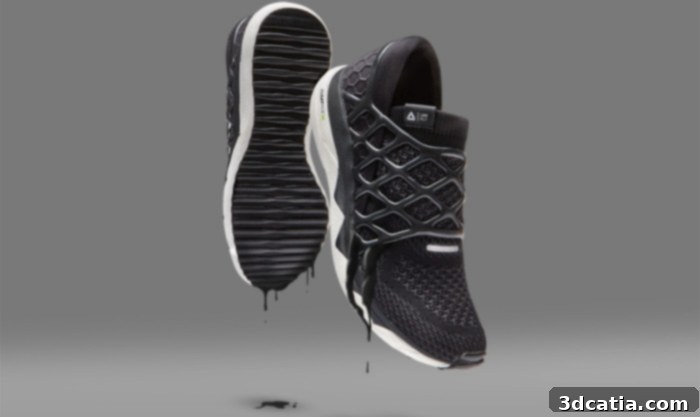
The Liquid Factory process itself is a testament to cutting-edge engineering and automation, harnessing a sophisticated combination of advanced software and highly precise robotic systems to meticulously model and produce shoes in 3D. Reebok’s proprietary robotic system plays a pivotal role, enabling the brand to accurately deposit and shape their patented liquid material with unparalleled precision. This unique, mold-less manufacturing process completely bypasses the need for traditional, costly, and time-consuming physical molds. This not only dramatically reduces lead times and development costs but also offers an extraordinary degree of design freedom, allowing for complex geometries and intricate structures that would be impossible or prohibitively expensive to create through conventional methods. The ability to iterate designs rapidly and produce customized components without tooling constraints positions Reebok at the forefront of agile manufacturing in the footwear industry. This innovative approach ensures that each Liquid Floatride Run sneaker benefits from a manufacturing process that is as advanced and performance-driven as the shoe itself. As a result, consumers can now experience this blend of innovation and performance firsthand, with the new sneakers readily available for order via the official Reebok online store at a price point of $180.
The Liquid Floatride Run, with its ingenious liquid laces, lightweight 3D printed outsole, and integrated Floatride cushioning, represents more than just a new shoe; it symbolizes Reebok’s strategic vision for the future of footwear. By prioritizing targeted 3D printing applications where they offer the most significant performance advantages, the brand differentiates itself in a competitive market. This selective adoption of additive manufacturing, coupled with their unique Liquid Factory process, positions Reebok as a leader in creating highly functional, personalized, and environmentally conscious athletic gear. The mold-less production system holds immense promise for sustainable manufacturing, reducing material waste and enabling localized, on-demand production. As 3D printing technology continues to advance, we can expect Reebok to further expand the capabilities of its Liquid Factory, potentially offering even greater customization options and pushing the boundaries of what is possible in shoe design and performance. The Liquid Floatride Run is a clear indication that the future of footwear is here, and it’s being shaped by innovative materials and cutting-edge manufacturing processes. What are your thoughts on Reebok’s latest 3D printed sneakers and the potential of the Liquid Factory? We encourage you to share your feedback and insights in a comment below or join the conversation on our Facebook and Twitter pages! Don’t forget to sign up for our free weekly Newsletter to receive all the latest news in 3D printing directly in your inbox!