
Ford Performance Unleashes Automotive Innovation: Unveiling the Largest 3D Printed Metal Part for Ken Block’s Hoonitruck
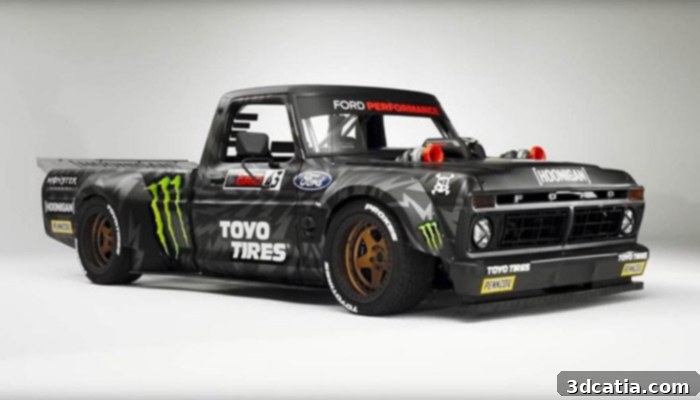
In a groundbreaking stride for automotive manufacturing and additive technology, Ford Performance, the revered high-performance division of Ford Motor Company, has shattered expectations by 3D printing what they confidently claim to be the largest metal automotive part ever created for a working vehicle. This monumental component has found its home within the legendary Hoonitruck – a custom-built 1977 Ford F-150, famously owned by motorsports icon Ken Block and powered by a formidable twin-turbo 3.5-liter V6 EcoBoost engine. This remarkable achievement not only underscores Ford’s commitment to innovation but also pushes the boundaries of what is possible with metal additive manufacturing in the high-stakes world of performance vehicles.
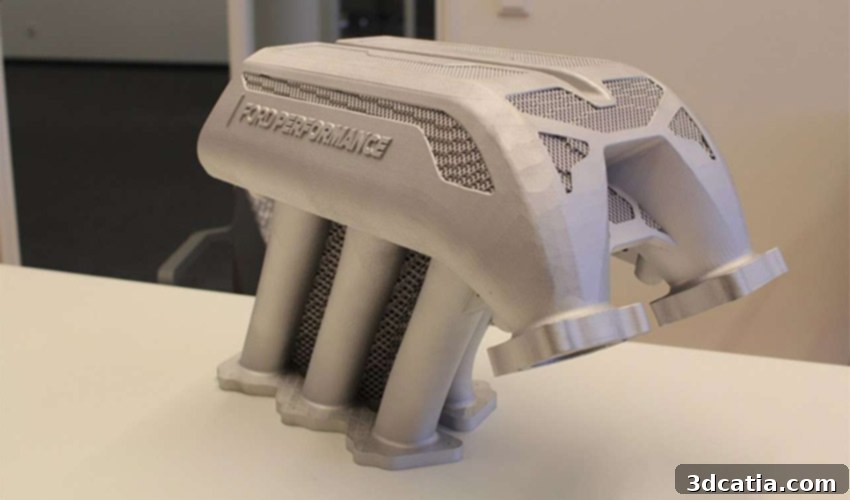
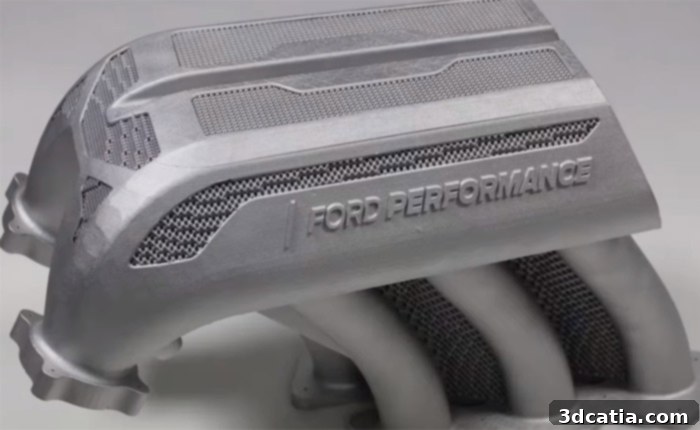
The revelation of this record-breaking part has sent ripples through both the automotive and 3D printing industries. While Ford has kept some of the precise specifications under wraps, they have disclosed that the component weighs approximately 6 kilograms (13.2 pounds) and required an intensive five-day printing process. This intricate piece is an aluminum manifold inlet, a critical component in any engine, and its creation was entrusted to one of the most advanced large-format metal 3D printers available: the GE Additive Concept Laser X LINE 2000R. This industrial-scale machine is renowned for its capacity to produce exceptionally large metal parts with high precision, making it the ideal choice for Ford’s ambitious project.
Defining “Largest”: A New Benchmark in Additive Manufacturing
The claim of creating the “largest metal additively manufactured part” for a functional vehicle is significant and places Ford at the forefront of this technological frontier. To put this into perspective, it implies that this new Ford part surpasses previously acclaimed large-scale components, such as Bugatti’s highly publicized 3D printed titanium brake caliper. Bugatti’s component, which also garnered considerable attention for its size and functionality, measured an impressive 41 x 21 x 13.6 cm (approximately 16.1 x 8.3 x 5.4 inches). While Ford has yet to release the exact dimensions of their manifold, its weight and the printer used suggest a component of substantial volume and complexity, pushing the definition of what constitutes a “large” functional metal 3D printed part in the automotive realm.
This achievement highlights a critical progression in additive manufacturing capabilities. As machines become larger and more precise, the scope for integrating 3D printed components into real-world applications expands dramatically. The ability to print larger, high-stress metal parts like an intake manifold directly impacts performance, weight reduction, and design freedom for specialized and production vehicles alike. This ongoing competition and innovation among leading automotive brands serve as a powerful catalyst for the entire additive manufacturing industry.
A Global Collaboration for Automotive Excellence
The creation of such an advanced and record-setting part was not a solitary endeavor but rather the culmination of a sophisticated international collaboration. Ford Performance, headquartered in Michigan, orchestrated a complex partnership that leveraged expertise from across the globe. A dedicated team of research engineers based in Europe played a pivotal role in the initial design phases and conducted exhaustive structural analyses, ensuring the part would meet the rigorous demands of a high-performance vehicle like the Hoonitruck. Following the design and analysis, the physical manufacturing took place at Ford’s state-of-the-art 3D printing laboratory in Germany. This German facility worked hand-in-hand with the Digital Additive Production Institut (DAP) at RWTH Aachen University, a renowned institution in Germany known for its pioneering research in additive manufacturing. This cross-continental effort exemplifies how global collaboration and specialized knowledge are essential for pushing the boundaries of automotive engineering and advanced manufacturing.
Unleashing Design Freedom: The Complex Web-like Structure
One of the most compelling aspects of this 3D printed manifold is its incredibly complex design and internal structure. Raphael Koch, an engineer in Advanced Materials and Processes at Ford Europe, shed light on the challenges and triumphs of this project: “We are fortunate to have access to incredible technology, but this was one project that pushed us – and our computing power – to the absolute limit. The manifold has a complex web‑like structure that couldn’t be made using traditional manufacturing methods. We ended up dissolving the support systems in acid.”
Koch’s statement highlights the transformative power of additive manufacturing. Traditional manufacturing techniques, such as casting or machining, are inherently limited by tooling and accessibility, making intricate internal geometries virtually impossible or prohibitively expensive to produce. An intake manifold, in particular, is a notoriously challenging component to manufacture. Its primary function is to distribute air evenly to each cylinder, a task critical for engine performance, efficiency, and power delivery. Uneven air distribution can lead to a host of problems, including reduced horsepower, inconsistent combustion, and increased emissions – issues that are magnified in a high-performance racing vehicle like the Hoonitruck. Furthermore, conventionally manufactured manifolds often comprise multiple smaller components that must be assembled, adding complexity and potential points of failure.
However, with the strategic application of metal additive manufacturing, Ford was able to overcome these limitations. By leveraging sophisticated design software and the precision of the GE Additive Concept Laser X LINE 2000R, they successfully printed the entire manifold as a single, cohesive unit. The “web-like structure” described by Koch is a testament to generative design and topological optimization, where material is placed only where functionally necessary, resulting in a lightweight yet incredibly strong component. This design freedom allowed engineers to optimize airflow paths within the manifold for maximum efficiency and performance, an advantage unattainable with conventional methods. The use of aluminum alloy powder further contributes to weight reduction without compromising strength, which is vital for racing applications where every gram counts. The post-processing step of dissolving internal support structures with acid further underscores the complexity and ingenuity involved, as these supports are essential during printing but must be meticulously removed to achieve the final, functional part.
The Hoonitruck: A Canvas for Innovation
The recipient of this pioneering 3D printed part is none other than Ken Block’s iconic Hoonitruck. This vehicle began its life as a classic 1977 Ford F-150 but has been transformed into a bespoke, high-performance machine synonymous with Block’s adrenaline-fueled Gymkhana YouTube series. The Hoonitruck’s development itself was an extensive process, taking two years before its debut in 2014, showcasing a deep commitment to engineering and customization that perfectly aligns with the adoption of advanced manufacturing techniques.
Ken Block, a figure revered by motorsports enthusiasts globally, expressed his profound satisfaction with the outcome. “I think Ford did an exceptional job. This is my favourite part of the Hoonitruck. You could not have made it any other way,” Block stated. His endorsement speaks volumes about the quality, performance, and aesthetic appeal of the 3D printed manifold. For a vehicle as meticulously crafted and performance-driven as the Hoonitruck, incorporating a component that Block praises as his “favourite part” underscores the undeniable impact of this advanced manufacturing technique.
Ford’s Broader Vision: Investing in the Future of Manufacturing
This isn’t the first time Ford has signaled its strategic investment in additive manufacturing. Just prior to this announcement, the company revealed its plans to invest a substantial $25 million into its Ford Trucks plant in Kentucky. A significant portion of this investment is earmarked for technological upgrades, including the purchase of a second industrial-grade 3D printer. This broader strategy indicates that Ford views 3D printing not merely as a tool for one-off projects or specialized parts, but as a fundamental technology that will shape the future of its production lines, from high-performance components to potentially more mainstream vehicle parts. This continued investment demonstrates Ford’s confidence in additive manufacturing to deliver benefits across various aspects of its business, including supply chain optimization, rapid prototyping, and the creation of parts that offer superior performance and efficiency.
The successful deployment of the largest 3D printed metal automotive part for the Hoonitruck is a landmark achievement, solidifying Ford Performance’s reputation at the cutting edge of automotive innovation. It represents a significant leap forward for metal additive manufacturing, showcasing its potential to revolutionize vehicle design, enhance performance, and enable previously impossible geometries. As 3D printing technology continues to evolve, we can expect to see even more sophisticated and integrated applications across the automotive industry, driving a new era of personalized, efficient, and high-performance vehicles.
For more detailed information on this remarkable feat, you can visit Ford’s official media website HERE.
What are your thoughts on Ford’s pioneering use of 3D printing for such a critical automotive component? Do you believe this marks a turning point for mainstream vehicle manufacturing? Share your insights in the comments below or engage with us on our Facebook and Twitter pages! Don’t miss out on the latest advancements in 3D printing – subscribe to our free weekly Newsletter to have all the breaking news delivered directly to your inbox!