
Revolutionizing Electronics Manufacturing: Introducing the eForge 3D Printer for Functional Devices
The electronics industry stands at the cusp of a profound transformation, driven by the rapid advancements in 3D printing technology. Once primarily relegated to the realm of rapid prototyping, additive manufacturing is now poised to redefine how electronic components and devices are conceived, designed, and produced. The demand for higher-volume, functional electronics manufactured through 3D printing is escalating, pushing innovators to develop groundbreaking solutions. Among the pioneers leading this charge is Electronic Alchemy, an Alabama-based company that is on the verge of introducing a revolutionary 3D printing system capable of fabricating fully functional electronic circuits and components. This innovation promises to unlock unprecedented possibilities, moving beyond mere structural prototypes to deliver intricate, working electronic devices directly from a digital design.
The introduction of such a system marks a pivotal moment, shifting the paradigm from conventional, multi-stage electronics manufacturing processes to an integrated, on-demand approach. This evolution is critical for industries requiring bespoke electronic solutions, rapid iteration, and localized production. Electronic Alchemy’s commitment to delivering a robust solution by October 1st signals a significant leap forward, promising to make advanced electronics accessible for a wider range of applications and users. The anticipation surrounding this launch is palpable, as it represents not just a new product, but a new era for the entire electronics supply chain, enabling greater flexibility, reduced lead times, and potentially lower costs for specialized electronic components. The implications extend across various sectors, from aerospace and defense to medical devices and consumer electronics, all eagerly awaiting the benefits of truly functional 3D printed electronics.
Introducing the eForge: A Game-Changer in Electronic Production
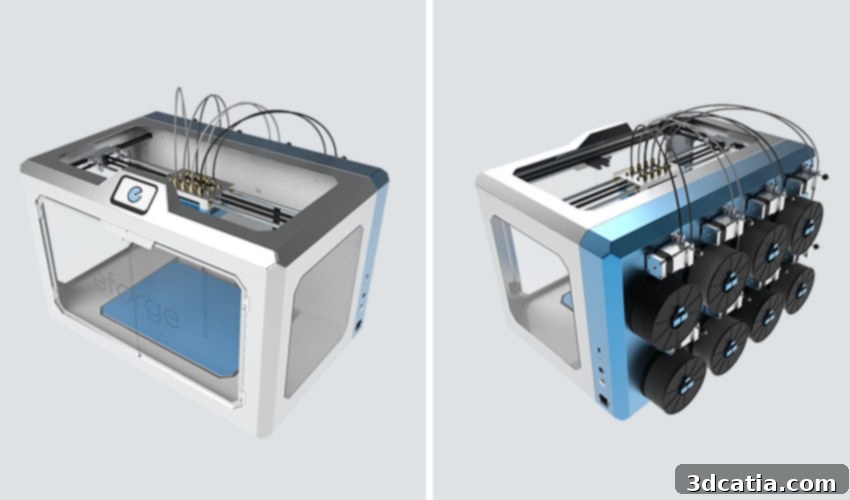
At the heart of Electronic Alchemy’s pioneering efforts is their innovative system, aptly named eForge. This advanced 3D printing platform is engineered to push the boundaries of what is possible in additive electronics manufacturing. While the commercially available version, eForge 1.0, is slated for release soon, the company has already demonstrated its capabilities with a prototype, version 0.6, which was meticulously built, rigorously tested, and successfully delivered to NASA at the end of June. This early deployment to a demanding client like NASA underscores the system’s robust design and potential for high-reliability applications, paving the way for its broader market adoption. The eForge is not just another 3D printer; it is a comprehensive solution designed to empower users to create sophisticated electronic devices with unprecedented ease and speed.
Electronic Alchemy envisions a future where electronic device components and complex sensors can be fabricated on demand, eliminating the lengthy lead times and intricate supply chains associated with traditional manufacturing. Users will have the flexibility to design their own components from scratch, tailored precisely to their specific needs, or to leverage a rich, shared library of designs available on their dedicated design portal. This design-on-demand capability, coupled with the ability to instantly print functional electronics, opens up immense opportunities for rapid innovation, customized solutions, and agile product development. The eForge’s intuitive interface and integrated design ecosystem are set to democratize advanced electronics manufacturing, making it accessible even to those without extensive traditional electronics fabrication expertise. It heralds a new era where creativity in electronics is limited only by imagination, not by manufacturing constraints.
Unpacking the Technical Specifications of the eForge
The eForge system is a testament to sophisticated engineering, incorporating a suite of features designed to meet the rigorous demands of additive electronics manufacturing. Its core architecture comprises a movable, heated platform bed, a highly advanced extruder block, and an intuitive LCD touchscreen interface for seamless operation. These components work in harmony to ensure precision, reliability, and versatility in printing complex electronic structures. The printer’s robust build quality and thoughtful design contribute to its ability to produce functional devices consistently and efficiently, positioning it as a leading solution in the emerging field of 3D printed electronics.
Multi-Material Printing with 8 Extruders
One of the most distinguishing features of the eForge is its extruder block, which boasts eight individual extruders. This multi-extruder configuration is revolutionary for electronics printing, as it enables the simultaneous deposition of up to eight different materials. This capability is crucial for fabricating functional electronic devices, which often require a combination of conductive, resistive, insulating, and even semi-conductive materials within a single contiguous structure. Each of these eight extruders features independently controlled temperatures, reaching up to 300°C. This precise temperature control is vital for handling a diverse range of specialized electronic filaments, ensuring optimal material flow and adhesion for each layer. The system is designed for practicality, accommodating eight spools of filament material conveniently attached at the back of the 3D printer, allowing for continuous and complex multi-material builds without manual intervention.
Precision and Stability for Delicate Electronics
Beyond its multi-material capabilities, the eForge emphasizes precision and environmental control, which are paramount for the reliability of printed electronics. The print bed on the eForge is not only heated but also auto-leveling, a critical feature for ensuring a perfectly flat and stable printing surface. This auto-leveling mechanism compensates for any minor inconsistencies, guaranteeing excellent first-layer adhesion and uniform layer deposition throughout the print. The bed can heat up to 120°C, providing the necessary thermal environment for various materials and minimizing warping or delamination of printed circuits. Furthermore, the eForge achieves an impressive Z-axis accuracy of 1.35 microns. This exceptionally high resolution in the vertical dimension is indispensable for fabricating the intricate geometries and fine traces required for modern electronic components, ensuring that even microscopic features are rendered with unparalleled precision and functional integrity.
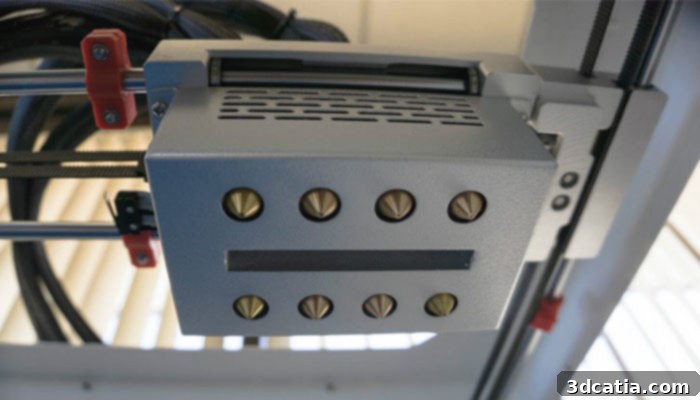
Image via Electronic Alchemy
Demonstrating Capability: The Capacitive Pressure Sensor
To showcase the practical capabilities of the eForge system, Electronic Alchemy recently conducted a compelling demonstration: the design and 3D printing of a fully functional capacitive-driven pressure sensor. This test not only validated the eForge’s technical prowess but also illuminated the streamlined workflow from design to a tangible, working electronic device. The creation of such a sensor, which typically involves multiple manufacturing steps and specialized equipment, was consolidated into a single, efficient additive manufacturing process, highlighting the transformative potential of this technology.
The process began with the design phase, utilizing readily available and user-friendly software. The two-material pressure sensor was meticulously designed on TinkerCAD, a testament to how accessible and intuitive the digital design aspect of additive electronics can be. Once the intricate layout of the sensor’s layers and connections was completed, the design was exported as an OBJ file. This standard file format then served as the blueprint for the next critical step: preparing the print. The OBJ file was imported into a specialized slicing software, a crucial interface that translates the 3D model into a series of printable layers. Within the slicing software, the intricate paths for the eForge’s extruders were calculated, and the specific G-code instructions were generated. These G-code files, containing all the precise movements and material depositions, were then exported to a USB drive, ready for transfer to the eForge system.
Upon transferring the G-code files, the printing process was initiated directly from the eForge’s intuitive interface. The first layer, often the most challenging due to the need for perfect adhesion and consistency, consisted of a resistive material. This layer forms the foundational sensing element of the device. Following the successful deposition of the resistive layer, the system seamlessly switched to printing a layer of capacitive material, precisely placed to interact with the resistive elements. This capacitive layer is fundamental to the sensor’s ability to detect changes in pressure. Finally, the last layer of resistive material was added, completing the electrical connections and encapsulating the functional components. The entire process resulted in a robust and functional pressure sensor, measuring 20 x 25 mm in surface area and 5 mm thick. Remarkably, this sophisticated electronic device took approximately only 9 minutes to print, showcasing the eForge’s efficiency and speed in producing complex, multi-material functional electronics.
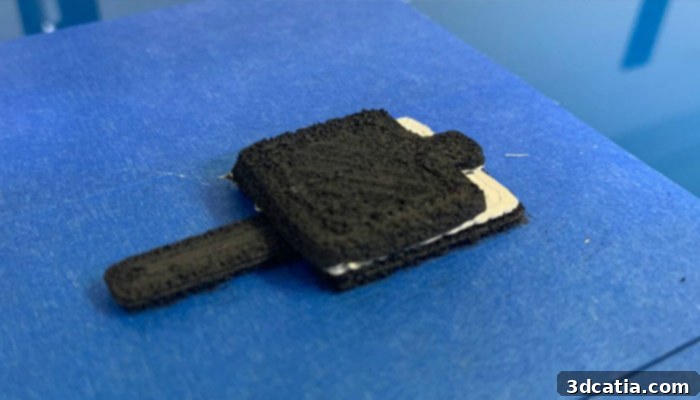
The 3D printed pressure sensor | Image via Electronic Alchemy
NASA’s Strategic Investment in Additive Manufacturing
Electronic Alchemy’s collaboration with NASA over the past two years highlights the critical importance of additive manufacturing for future space exploration and operations. NASA’s sustained support and investment in 3D printing technologies are not merely a pursuit of novel gadgetry but a strategic imperative driven by the inherent challenges of operating in the harsh and distant environment of space. The ability to manufacture tools, components, and even mission-critical devices on demand offers a paradigm-shifting solution to logistical hurdles that have long plagued space missions, promising greater autonomy, resilience, and efficiency for astronauts.
The primary motivation for NASA’s deep interest in 3D printing lies in the complexities and costs associated with resupply missions. Sending supplies, tools, and spare parts to astronauts in low Earth orbit, let alone to future lunar or Martian outposts, is an extraordinarily expensive and time-consuming endeavor. Resupply missions can take months, or even years, to plan and execute, making it impossible to address immediate needs or unexpected equipment failures promptly. The capacity for astronauts to “print what they need, when they need it” fundamentally alters this dynamic. Instead of waiting for a costly resupply vessel to bring a specific wrench, a specialized bracket, or a replacement electronic component, astronauts could simply download a design and fabricate the item directly on their habitat or spacecraft.
This capability is of particular and profound value when it relates to mission-critical devices and components. In situations where a sensor fails, a circuit board malfunctions, or a vital piece of equipment breaks, the ability to rapidly produce a functional replacement could mean the difference between mission success and failure, or even between life and death for the crew. The chemical sensor printed on the eForge, for example, represents exactly the kind of critical device that could be needed instantly to monitor environmental conditions, detect hazards, or ensure the proper functioning of life support systems. Furthermore, additive manufacturing minimizes the need to carry extensive inventories of spare parts, which are heavy, take up valuable space, and are difficult to manage in microgravity environments. By reducing reliance on Earth-based logistics, 3D printing empowers astronauts with unparalleled self-sufficiency, enabling them to adapt to unforeseen circumstances and extend the duration and ambition of future space missions. This strategic investment by NASA underscores the transformative potential of technologies like the eForge, not just for space, but for any scenario demanding flexible, on-demand manufacturing of complex, functional devices.
Beyond Prototypes: The Transformative Impact of Functional Electronics 3D Printing
The eForge system by Electronic Alchemy represents a significant leap forward in additive manufacturing, pushing the boundaries beyond mere prototyping to the creation of truly functional electronic devices. This capability holds transformative implications for a multitude of industries, promising to revolutionize product development cycles, foster unprecedented customization, and streamline supply chains. The shift from manufacturing structural components to integrated circuits and sensors within a single print process is a game-changer that will accelerate innovation across diverse sectors.
In rapid product development, the eForge allows engineers and designers to iterate on electronic designs at an unparalleled speed. Instead of waiting weeks for PCB fabrication and component assembly, a functional prototype can be printed and tested within hours or days. This drastically reduces time-to-market for new products and enables more robust testing and refinement. For industries like medical devices, this means the possibility of creating custom electronics tailored precisely to individual patient needs, from wearable sensors that monitor vital signs to bespoke implants with integrated electronic functions. Imagine hearing aids or prosthetic limbs with perfectly integrated, custom-fit electronic circuits, enhancing both comfort and performance.
The Internet of Things (IoT) sector stands to benefit immensely. The ability to rapidly produce unique sensors and connectivity modules on demand will fuel the expansion of smart environments, smart homes, and industrial IoT applications. Designers can experiment with novel form factors and integrate electronics directly into the structure of everyday objects, making devices more compact, efficient, and aesthetically pleasing. Furthermore, functional electronics 3D printing can contribute to reduced waste and more sustainable manufacturing practices. By printing only what is needed, and often with less material scrap than traditional methods, the eForge promotes a more resource-efficient approach. While challenges remain, such as the development of an even wider range of printable electronic materials, standardization of processes, and scaling for mass production, the foundational technology presented by the eForge lays a robust pathway for the future landscape of additive electronics. It empowers innovators to create complex, integrated, and customized electronic solutions that were once considered impossible, ushering in an exciting era of technological advancement.
What do you think of the eForge prototype and its potential impact on the electronics industry? We would love to hear your thoughts and insights! Share your comments below or engage with us on our Facebook and Twitter pages. Don’t forget to sign up for our free weekly Newsletter to receive all the latest news and updates in 3D printing delivered straight to your inbox, ensuring you stay at the forefront of this rapidly evolving technology!