
Top 5 Must-Watch 3D Printing Videos: Navigating Automation, Innovative Design, AI Integration, and Speed Comparisons
Welcome back to our highly anticipated “Top 5 Videos” series! This month, we’ve curated an exceptional selection of additive manufacturing insights, pushing the boundaries of what’s possible in the world of 3D printing. Our journey begins with a deep dive into the practicalities and benefits of automating your 3D print farms, a critical topic for any growing operation. Following this, we shift our attention to design and application, showcasing how 3D printing is revolutionizing outdoor furniture and transforming architectural education at a leading New Zealand university. We then explore the cutting-edge synergy between Artificial Intelligence and Additive Manufacturing, unveiling how these two powerful technologies are combining to create unprecedented efficiencies and innovations. Finally, we wrap up with an illuminating comparison of the print speeds across FDM, SLA, and SLS processes, helping you understand which technology offers the best balance for your specific needs. Prepare to be inspired by the latest advancements and thought leadership in additive manufacturing.
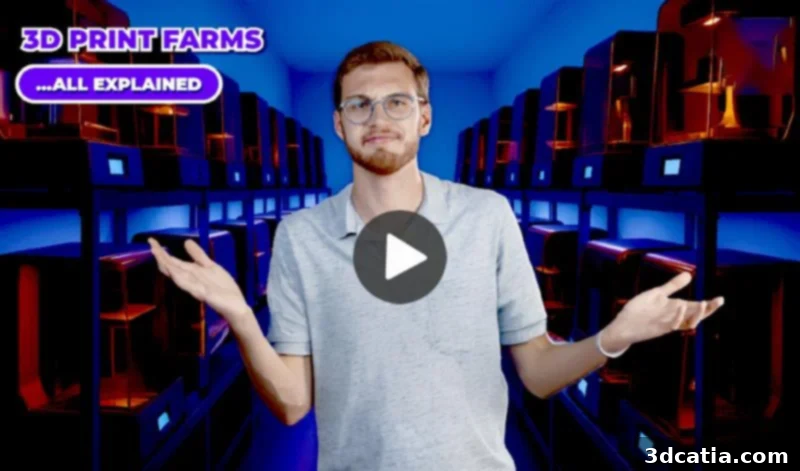
Top 1: Unlocking Efficiency – Exploring the Challenges and Rewards of Automating 3D Print Farms
Are you considering scaling up your 3D print operations? As demand for custom parts and rapid prototyping grows, many businesses find themselves at a crossroads: how to manage increased production without sacrificing efficiency or quality. Automating a 3D print farm presents a compelling solution, promising streamlined workflows, reduced labor costs, and consistent output. However, this transition isn’t without its complexities and hurdles. Before you embark on this transformative journey, we highly recommend watching our insightful video where our Technical Content Specialist meticulously unpacks the benefits and difficulties inherent in automating a 3D print farm. This detailed explanation covers essential considerations such as identifying which specific steps in the printing process are most amenable to automation, with a particular focus on FDM printing – a ubiquitous technology ripe for such advancements. Furthermore, the video addresses the crucial topic of automation limits, helping you set realistic expectations and understand where human intervention remains indispensable. Discover how intelligent automation can pave the way for a more productive, reliable, and scalable additive manufacturing future.
Top 2: Revolutionizing Architectural Education with 3D Printing at Unitec School of Architecture
The future of architectural design is being shaped in innovative classrooms across the globe, and a prime example is the Unitec School of Architecture in Auckland, New Zealand. This institution is harnessing the power of 3D printing to fundamentally transform its curriculum and pedagogical approach. By integrating additive manufacturing, Unitec is moving beyond traditional model-making techniques, enabling students to explore complex geometries, iterate designs rapidly, and gain a deeper understanding of buildability and structural integrity. The school has established a dedicated Makerspace, a vibrant hub where students can bring their visionary architectural concepts to life through digital fabrication. In this captivating video from Creality, Carl, a passionate lecturer at Unitec, shares insights into how the school is fostering a new generation of architects adept at leveraging cutting-edge technology. You’ll discover how students are utilizing 3D printing for everything from intricate building models to experimental sculptural art, blurring the lines between design, fabrication, and artistic expression. This case study powerfully illustrates how digital fabrication, innovative design thinking, and additive manufacturing are converging to create a dynamic learning environment, preparing students for the evolving demands of the architecture and construction industries.
Top 3: Redefining Durability and Design – Innovative Outdoor Furniture with Large-Format Additive Manufacturing
When it comes to outdoor furniture, aesthetics often compete with the crucial need for durability and weather resistance. However, a revolutionary approach combining traditional craftsmanship with state-of-the-art 3D printing is reimagining what’s truly possible. This month’s third video showcases an inspiring partnership between robot additive manufacturing company CEAD and Benkert Bänke, a distinguished Bavarian family-run enterprise. For over four decades, Benkert Bänke has been synonymous with robust, long-lasting public space solutions, traditionally relying on expert stainless-steel craftsmanship. Now, they are pushing the boundaries further by integrating Large-Format Additive Manufacturing (LFAM) from CEAD Group into their production processes. The result is not just aesthetically pleasing furniture but pieces engineered to withstand the harshest outdoor conditions, offering unparalleled wear and tear resistance. This collaboration highlights how LFAM enables the creation of complex, ergonomic designs that are virtually impossible or prohibitively expensive to produce with conventional methods. Discover how Benkert Bänke is leveraging the speed, flexibility, and material capabilities of additive manufacturing to efficiently create highly sustainable, exceptionally durable, and uniquely designed pieces for public spaces, setting new benchmarks for urban furniture solutions.
Top 4: The Powerful Partnership – Where Artificial Intelligence Elevates Additive Manufacturing
In an era defined by rapid technological advancement, two groundbreaking forces are converging to redefine manufacturing: artificial intelligence (AI) and additive manufacturing (AM). Individually, they represent significant leaps; together, they unlock unprecedented potential for innovation, efficiency, and quality control. But how can these systems be optimally integrated to yield the greatest benefits? This enlightening video delves into the fundamental principles of combining AI with AM, demonstrating how artificial intelligence can augment nearly every stage of the additive workflow. From the initial design phase, where AI-powered generative design algorithms can autonomously create highly optimized 3D models and make designs inherently more efficient, to the predictive capabilities that can foresee potential manufacturing issues before they occur – AI is transforming the landscape. The applications extend to real-time process monitoring, automated quality inspection, and intelligent material selection, leading to reduced waste, accelerated development cycles, and superior product performance. Learn about the myriad benefits this powerful synergy offers and explore the diverse industries, including aerospace, medical, and automotive, that are already leveraging AI and AM to drive the next wave of industrial revolution. This integration isn’t just an improvement; it’s a paradigm shift in how products are conceived, designed, and manufactured.
Top 5: The Need for Speed – Comparing FDM, SLA, and SLS 3D Printing Processes
One of the most celebrated advantages of 3D printing, or in-house additive manufacturing, is its remarkable ability to reduce lead times. This efficiency translates into significant savings, often cutting weeks off the production schedule for prototypes, low-volume batches, or highly customized parts. The capacity to generate multiple design iterations within days, without the need for external suppliers or lengthy tooling processes, fundamentally accelerates product development. However, while we acknowledge the general speed of AM, a critical question often arises: which 3D printing method is truly the fastest? Speed, though vital for rapid innovation and competitive advantage, is not the sole determinant of success; factors like cost, material properties, and final part quality also play significant roles. This comprehensive video from Formlabs tackles this very question head-on, meticulously comparing the speed performance of three of the most common plastic 3D printing techniques: Fused Deposition Modeling (FDM), Stereolithography (SLA), and Selective Laser Sintering (SLS). The video delves into the nuances of each technology’s operational speed, considering not just the raw print time but also aspects like build preparation and post-processing requirements. By tuning in, you’ll gain a clearer understanding of the comparative time-efficiency of FDM, known for its cost-effectiveness; SLA, lauded for its high detail; and SLS, celebrated for its robust, functional parts. This comparison will help you determine which technology offers the optimal balance of speed and desired outcomes for your specific additive manufacturing projects.
We hope this curated selection of videos has provided you with valuable insights into the exciting and rapidly evolving world of 3D printing. From the strategic automation of print farms to the artistic integration in architectural education, the robust design of outdoor furniture, the intelligent partnership of AI and AM, and the crucial speed comparisons across various technologies – these videos collectively highlight the incredible breadth and depth of innovation within additive manufacturing. We’re eager to hear about your own experiences and perspectives. Have you ventured into automating a 3D print farm, or perhaps utilized 3D printing in a unique design or educational context? Share your thoughts and stories with us in a comment below or connect with our vibrant community on our LinkedIn or Facebook pages! Don’t miss out on the latest advancements and breaking news in the additive manufacturing industry – make sure to sign up for our free weekly Newsletter to get all the updates delivered straight to your inbox. For a visual feast of innovation, you can also explore our extensive library of videos directly on our YouTube channel. Stay connected, stay informed, and keep pushing the boundaries of what’s possible with 3D printing!