

Revolutionizing Materials: MIT’s 3D Printed Strong and Stretchable Metamaterials
In the dynamic field of material science, metamaterials represent a paradigm shift. These synthetic materials, unlike traditional ones, derive their extraordinary properties not from their chemical composition alone, but from their meticulously designed microscopic structures. For decades, the primary focus in developing these advanced materials has been on achieving superior strength and rigidity, often leading to final products that, while robust, lacked inherent flexibility. This pursuit of stiffer structures inevitably meant sacrificing deformability, limiting their potential applications in areas requiring dynamic movement or resilience against various stresses. However, a pioneering team of researchers at MIT has embarked on a new trajectory, shifting the focus towards creating metamaterials that defy this conventional trade-off, aiming for structures that are simultaneously strong and remarkably stretchable, leveraging the power of 3D printing to achieve unprecedented control over their internal architecture.
The Genesis of Flexibility: Inspiration from Hydrogels
The conceptual breakthrough for these flexible metamaterials emerged serendipitously from an unexpected source: hydrogels. Traditionally, hydrogels are characterized by their soft, gel-like, and often fragile texture, making them unsuitable for load-bearing or highly deformable applications. Yet, another innovative MIT research group had previously achieved a significant feat by developing a hydrogel that maintained its characteristic softness while exhibiting surprising durability and strength. This was accomplished by ingeniously chemically linking disparate polymer networks within the hydrogel — for instance, by combining a rigid network with a flexible one. This revolutionary approach to material design deeply inspired Dr. Carlos Portela, a distinguished professor at MIT. He recognized the potential to apply this ‘network combination’ principle to the broader class of metamaterials, hypothesizing that by engineering new microscopic architectures, he could imbue materials with novel, previously unattainable mechanical properties. His vision was to move beyond the limitations of single-network structures and harness the synergy of multiple interwoven networks to create materials that are not only strong but also inherently flexible and resilient.
Designing the Unbreakable: The “Double Network” Architecture
The innovative material developed by Portela’s team represents a sophisticated triumph in structural engineering at the microscopic level. Its core design principle hinges on what they term a “double network.” This complex structure begins with a rigid, brittle base material composed of plexiglass polymers, meticulously arranged into a precise lattice. This initial framework, by itself, would fracture under stress. However, the true genius lies in what surrounds this base: a meticulously designed “spaghetti-like network” also constructed from the very same plexiglass polymer. The entire construction is built from individual microscopic struts. Crucially, these struts, in their isolated form, possess no inherent flexibility. Their magic emerges through their collective arrangement. It is the unique and intricate weaving pattern of these struts, precisely fabricated using advanced 3D printing technologies, that orchestrates the creation of an overall structure that is profoundly stretchable and resistant to failure. This hierarchical design allows for the macroscopic properties of flexibility and resilience to emerge from the careful arrangement of brittle, microscopic components, showcasing the immense power of architectural design in materials science.
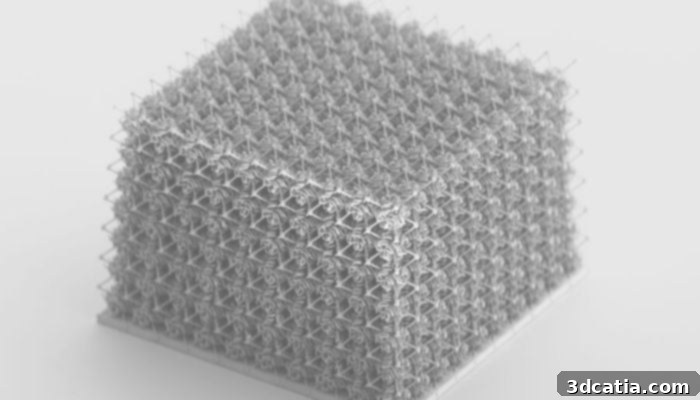
The structure of the material “from a distance” (Image: MIT)
Unprecedented Performance: Strength, Stretchability, and Resilience
The performance of this newly engineered “double network” metamaterial is truly revolutionary. It can be stretched to an astonishing four times its original size without undergoing complete fracture, a feat that is virtually impossible for conventional materials. To put this into perspective, a normal polymer or plastic material typically breaks immediately upon reaching its elastic limit, often with minimal deformation. The resilience of this metamaterial stems from its unique architectural design, which allows it to absorb and redistribute stress across its complex network, effectively delaying catastrophic failure.
Dr. Portela describes these research results as nothing short of groundbreaking, emphasizing the far-reaching implications: “You can print a double network out of metal or ceramic and achieve the same advantages. That means it takes much more energy to break the structures, and they would be significantly more stretchable.” This statement highlights a pivotal aspect of the research: the design principles of the network are material-agnostic. This means the innovative architecture can be applied to other inherently brittle materials such as glass, advanced ceramics, or various metals, transforming their mechanical properties by design rather than relying solely on their intrinsic chemical composition. This opens up entirely new possibilities for engineering materials with tailored properties that were previously thought impossible.
The Mechanics of Resilience: How it Works
The secret to this exceptional durability lies in the clever redistribution of weight and stress within the metamaterial’s structure. In the event of localized damage or a strut breaking, the load is not concentrated on the fractured points. Instead, it is immediately and efficiently redistributed to the surrounding spiral-shaped structures within the network. This ingenious mechanism prevents the immediate propagation of cracks, which is the common failure mode for most brittle materials. As a result, the structure does not break immediately and can continue to function, maintaining its structural integrity and utility even after sustaining damage. This feature is critical for applications where reliability and damage tolerance are paramount.
Adding another layer of intrigue to their findings, the MIT team even deliberately introduced “flaws” and holes into the metamaterial’s design. Counter-intuitively, these engineered imperfections demonstrably increased the stability and robustness of the overall structure. This phenomenon can be attributed to several factors: these intentional flaws can act as crack arrestors, diverting stress pathways and preventing small cracks from propagating into larger, destructive ones. They can also create zones where energy is dissipated more effectively, enhancing the material’s ability to absorb impacts without failing. This discovery challenges traditional material design paradigms, suggesting that in some cases, imperfections, when strategically placed, can become advantageous design features.
Transformative Applications Across Diverse Industries
The potential applications for these strong and stretchable metamaterials are vast and truly transformative, poised to revolutionize numerous industries. Imagine fabrics that are virtually impossible to tear, offering unparalleled durability for protective gear, sportswear, and industrial textiles. In the realm of electronics, these materials could lead to the development of truly flexible semiconductors and robust chip casings, enabling the next generation of bendable smartphones, wearable devices, and implantable electronics that can conform to biological structures without compromising performance or integrity.
Beyond consumer electronics, the biomedical field stands to benefit immensely. The creation of resilient yet flexible support structures for tissue cell growth could accelerate advancements in regenerative medicine, paving the way for more effective implants, scaffolds for organ regeneration, and personalized medical devices. In robotics, especially soft robotics, these metamaterials could provide compliant, strong, and highly deformable components, allowing robots to interact with their environment and humans more safely and effectively. The aerospace and automotive sectors could utilize these materials for lightweight, damage-tolerant structures that can absorb significant impact energy without failing catastrophically, enhancing safety and performance. This research heralds an era where materials can be designed with unprecedented precision to meet specific, complex functional requirements, pushing the boundaries of what is mechanically possible. You can find more information HERE.
Engage with the Future of Materials
What are your thoughts on these groundbreaking metamaterials and their potential to redefine material science? We invite you to share your insights and predictions in a comment below, or join the conversation on our LinkedIn or Facebook pages! Don’t miss out on the latest advancements and news in the additive manufacturing world. Make sure to sign up for our free weekly Newsletter to receive curated updates directly to your inbox. Additionally, explore our comprehensive collection of videos and interviews on our dedicated YouTube channel for deeper dives into the world of 3D printing.
*All Photo Credit: MIT