
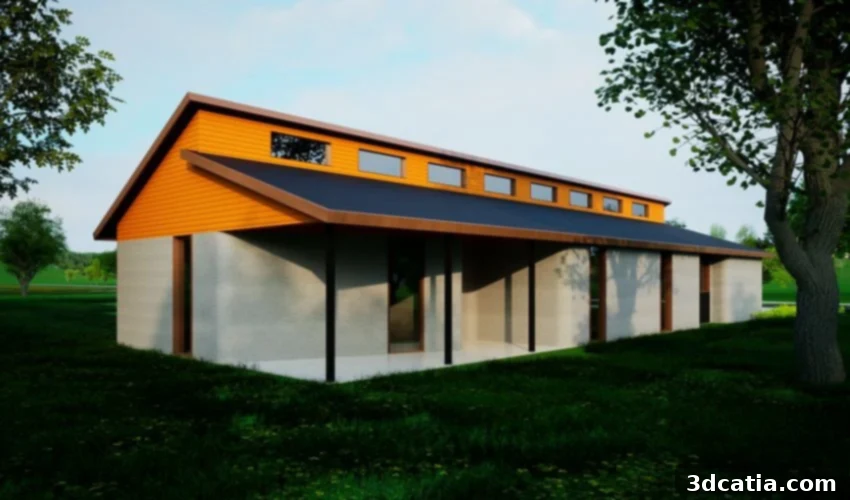
Pioneering the Future: Australia’s First Owner-Occupied 3D Printed Home by Luyten and UNSW
The global landscape of 3D printing in construction is experiencing an unprecedented surge, with groundbreaking projects continually redefining what’s possible in the built environment. From Denmark’s innovative community buildings utilizing low-CO2 concrete to Japan’s remarkably affordable 3D printed homes and sustainable developments emerging in the Caribbean, additive manufacturing is rapidly moving from a niche technology to a mainstream construction solution. Now, the spotlight turns to Australia, where local 3D printing trailblazer Luyten, in collaboration with the prestigious University of New South Wales (UNSW), has unveiled ambitious plans to construct a revolutionary 3D printed home in Melbourne, Australia. This project marks a significant milestone: it will be the very first owner-occupied 3D printed residence in the entire Southern Hemisphere, setting a new benchmark for innovative and sustainable housing solutions.
This pioneering cooperative effort synergizes Luyten’s cutting-edge construction and 3D printing capabilities with UNSW’s profound academic and design expertise. Luyten’s advanced line of Platypus 3D construction printers stands at the forefront of this initiative, leveraging sophisticated artificial intelligence algorithms to facilitate the large-scale manufacturing of structures using specialized, high-performance concrete. These intelligent systems ensure unparalleled precision, efficiency, and adaptability in the construction process, pushing the boundaries of what traditional building methods can achieve. Concurrently, the dedicated research group from UNSW, aptly named Arch_Manu (Next-Gen Architectural Manufacturing), brings invaluable design prowess to the project. Beyond architectural conception, Arch_Manu plays a critical role in rigorously compiling and analyzing data gathered throughout the construction lifecycle. This crucial data will be instrumental in informing and developing new, comprehensive standards for 3D printed construction projects across Australia, effectively laying the groundwork for future advancements in digital fabrication within the building sector.
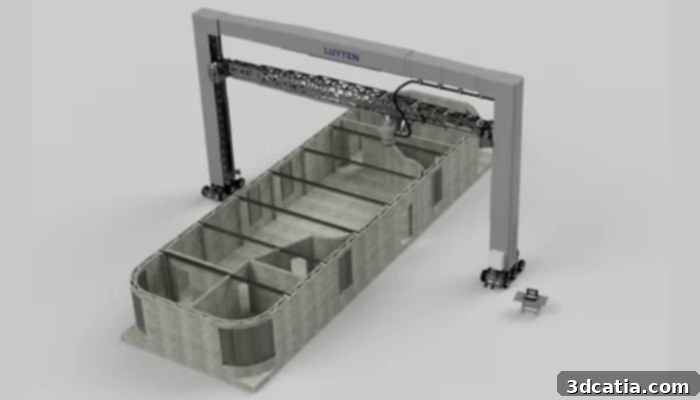
A Luyten Platypus 3D printer demonstrating its capabilities on a concrete construction project.
A Lighthouse Project for Australian Housing Innovation
Professor M. Hank Haeusler, the esteemed director of UNSW Arch_Manu, expressed immense enthusiasm for this groundbreaking partnership, characterizing it as a pivotal moment for the nation’s construction industry. “This will be a lighthouse project for 3D printing in Australia, encompassing state-of-the-art research in design and technology and bringing research findings into practice. It will change Australian housing,” Professor Haeusler affirmed. His statement underscores the profound impact this collaboration is expected to have, not just as a singular construction endeavor, but as a guiding light for future innovation. By integrating cutting-edge academic research with practical, real-world application, the project aims to demonstrate the immense potential of additive manufacturing to address contemporary housing challenges, particularly concerning affordability, sustainability, and design flexibility.
Ahmed Mahil, CEO and co-founder of Luyten, echoed Professor Haeusler’s sentiments, highlighting the strategic objectives of the collaboration. “Our partnership with UNSW will involve working together to document and provide a tangible proof of concept for the advantages of 3D printing, such as superior design and project management. […] The project will provide the world with a leading example of why 3D printing technology is providing the next frontier in sustainable and affordable housing.” Mahil’s remarks emphasize the dual focus of this initiative: to scientifically validate the practical benefits of 3D printing in construction and to showcase its transformative power on a global stage. The project aims to prove that digital fabrication can deliver not only aesthetically pleasing and structurally sound homes but also optimized project timelines and enhanced resource management, making it an indispensable tool for future development.
Unlocking the Benefits of Additive Construction
The tangible advantages of 3D printed construction are manifold and extend far beyond conventional building methodologies. This innovative approach offers substantial savings across several critical metrics, including significantly reduced construction costs, dramatically shorter build times, optimized resource utilization, and a notable decrease in greenhouse gas emissions. Traditional construction often grapples with labor-intensive processes, extensive material waste, and prolonged project schedules, all of which contribute to higher overall expenses and environmental impact. 3D printing, however, streamlines these processes through automation and precision.
Cost-Efficiency and Accelerated Timelines
One of the most compelling aspects of 3D concrete printing is its ability to slash construction costs. By automating much of the building process, the need for extensive manual labor is significantly reduced, addressing challenges associated with skilled labor shortages and high wages. Furthermore, the precise deposition of material by robotic printers minimizes waste, as concrete is only placed where structurally necessary, unlike traditional methods that often involve cutting and discarding excess materials. This precision also eliminates the need for expensive and labor-intensive concrete formworks, which are temporary molds that consume considerable resources and generate substantial waste. The integrated design-to-build workflow also compresses project timelines, moving from concept to completion at an unprecedented pace. This acceleration reduces overhead costs associated with extended site management and allows for quicker occupancy, providing economic benefits to both developers and homeowners.
Environmental Sustainability and Resource Optimization
Beyond financial savings, 3D printing offers significant environmental benefits. The precise material application inherently leads to less waste generated on construction sites, which is a major contributor to landfills globally. Moreover, Luyten’s use of specialized concrete, potentially incorporating low-carbon binders or recycled aggregates, can further reduce the carbon footprint associated with cement production, a notoriously energy-intensive process. The ability to create optimized, hollow, or lattice structures that maintain structural integrity while using less material also contributes to resource efficiency. This not only conserves raw materials but also reduces the energy required for their transportation. By minimizing the logistical footprint and overall material consumption, 3D printed homes represent a greener alternative to conventional buildings, aligning perfectly with global efforts towards sustainable development and climate action.
Enhanced Design Flexibility and Architectural Innovation
The advanced capabilities of 3D printing also unlock unparalleled design flexibility that is often cost-prohibitive with traditional methods. Architects can conceive and execute complex geometries, organic shapes, and intricate textures that were previously limited to conceptual drawings or incredibly expensive bespoke construction. This allows for the creation of truly unique and aesthetically stunning structures that are tailored to specific environmental conditions, client preferences, and functional requirements. Computational design, integrated with the additive manufacturing process, empowers designers to explore innovative architectural forms that optimize structural performance, thermal efficiency, and natural light, transforming living spaces into extraordinary, bespoke environments.
The Melbourne Project: A Glimpse into the Future of Housing
The much-anticipated 3D printed home, slated for construction in Melbourne in early 2024, is more than just a house; it’s a living laboratory designed to showcase the advanced technologies and myriad benefits inherent in this revolutionary construction method. Ahmed Mahil elaborates on its significance: “The design not only demonstrates the versatility and flexibility of 3D printing capability; it also captures the stunning architectural advantages of computational design and architectural manufacturing technology and the ability to create extraordinary spaces for a fraction of the cost.” This project will serve as a powerful testament to how digital fabrication can democratize access to high-quality, customized housing by making complex architectural designs economically viable. It signifies a paradigm shift where architectural dreams can be realized with unprecedented efficiency and affordability.
The implications of this pioneering project extend far beyond Melbourne. It has the potential to influence housing policy, construction practices, and urban development not only across Australia but globally. As Luyten continues to expand its footprint with projects in the U.S. and beyond, this owner-occupied home will stand as a concrete example of the practical application and benefits of their technology. It demonstrates how additive manufacturing can provide rapid, durable, and sustainable solutions for various housing needs, from individual homes to community developments and even humanitarian aid projects. For those keen to delve deeper into this transformative initiative and explore Luyten’s wider portfolio of projects, more information is available on their official website HERE.
Join the Conversation on 3D Printed Construction
What are your thoughts on this groundbreaking 3D construction project unfolding in Australia? The possibilities that additive manufacturing brings to the housing sector are immense, promising a future of more sustainable, affordable, and architecturally diverse communities. Share your insights, questions, and predictions regarding the impact of this technology on urban development, environmental sustainability, and the evolution of architectural design. We encourage you to engage with us and let us know your perspective in a comment below or on our active social media channels. Connect with our community on LinkedIn, Facebook, and Twitter pages! Don’t miss out on the latest advancements and news in the additive manufacturing world; sign up for our free weekly Newsletter here to receive direct updates straight to your inbox! Additionally, explore a wealth of informative videos and demonstrations on our YouTube channel.
*All photo credits: Luyten