
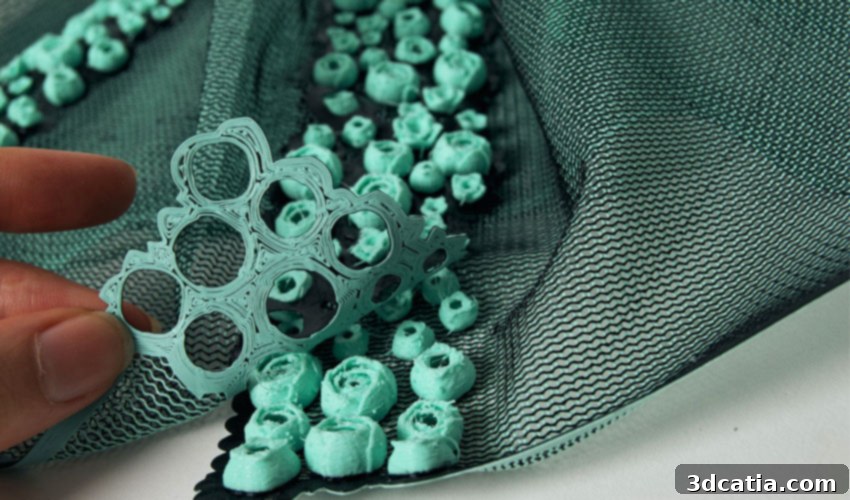
Revolutionizing Fashion: Miranda Marquez on 3D Printing, Accessibility, and the RESILIENCE Project
The landscape of fashion is undergoing a transformative shift, with additive manufacturing emerging as a pivotal force. This innovative technology is increasingly embraced by designers worldwide, enabling the creation of truly unique pieces, from avant-garde footwear to entire haute couture collections. Within the dynamic realms of fashion and industrial design, 3D printing technology offers an unprecedented level of artistic freedom, empowering creators to conceptualize and produce the most original, personalized, and intricate designs imaginable. A prime example of this pioneering spirit is the renowned model and multimedia artist, Miranda Marquez. Through her collaborations with various CGI digital artists, Miranda has delved deep into exploring the vast potential of 3D printing technologies, pushing the boundaries of what is possible in contemporary fashion. We recently had the privilege of sitting down with Miranda to discuss her groundbreaking projects, gain insights into her unique vision for the future of fashion, and understand how 3D printed garments relate to the current global health crisis and its broader implications for society.
3DN: Could you introduce yourself and tell us why you decided to start using 3D printing technology in your work? What additive manufacturing method do you primarily utilize?
Miranda Marquez
Hello, I’m Miranda Marquez, and among my diverse artistic endeavors, a significant focus lies in creating additively manufactured clothing and accessories. My background is quite unique, shaped by a very technical yet inherently creative education in Multimedia Engineering. This academic path provided me with a robust foundation in digital design, technology, and innovative problem-solving, which has proven invaluable in my current work. During my final year of studies, I embarked on an international modeling career, an experience that immersed me deeply in the world of fashion. However, even amidst the demands of modeling, I always carved out time for my personal artistic projects. These projects consistently revolve around exploring novel means of creative expression and leveraging technology to push artistic boundaries.
My journey into 3D printed fashion began when I encountered individuals who were successfully creating garments using surprisingly simple desktop FDM (Fused Deposition Modeling) printers. This discovery ignited a profound interest within me. I immediately recognized the immense, often untapped, potential within this accessible technology. It became clear that there was a significant opportunity to merge my innate curiosity for innovation and research with the passion for fashion that I had cultivated throughout my modeling career. I saw FDM technology not just as a tool, but as a gateway to democratizing fashion production and enabling unprecedented levels of personalization. This convergence of my technical background, artistic drive, and newfound fascination with 3D printing laid the groundwork for my current explorations in additive manufacturing for apparel.
3DN: You recently launched the RESILIENCE project, an initiative that has garnered considerable attention. Can you elaborate on the core concept and inspiration behind this unique venture?
The RESILIENCE project marks a significant milestone for me, representing my inaugural downloadable and printable fashion endeavor specifically designed for desktop 3D printers. At its heart, RESILIENCE is an artistic statement brimming with optimism, conceived in direct response to the global pandemic and the challenges it presented. The project’s central theme revolves around humanity’s inherent capacity to flourish, adapt, and grow even after experiencing profound adversity. It speaks to our collective ability to rebuild, reimagine, and ultimately forge a brighter future from difficult circumstances. As we collectively strive for recovery and societal healing, I firmly believe that the act of creation itself can and should be a collective effort.
This conviction underpins my proposal to leverage 3D printing as a truly democratic medium for disseminating art and fashion. RESILIENCE embodies this principle by offering two distinct pieces that anyone, anywhere in the world, can self-produce using their own desktop 3D printer. The first is a stylish tank top, and the second, highly relevant to our current global context, is a protective mask. Both designs are available for free download under a Creative Commons (CC) license, accessible HERE. This open-source approach empowers individuals not only to engage with cutting-edge fashion but also to become active participants in its creation, fostering a sense of community and shared resilience through tangible artistic output. It’s about empowering people to literally print their own future, reflecting an optimistic outlook on our shared journey of recovery and innovation.
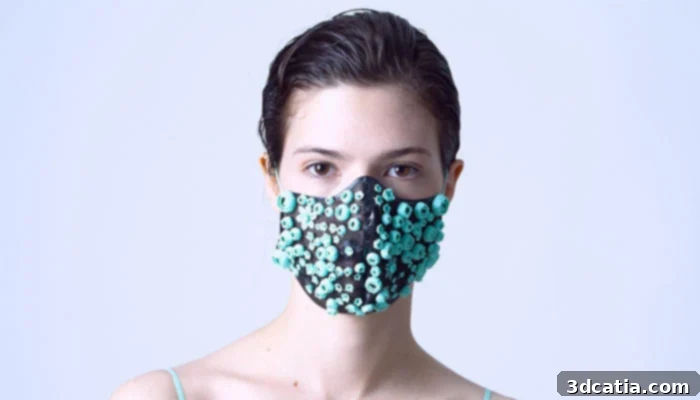
RESILIENCE is Miranda Marquez’ most recent project, showcasing accessible 3D printed fashion.
3DN: From your unique perspective, how do you envision the role and application of 3D printing within the broader fashion industry today and in the future?
The integration of 3D printing into fashion is certainly not a new phenomenon; it’s a concept that has been explored for many years. However, my observations suggest that much of this prior work has often utilized production methods that I perceive as inherently elitist, primarily due to their prohibitive costs. Technologies like PolyJet, for instance, create incredibly intricate and high-resolution pieces. While these technologies are undeniably impressive and make perfect sense for haute couture, where creative potential is boundless and pieces are conceptualized as high fashion, expensive, and exclusive works of art, they are inherently inaccessible to the vast majority of consumers. They cater to a niche market that prioritizes avant-garde design over widespread practicality.
On the other hand, we see various brands that employ more accessible FDM (Fused Deposition Modeling) technologies to create fashion items. Yet, many of these brands continue to adhere to traditional distribution channels. In my view, this approach, while utilizing a more democratized production method, doesn’t fully leverage the transformative power of 3D printing for the end consumer. Regardless of how much we innovate the garment-making process itself, if the final products are still distributed and consumed through conventional retail models, the end consumer ultimately experiences only a marginal difference, often just a slight variation in the garment’s finish or aesthetic. The fundamental relationship between consumer and product remains unchanged.
This is precisely why I advocate for a paradigm shift: I propose that we harness 3D printing not merely as another production method for brands, but fundamentally as a revolutionary method of *self-production and consumption*. Imagine a future where consumers actively participate in creating their own wardrobe, tailoring designs to their exact preferences and needs. Beyond the undeniable appeal of personalization, I profoundly believe that when individuals actively create their own clothes, their emotional involvement with the final piece becomes significantly deeper. This increased personal investment naturally leads to a greater appreciation and care for their garments, fostering a more sustainable approach to fashion by extending the lifespan of clothing and reducing the cycle of disposable trends. This model empowers individuals, fosters creativity, and promotes a more mindful and sustainable fashion ecosystem.
3DN: Looking ahead, what are your aspirations and upcoming projects in the fascinating field of additive manufacturing for fashion?
My journey into the realm of 3D printed clothing is far from over; in fact, I feel I’ve only just scratched the surface. I am incredibly eager to continue experimenting and innovating within this dynamic field. My mind is brimming with numerous ideas and concepts that I am excited to explore and bring to fruition. One immediate focus is to further iterate and refine the 3D printed shoe project that I’ve already initiated. A key challenge and personal goal here is to find ingenious ways to enhance their comfort, ensuring that style doesn’t compromise wearability. Beyond footwear, I’m keen to venture into designing and making bags using additive manufacturing, exploring new forms and functionalities for accessories.
Another critical area of experimentation involves discovering novel and efficient methods for assembling the various pieces of my 3D printed models. This includes exploring interlocking mechanisms, flexible connections, and other innovative techniques that move beyond traditional joining methods. I also plan to tackle larger garment structures, such as skirts and tops, experimenting with printing them straight upright and at full length, which presents exciting challenges in terms of structural integrity, material flexibility, and printer capabilities. The possibilities truly feel endless. I can assure you that if I don’t develop more new projects, it will unequivocally be due to a lack of time, not for a lack of ideas or creative ambition! The field is vast, and I am driven by an insatiable curiosity to uncover its full potential in fashion.
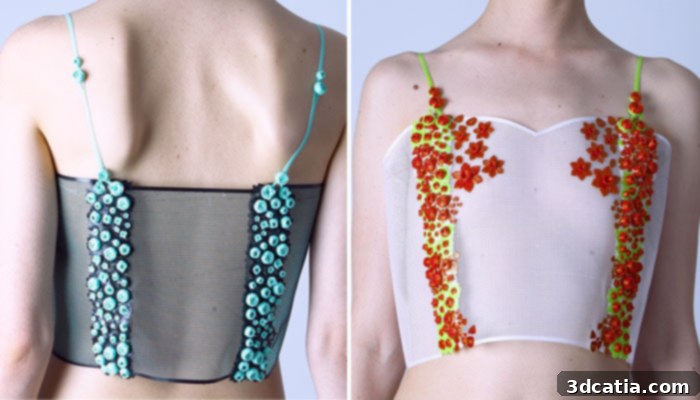
All image credits: Miranda Marquez
3DN: Do you have any final words or messages you’d like to share with our readers, who are undoubtedly inspired by your pioneering work?
First and foremost, I extend my heartfelt gratitude to all of you for your interest in my work and for taking the time to learn about the RESILIENCE project. Your engagement is truly motivating. I sincerely invite everyone who has access to a compatible 3D printer to try printing my model. I encourage you to share your experiences and constructive feedback on the project page; your opinions are incredibly valuable as they help shape the evolution of these open-source designs. The beauty of this democratic approach to fashion lies in collective participation and continuous improvement.
For those who may not currently own a 3D printer but are nevertheless fascinated by the potential of 3D printed clothing, I warmly invite you to fill out this brief survey. My goal is to gather as many diverse opinions as possible regarding the project and to understand how it can best evolve to serve a wider audience and address future needs. Your insights are crucial for guiding the next steps and ensuring that this vision of accessible, self-produced fashion truly resonates with and benefits the community.
What are your thoughts on Miranda Marquez’s innovative approach and her captivating 3D printed designs? We’d love to hear from you! Please share your comments below or engage with us on our social media platforms – you can find us on Facebook and Twitter. And if you want to stay up-to-date with all the latest advancements and news in the exciting world of 3D printing, be sure to sign up for our free weekly Newsletter, delivered straight to your inbox!