

3D Printing Breakthrough: Clemson University Pioneers Scalable Protonic Ceramic Fuel Cells for a Sustainable Future
Clemson University researchers have achieved a monumental breakthrough in renewable energy by leveraging the precision and versatility of 3D printing technology to fabricate protonic ceramic fuel cells (PCFCs). This innovative development is set to redefine the landscape of sustainable energy generation, offering a compelling alternative to conventional power sources that predominantly rely on fossil fuels. Unlike their traditional counterparts, PCFCs are designed to operate efficiently on a diverse range of renewable fuels, including hydrogen, ammonia, various alcohols, and sustainable hydrocarbons. This represents a critical leap towards fostering a greener, more sustainable, and environmentally responsible approach to electricity production. However, a persistent challenge in the widespread adoption of PCFCs has been the inherent difficulty in scaling up their manufacturing processes to meet global energy demands economically and efficiently.
Recognizing this significant hurdle, a dedicated team of researchers at Clemson’s Advanced Materials Research Laboratory strategically turned their attention to the transformative capabilities of 3D printing, also known as additive manufacturing. This cutting-edge technology allows for the precise creation of highly complex and customizable objects, layer by layer, with unparalleled accuracy. For PCFCs, a technology that demands intricate geometries and precise material layering, 3D printing emerged as a true game-changer, fundamentally altering the paradigm of fuel cell manufacturing and opening new avenues for mass production and design optimization.
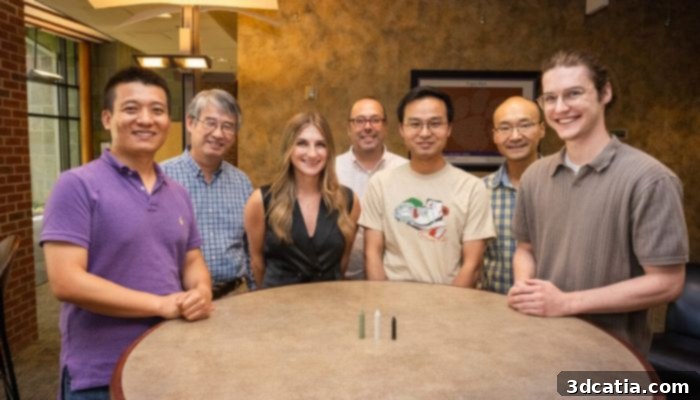
The team of researchers comprised Jiawei Zhang, Jianhua “Joshua” Tong, Bridget Sheridan, Kyle S. Brinkman, Minda Zou, Fei Peng, and Jacob Conrad (from left to right).
Optimized Design: The Advantage of Tubular PCFCs
The Clemson team’s most significant breakthrough involved the successful fabrication of tubular PCFCs, a design that offers substantial advantages over the more conventional flat-plate fuel cell configurations. Tubular designs inherently provide enhanced structural integrity, superior durability, and more effective sealing mechanisms, making them significantly more resilient and robust for demanding, real-world applications. The increased surface area-to-volume ratio in tubular structures can also lead to higher power density and improved overall performance. To validate their innovation, the researchers conducted a rigorous experiment where they fueled a single tubular PCFC with hydrogen and subjected it to continuous operation for an impressive 200 hours. Throughout this extended testing period, the fuel cell consistently produced stable power, a testament to its reliability and the efficacy of the 3D printing manufacturing process. This achievement underscores the immense potential of 3D printed protonic ceramic fuel cells to deliver not only improved precision and consistency in manufacturing but also a substantial reduction in production costs compared to conventional, labor-intensive techniques.
The extensive research and groundbreaking findings were meticulously documented and reported by the entire team of dedicated researchers at Clemson University. Key contributors included Jiawei Zhang, Bridget Sheridan, Jacob Conrad, and others who collaborated on this pioneering project. Their seminal work was subsequently published in the highly regarded scientific journal ACS Energy Letters, signifying its importance and peer recognition within the energy research community. Minda Zou, a talented Ph.D. candidate, spearheaded the research as the first author, demonstrating exceptional leadership and technical prowess. Professor Jianhua “Joshua” Tong from the Department of Materials Science and Engineering, alongside Jiawei Zhang, served as corresponding authors, guiding the research and contributing their profound expertise to the project.
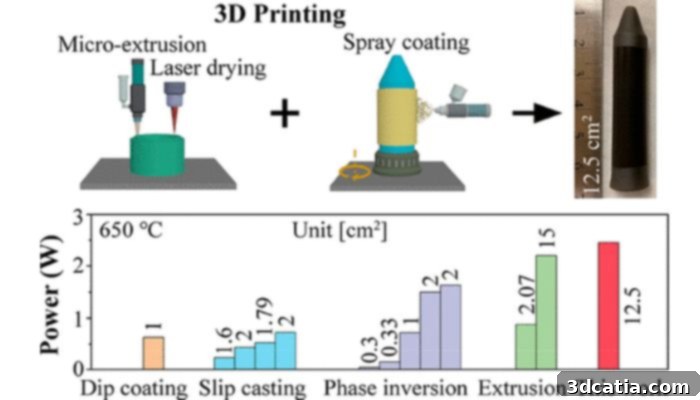
Enabling Scalable Tubular Protonic Ceramic Fuel Cells Through 3D Printing (Photo credits: ACS Publications)
A New Era for 3D Printed Fuel Cells: Integrated Manufacturing
What truly distinguishes this research and positions it at the forefront of fuel cell innovation is the team’s unprecedented success in 3D printing all three fundamental layers of a fuel cell – the anode, cathode, and electrolyte – in a single, integrated manufacturing process. This simultaneous fabrication of multiple functional layers is an extraordinarily complex undertaking, as each layer requires specific material properties, compositions, and processing conditions. Professor Tong emphatically highlighted the profound significance of this achievement, stating, “Nobody else has done that.” This integrated approach not only simplifies the manufacturing workflow but also minimizes potential interfaces and defects that can arise when assembling separate layers, leading to more robust and higher-performing fuel cells. Furthermore, Professor Tong underscored the inherent simplicity and remarkable cost-effectiveness of their innovative method, factors that hold immense promise for the rapid commercialization and widespread adoption of this advanced fuel cell technology.
The current iteration of this 3D printing process allows for the fabrication of a single PCFC in approximately three hours. While this represents a significant improvement over traditional methods, the researchers are already envisioning and actively developing more advanced designs and optimized printing strategies for the next phase of their work. These advancements are aimed at further reducing manufacturing time, enhancing efficiency, and broadening the applicability of their technology. With continuous progress and refinement, the team projects that the commercialization of these highly efficient and sustainably produced 3D printed protonic ceramic fuel cells could become a reality within the next five years, poised to make a substantial impact on global energy markets and contribute to a cleaner energy future.
The meticulously detailed paper, titled “3D Printing Enabled Highly Scalable Tubular Protonic Ceramic Fuel Cells,” stands as a powerful testament to the Clemson team’s unwavering dedication, profound scientific acumen, and pioneering innovative spirit. As the global imperative for renewable energy solutions intensifies in the collective drive towards sustainability and combating climate change, groundbreaking technologies like these 3D printed PCFCs offer an exciting glimpse into a future where clean energy sources can be harnessed not only more efficiently but also more effectively and economically. This innovation has the potential to decentralize energy production, reduce reliance on fossil fuels, and provide stable, reliable power in diverse applications ranging from industrial to residential uses. To delve deeper into the original scientific study and explore the intricate details of their methodology and findings, interested readers can access the full paper by clicking the link HERE.
The Future of Sustainable Energy with 3D Printing
The implications of Clemson University’s research extend far beyond the laboratory, offering a compelling vision for the future of sustainable energy. By making PCFC production scalable and cost-effective through advanced additive manufacturing, this team has laid a crucial foundation for widespread adoption of fuel cell technology. The ability to print complex tubular geometries with high precision means that fuel cells can be tailored for specific power requirements and integration into various systems, from backup power for critical infrastructure to primary energy sources for remote communities. Furthermore, the use of diverse renewable fuels like hydrogen and ammonia allows for a flexible energy ecosystem, reducing dependence on a single energy carrier and enhancing energy security. This innovation not only promises a significant reduction in carbon emissions but also paves the way for a more distributed and resilient energy grid.
This breakthrough also highlights the synergistic potential of combining advanced materials science with cutting-edge manufacturing techniques. The challenges in developing high-performance PCFCs have always revolved around material compatibility, electrochemical stability, and mechanical strength at high operating temperatures. 3D printing allows researchers to experiment with novel material compositions and intricate microstructures that were previously impossible to achieve with traditional methods. This capability accelerates the discovery and optimization process for new fuel cell designs, making the path to commercialization shorter and more efficient. As the technology matures, we can anticipate even greater strides in efficiency, durability, and cost reduction, positioning 3D printed PCFCs as a cornerstone of the future energy landscape.
What are your thoughts on Clemson’s revolutionary 3D Printed Fuel Cells and their potential to transform renewable energy? We invite you to share your insights and comments below or connect with us on our LinkedIn, Facebook, and Twitter pages! Don’t forget to sign up for our free weekly Newsletter here to receive the very latest 3D printing news and innovations delivered straight to your inbox! You can also find all our compelling videos and interviews on our dedicated YouTube channel.