
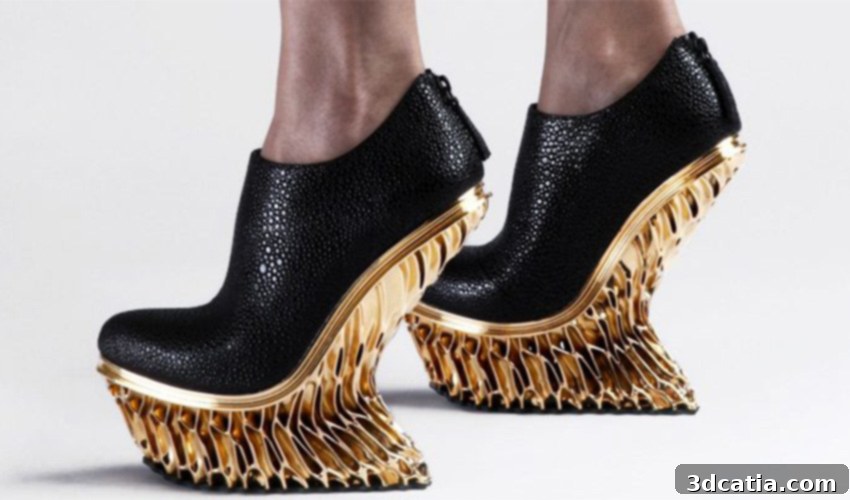
The Future of Footwear: How 3D Printing is Revolutionizing Shoe Design and Manufacturing
The landscape of various industries is undergoing a profound transformation with the increasing integration of 3D printing, and the dynamic world of fashion stands as a prime example. This groundbreaking technology is not merely an incremental improvement; it’s a catalyst, unlocking unprecedented creative possibilities and innovative solutions. We’ve witnessed its versatile application across numerous domains, from intricate jewelry pieces and stunning costume designs to a myriad of other bespoke creations. However, one sector where the adoption and impact of 3D printing are particularly gaining momentum is the footwear industry, heralding a new era of shoe manufacturing.
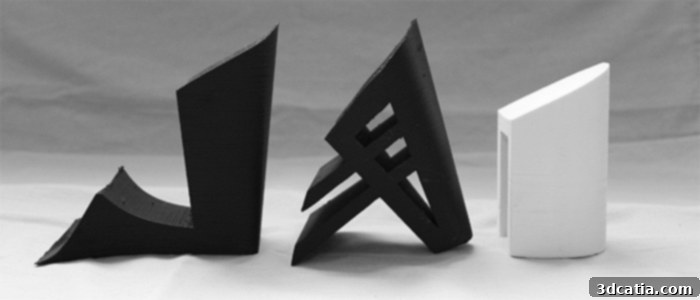
Silvia Fado’s innovative 3D printed heels.
Additive manufacturing, the technical term for 3D printing, has experienced a remarkable surge in the footwear sector over the past few years. Crafting shoes is an inherently complex and specialized process, often requiring significant time and artisanal skill, especially when dealing with customized products. Traditional methods often involve multiple stages, specialized machinery, and skilled labor, making customization both costly and time-consuming. This inherent complexity makes 3D printing an ideal tool to streamline and revolutionize the entire production workflow. From the initial rapid prototyping phase to the creation of intricate final products and detailed components, additive manufacturing offers a more agile and efficient approach. While the full integration of 3D printed components into large-scale mass production is still an evolving journey, industry giants like Adidas have already made monumental strides, aggressively pushing the boundaries of this technology in their sneaker production, setting a precedent for what’s possible.
Bringing Technological Innovation to Footwear Craftsmanship
The art and science of creating footwear boast a rich history spanning centuries. For a significant portion of this timeline, shoes were painstakingly crafted entirely by hand, a testament to human skill and dedication. The industrial revolution brought about pivotal changes, with American inventor Lyman Blake developing the first shoe stitching machine in 1856, which was further perfected by 1864. This invention marked a turning point, ushering in the industrialized era of shoe manufacturing and significantly increasing production capabilities. Today, 3D printing in footwear is poised to drive the next major evolution, as an increasing number of designers and manufacturers actively explore its vast potential to redefine how shoes are conceived, designed, and produced.
Similar to its trajectory in many other industries, 3D printing initially gained traction in the footwear sector primarily as a powerful tool for prototyping. Silvia Fado, a renowned CEO and Head Footwear Designer, eloquently explains this initial application: “Mainly in prototyping to show to the customers the volume before spending money in mould making, which is very time and cost effective.” This allows designers to rapidly iterate on ideas, test different forms, and make crucial adjustments without incurring the prohibitive costs and lengthy lead times associated with traditional mold creation. However, as the technology matures and its capabilities expand, 3D printing is steadily being implemented into other critical areas of shoe production, moving beyond mere conceptualization to tangible manufacturing.

Silvia Fado, pioneering 3D printed shoe designs.
The continuous development of new 3D printing techniques and advanced materials constantly unlocks novel possibilities for footwear design and production. Silvia Fado herself is a strong advocate of exploring these innovative frontiers. She emphasizes her proactive approach: “I like to also use the technology for production. Always using appropriate materials for footwear, trying resistance and forces during the prototyping process.” This statement highlights not only the utility of 3D printing in the initial prototyping stages but also its growing relevance in crafting final products. It facilitates the iterative process of adjusting and customizing designs, allowing for unparalleled precision and personalization. For designers like Silvia Fado, this technology is instrumental in producing limited series collections and innovating truly unique, previously unimaginable shoe shapes and structures. The ability to test material resistance and forces during prototyping ensures that even the most avant-garde designs maintain the necessary durability and functionality for actual wear.
Silvia Fado is certainly not alone in recognizing the profound potential of 3D printing beyond basic prototyping. Another pivotal figure who has consistently pushed the boundaries of fashion for years is Iris van Herpen. Her exquisite collections seamlessly blend sophisticated 3D printing techniques with traditional artisanal methods, creating breathtaking and often otherworldly garments and accessories. As early as 2013, she embarked on a visionary collaboration with acclaimed shoe designer Rem D. Koolhaas, founder of United Nude. Together, they created iconic 3D printed shoes that strikingly resembled organic tree roots, demonstrating the technology’s capacity for sculptural and naturalistic forms. Koolhaas elaborated on this collaboration, stating: “Iris is very dramatic with her concepts and the shapes she wanted were only possible with 3D printing. They are almost like a sculpture on your feet, mimicking nature.” This ability to transcend conventional design limitations is precisely why an increasing number of designers and established brands are turning to 3D printing as a cornerstone of their creative and manufacturing processes, seeking to bring truly unique visions to life.
Iris van Herpen’s stunning 3D printed shoes, a collaboration with Rem D. Koolhaas.
A Growing Market for 3D Printing in Footwear and Mass Production
The footwear sector is a colossal global industry, characterized by its immense diversity in materials, designs, and product categories – encompassing everything from everyday men’s and women’s footwear to highly specialized items like snowboard boots and athletic performance shoes. In 2018 alone, this industry generated over $106 billion worldwide, underscoring its significant economic footprint. While a vast majority of companies within this industry still rely predominantly on time-honored traditional manufacturing methods, there is an undeniable and rapidly expanding market for integrating 3D printing. This trend is particularly pronounced within the sportswear segment, where pioneering brands such as Nike, Under Armour, and Reebok are actively exploring and releasing their unique interpretations of 3D printed footwear, each striving to gain a competitive edge through technological innovation.
While many brands are cautiously experimenting, some, like ECCO, have made significant investments in expanding the use of 3D printing for finished products, particularly focusing on customized midsoles. However, it is Adidas that undeniably remains at the forefront of the industry in this transformative area. As a recognized leader, Adidas stands out as one of the few brands that have truly managed to elevate 3D printing to a new level of mass production within footwear. For years, 3D printing has ebbed and flowed in its market presence within footwear, often limited to niche applications or experimental prototypes. Yet, Adidas has successfully amplified its production capabilities like no other. They recently unveiled their cutting-edge sneaker, the Alphaedge 4D, a remarkable example of synergistic design that seamlessly blends traditional manufacturing techniques with advanced 3D printing. This innovative sneaker was the fruit of their ongoing strategic collaboration with the pioneering 3D startup Carbon. By the end of 2018, Adidas had already introduced an impressive 100,000 pairs of their new 4D shoes and articulated ambitious plans to further escalate the technology’s application in 2019, with the audacious goal of producing millions of pairs in the subsequent years. This commitment signifies a genuine shift from niche application to significant market penetration.
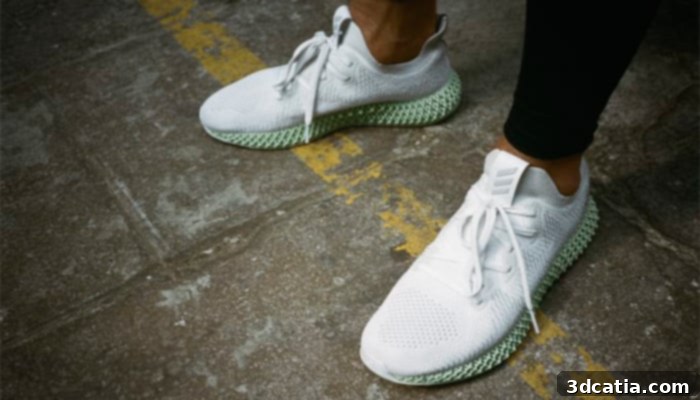
The innovative Adidas Alphaedge 4D, demonstrating scalable 3D printing in footwear.
“We have a really aggressive plan to scale this,” confidently stated James Carnes, vice president of strategy creation at Adidas, in a prior interview. He continued, emphasizing the scale of their ambition: “We are scaling a production. The plan will put us as the (world’s) biggest producer of 3D printed products.” This bold vision clearly positions Adidas as a dominant force in the 3D printing aspects of the footwear market at present. Their investment in specialized additive manufacturing processes, particularly with Carbon’s Digital Light Synthesis (DLS) technology, allows for the creation of intricate lattice structures in midsoles that offer superior cushioning, energy return, and personalized performance. However, despite Adidas’s immense size and their vigorous efforts in pushing the technology forward, they have yet to release a shoe that is fully 3D printed. This highlights a significant challenge in achieving a completely additive manufactured shoe that meets mass market durability, comfort, and cost requirements. At the moment, very few companies have managed to achieve a truly comprehensive fully 3D printed footwear product, indicating the complexity and ongoing developmental hurdles in this frontier of shoe manufacturing.
The Quest for Fully 3D Printed Products
The realization of fully 3D printed shoes, from sole to upper, appears to be a goal that still requires significant research, development, and material innovation. However, several visionary designers and emerging brands are actively developing their own products, steadily advancing towards this ambitious objective. Olivier van Herpt, celebrated for his pioneering integration of 3D printing into traditional crafts such as pottery, has extended his innovative approach to footwear. His aim is to create shoes that precisely conform to the unique measurements and contours of each wearer’s foot. By meticulously utilizing 3D scanning technologies to capture individual foot geometry and then employing 3D printing, he has successfully crafted unique, lightweight, and remarkably strong open-structure shoes. This methodology not only leads to shoes manufactured locally, reducing supply chain complexities, but also ensures they are truly bespoke, accommodating the specific shape and subtle differences of each foot. This represents a paradigm shift towards hyper-personalized footwear, moving away from standardized sizing to truly customized comfort and fit.
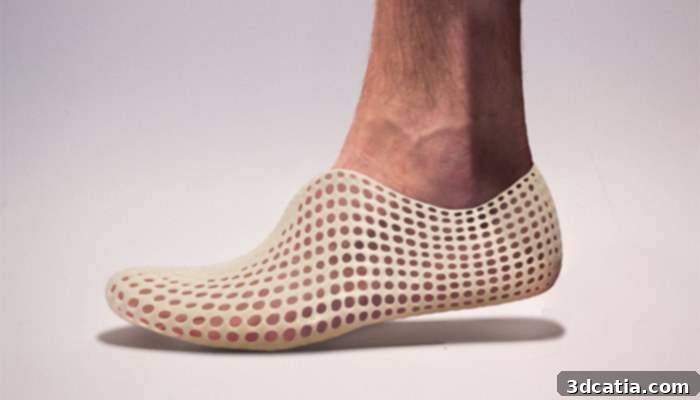
Olivier van Herpt’s innovative 3D printed shoe, designed for ultimate personalization.
Beyond established innovators, ambitious newcomers like Nicholas Unis are also making significant inroads into the market with their own fully 3D printed shoes. A young man initially studying Finance and Accounting at Pennsylvania State University, Nicholas harbored a lifelong passion for footwear. This passion ultimately led him to launch UnisBrands. Initially operating as a reseller of major footwear brands, the company soon pivoted towards comprehensive customization, focusing on “Adding materials, colors and graphics based on the customer’s needs.” This bold new initiative quickly gained traction and demonstrated substantial growth, prompting Nicholas to pursue it with even greater vigor and commitment, recognizing the burgeoning demand for personalized products.
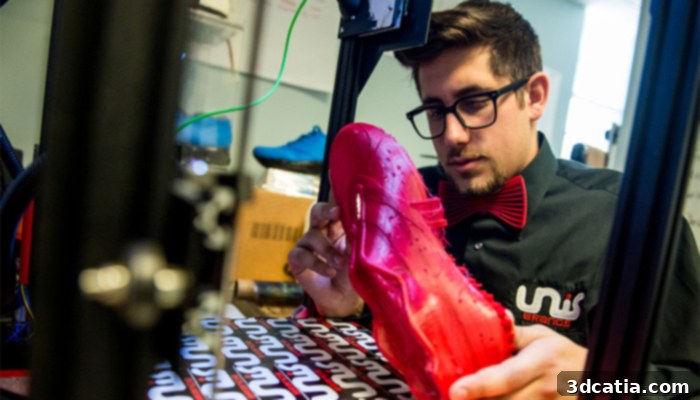
Nicholas Unis, at the forefront of custom 3D printed footwear.
Nicholas recounts a pivotal experience that reshaped his company’s direction: “I then did a shoe with a larger rapper (at the time) Riff Raff. We put this custom shoe on eBay, which hit over a million dollars,” he continues. “Nike then sent us a letter demanding we remove the listing and cancel the sale. I had done the custom over-top of an Air-Jordan 5.” As Nike asserted a violation of copyright in the sale of this customized shoe, the transaction was ultimately canceled. However, this incident, rather than being a setback, decisively steered UnisBrands in a new and profoundly innovative direction. Nicholas made a resolute decision: “to create my own footwear brand focused on customization. The best way I could think to do this was to use 3D printing.” Today, UnisBrands designs and manufactures its own unique footwear. Aside from a few minor components, the vast majority of each shoe is meticulously produced through 3D printing, epitomizing the brand’s commitment to bespoke designs and advanced manufacturing. This not only avoids copyright issues but also offers unprecedented design freedom and personalization for their customers.
Disrupting the Global Footwear Industry: Influence and Future Potential
3D printing is undeniably exerting a transformative influence on the global footwear industry, albeit to varying degrees depending on the segment. At the very least, as Silvia Fado judiciously states, it “is certainly influencing the industry.” She further specifies, highlighting its impact “especially on big sportswear’s brands that innovate constantly.” This perspective is strongly corroborated by Nicholas Unis, who agrees that while a complete upheaval isn’t happening instantaneously, it is an inevitable future trajectory. This collective foresight underscores that the technology is not merely a passing trend but a powerful force consistently pushing the industry forward. For the time being, designers primarily leverage 3D printing for its unparalleled capabilities in rapid prototyping and intricate customization. However, its application is rapidly expanding, stretching from the haute couture of high fashion and performance-driven sneakers to highly specialized products like custom insoles and bespoke sports equipment. This technology not only introduces revolutionary new production methods and significantly reduces material waste through additive processes but also holds the long-term potential to drastically optimize the production time for each individual piece. These are all invaluable assets for companies operating in the global footwear market, seeking efficiency, sustainability, and competitive differentiation. The lingering question, however, remains: does this technological advancement truly translate into worthwhile benefits for the end consumers, justifying potential premium costs?
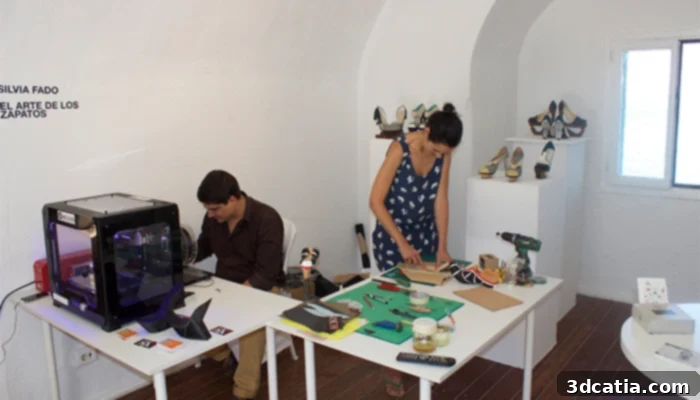
Silvia Fado’s workshop, showcasing the synergy of craftsmanship and 3D printing.
The Good and Bad of 3D Printing in Footwear: Challenges and Opportunities
At this current stage, particularly on a smaller operational scale, the widespread adoption of 3D printing in footwear still encounters several significant hurdles. Firstly, the research and development phases for implementing this technology remain considerably demanding, especially for smaller companies that may lack extensive capital and resources. This includes investing in specialized printers, materials, and skilled personnel. There are also ongoing challenges related to current 3D printing speeds, an area where numerous companies are actively dedicating resources to improve. For now, however, production can still be time-consuming compared to traditional high-volume manufacturing. Furthermore, with certain materials and printing techniques, achieving the desired perfect finish or optimal mechanical properties can be challenging, sometimes leading to deliverables that do not quite meet the high aesthetic or functional standards hoped for.
Despite these challenges, the advantages and positive aspects of 3D printing in footwear are numerous and compelling. Beyond the inherently more eco-conscious approach to manufacturing, which significantly reduces material waste due to its additive nature, the technology excels in producing made-to-measure products. This leads to a finished item that, at the consumer end, is far more personalized and precisely tailored to individual needs. Imagine a shoe that perfectly fits the unique contours of your foot, addressing specific comfort requirements and foot anomalies. This capability can provide a superior product in terms of both fit and style, minimizing discomfort and maximizing performance. 3D printing offers unparalleled flexibility for customization, making it ideal for sports equipment, such as the innovative approach taken by TAILORED FITS, which uses the technology to create bespoke insoles. Similarly, designers like Alex Reed leverage it to add a distinctive edge to traditional craftsmanship, blending old and new seamlessly. This technology empowers designers with unprecedented freedom, enabling them to realize complex geometries and avant-garde aesthetics that were previously impossible. For consumers seeking unique, fashion-forward, or highly functional personalized footwear, 3D printing provides an exceptional avenue for self-expression and unparalleled comfort, pushing the boundaries of what a shoe can be.
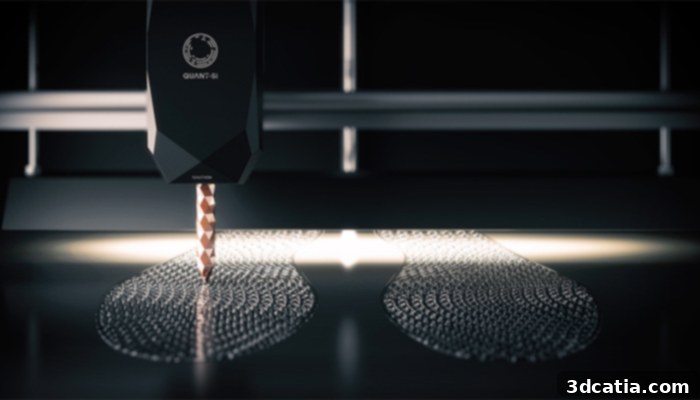
ECCO’s innovative customized midsoles, a testament to 3D printing’s impact on comfort.
What are your thoughts on the rapidly evolving role of 3D printing in the footwear industry? Do you foresee it becoming the standard for personalized shoes, or will it remain a niche for high-performance and luxury items? Let us know what you think in the comments below or join the conversation on our Facebook and Twitter pages! Don’t forget to sign up for our free weekly Newsletter to receive all the latest news and innovations in 3D printing delivered directly to your inbox!