
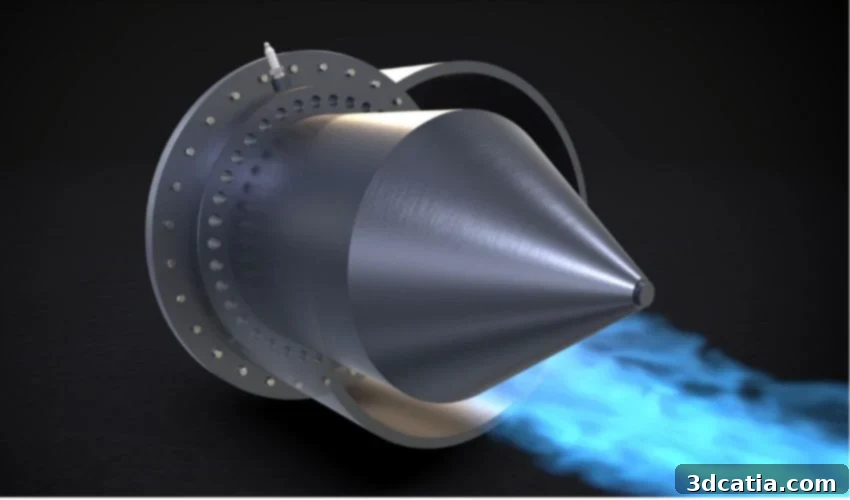
Revolutionizing Aerospace: RTX’s Breakthrough with Scalable Rotating Detonation Engines and Additive Manufacturing
For decades, the concept of a rotating detonation engine (RDE) has captivated the imagination of aerospace engineers, promising a propulsion system far more efficient and powerful than its conventional counterparts. While theoretically compelling, and explored through numerous prototypes and academic research, a fully scalable, high-performance RDE remained elusive – largely confined to design documents and experimental testbeds. This year marks a pivotal moment in propulsion technology, as a dedicated team of engineers at RTX successfully built and rigorously tested a rotating detonation engine at scale. This groundbreaking achievement represents a significant leap forward, validating a unique propulsion system characterized by its lack of moving parts, inherent lightness, and superior power density compared to traditional engines. This monumental success for the RTX team was, in no small part, enabled by the innovative application of additive manufacturing and other cutting-edge engineering methodologies.
At the heart of a rotating detonation engine is an elegantly simple, yet profoundly complex, design: an enclosed, ring-shaped combustion chamber. Unlike traditional jet engines that rely on subsonic deflagration (a slow burn) to generate thrust, RDEs harness the power of supersonic detonation waves. In operation, high-velocity air is continuously drawn into this annular chamber. Simultaneously, a precisely metered mixture of fuel is injected. This injection ignites a powerful, flame-like detonation wave that then propagates rapidly around the ring, sustaining itself as long as fuel is supplied. This continuous, self-sustaining detonation creates a tremendous amount of energy. The exhaust gases, expanding at extremely high velocities, are then channeled to produce propulsive thrust, efficiently propelling the vehicle forward. The fundamental advantage lies in the thermodynamic cycle; detonation engines operate closer to the theoretical ideal constant-volume heat addition cycle, offering significantly higher thermal efficiency and power density compared to constant-pressure combustion cycles employed by conventional engines.
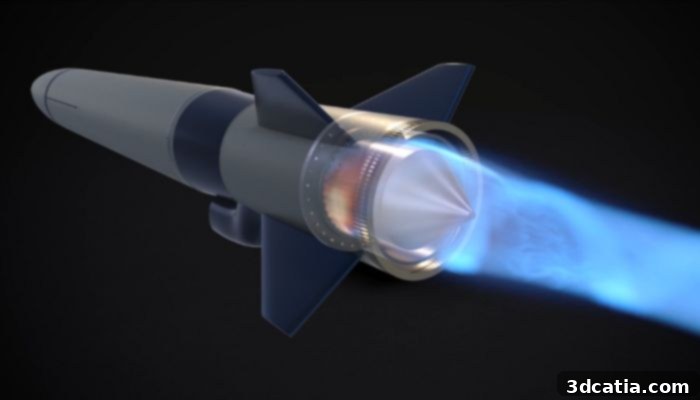
Rotating detonation engines are lighter and more powerful than traditional engines.
The rigorous testing of RTX’s rotating detonation engine took place at the state-of-the-art RTX Technology Research Center (RTRC) in Connecticut. This facility provided the engineers with unparalleled access to specialized infrastructure essential for pushing the boundaries of propulsion technology. Key among these capabilities is the Center’s Jet Burner Test Stand, a rarity in the United States. This unique test stand is specifically designed to achieve the extreme airflow rates, temperatures, and pressures necessary to accurately simulate high-speed flight conditions. Such advanced testing environments are critical for validating the performance and durability of RDEs under the demanding operational parameters they would face in real-world applications. The ability to conduct these tests “at scale” signifies a crucial step beyond bench-top prototypes, moving towards viable engineering solutions.
The journey toward this significant milestone began over a decade ago, with Pratt & Whitney, a renowned original engine manufacturer, conducting extensive design and testing activities at the RTRC. Their deep expertise in advanced propulsion systems laid the groundwork for future innovations. The acceleration of RDE development occurred upon receipt of a crucial contract from the Air Force Research Laboratory (AFRL). This contract initiated a collaborative effort involving Pratt & Whitney, the RTRC, and Raytheon, with the specific objective of developing a rotating detonation engine tailored for advanced effectors. It was this strategic partnership and targeted funding that directly culminated in the recent, highly successful performance testing, propelling the RDE from theoretical promise to demonstrable capability. This synergy between government research initiatives and industry expertise is often the catalyst for such transformative technological advancements.
“We’ve taken this technology out of the academic setting and into application,” affirmed Chris Hugill, the leader of Pratt & Whitney’s GATORWORKS development team, highlighting the transition from fundamental research to practical engineering. He further underscored the indispensable role of external support, explaining that securing backing from the U.S. government, coupled with substantial internal investment, was absolutely critical to achieving their objectives. The results speak for themselves: “Our latest test results exceeded expectations, and they make a compelling case for further investment as we move toward full system ground testing and then vehicle flight test.” This statement not only celebrates past successes but also clearly outlines the ambitious roadmap ahead for RDE technology.
Advantages of the Rotating Detonation Engine: A Game Changer for Aerospace
The potential advantages of rotating detonation engines are multifaceted and profound, positioning them as a genuine game-changer, particularly for military and advanced aerospace applications. One of their most compelling characteristics is their compact design. By eliminating complex turbomachinery and other moving parts found in traditional jet engines, RDEs free up significant internal volume. This translates directly into more available space within a vehicle for additional fuel, sophisticated sensors, and increased payload capacity, making them exceptionally valuable for next-generation missiles, drones, and other effectors requiring extended range and enhanced capabilities. Beyond compactness, RDEs are inherently more efficient and boast higher power density. This superior performance stems from the detonation cycle itself, which, as mentioned, is thermodynamically more efficient than the deflagration cycle of conventional engines. By augmenting the range and speed capabilities of flight vehicles, RDEs enable the engagement of targets at greater distances and with reduced transit times, offering a significant tactical advantage. Furthermore, the inherent simplicity of the RDE design, with its minimal number of parts, not only reduces complexity but also promises substantially more cost-effective production and potentially lower maintenance requirements over the operational lifespan of the engine.
However, transforming the theoretical elegance of rotating detonation engines into a functional reality is an engineering challenge of immense proportions. Steven Burd, Pratt & Whitney’s chief engineer for Advanced Military Engines, aptly articulated this complexity: “It sounds simple, but getting the physics to work is not. When you really try to make the design do what you want it to do consistently with the right fuels and over the right operational conditions, that’s the challenge.” This highlights the intricate dance between theoretical understanding, materials science, and practical application. The precision required to initiate and sustain a stable, continuous detonation wave under varying operational environments, with a range of fuel types, demands an extraordinary level of engineering ingenuity.
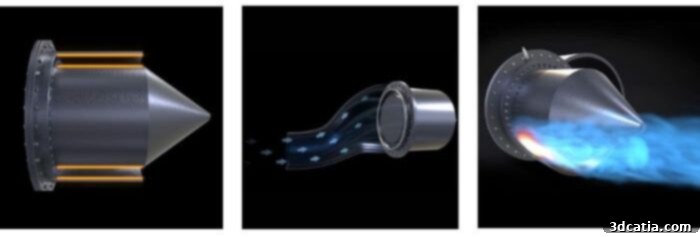
The ring-shaped chamber allows air to be drawn in and injected with fuel, igniting and propelling the vessel.
One of the paramount engineering hurdles faced by the RTX team was the meticulous perfection of fuel injection. This is not merely about introducing fuel; it involves a sophisticated process where fuel must be precisely mixed and introduced into the combustion chamber in a highly repeatable and consistent manner to initiate and sustain the detonation wave. Any deviation in this process can disrupt the delicate balance required for stable operation. In addition to this critical challenge, the team was tasked with the formidable responsibility of designing and fabricating the intricate and durable components for this entirely new propulsion system. This is precisely where the transformative power of additive manufacturing, often referred to as 3D printing, became indispensable. While RTX has not publicly disclosed the specific type of AM technology employed, they confirmed the use of advanced techniques, including additive manufacturing, to create robust test articles with highly unusual and complex specifications. AM’s ability to produce intricate geometries, internal cooling channels, and structures optimized for extreme temperatures and pressures was undoubtedly crucial. Complementing this, the engineers heavily relied on advanced physics-based modeling and simulation to guide their design iterations. Each test conducted provided invaluable data, which was then fed back into these models, creating a virtuous cycle of design, testing, and refinement, accelerating the development process significantly.
Beata Maynard, an associate director in Advanced Military Engines at Pratt & Whitney, shared insights into the future trajectory of the project. After approximately a year of intensive development and performance testing, the team’s immediate focus has shifted towards further refining their design and manufacturing processes. The next crucial phase will involve integrating the advanced RDE into a ground vehicle for comprehensive testing, simulating real-world operational conditions on a larger scale. As the team continues to validate and enhance their physics-based models with new, empirical data, additive manufacturing is poised to play an even more significant role. What began as a tool for crafting durable test articles will expand to become a cornerstone technology for the full-scale production of the rotating detonation engine itself. This move signifies AM’s transition from rapid prototyping to full-fledged industrial manufacturing, particularly for high-performance, complex aerospace components.
“The government is looking for missiles that go faster and fly farther,” Maynard emphasized, articulating the strategic imperative driving this innovation. “Combining Pratt & Whitney propulsion technology with a Raytheon vehicle could result in a weapons system that addresses warfighters’ immediate needs.” This vision underscores the profound impact RDE technology, bolstered by additive manufacturing, could have on national defense capabilities, providing a significant advantage in speed, range, and operational flexibility. To delve deeper into the specifics of this groundbreaking rotating detonation engine, you can find more information by clicking HERE.
What are your thoughts on the revolutionary rotating detonation engine and its potential to redefine aerospace propulsion? We invite you to share your insights in a comment below or engage with us on our LinkedIn or Facebook pages! Furthermore, ensure you don’t miss out on the latest advancements in 3D printing by signing up for our free weekly Newsletter, delivered directly to your inbox. You can also explore all our informative videos on our YouTube channel. For more dedicated news and updates concerning 3D printing applications within the aerospace and defense sectors, visit our specialized page HERE.
*All Photo Credits: RTX