
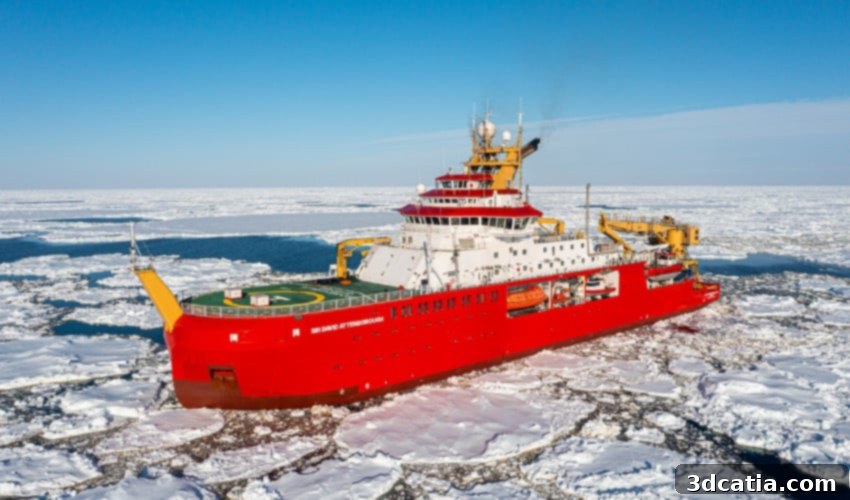
Revolutionizing Arctic & Antarctic Exploration: How 3D Printing and DEFEND3D Empower the RRS Sir David Attenborough
The RRS Sir David Attenborough, hailed as Britain’s most advanced polar research vessel, embarked on its inaugural mission to Antarctica last October, marking a significant milestone in scientific exploration. Beyond its impressive capabilities for navigating treacherous icy waters, this state-of-the-art ship is pioneering a transformative approach to onboard maintenance and repair: the groundbreaking utilization of 3D printing technology. In an ambitious effort to enhance operational efficiency and self-sufficiency in the planet’s most remote regions, the vessel is increasingly adopting additive manufacturing to revolutionize its repair and modification processes. This crucial innovation is made possible by leveraging DEFEND3D software, which empowers the RRS Sir David Attenborough to harness the full potential of additive manufacturing while ingeniously overcoming one of the most significant challenges in polar regions: severely limited bandwidth connectivity. This strategic integration of advanced technology ensures that critical scientific endeavors can continue uninterrupted, even in the harshest and most isolated environments on Earth.
Operating in the challenging, isolated, and often unforgiving conditions of the Arctic and Antarctic poses unique logistical hurdles for any vessel, particularly a research ship dependent on precise instrumentation. Traditionally, repairs on ships like the RRS Sir David Attenborough have relied on rudimentary materials such as wood and glue for quick fixes, or, more often, on the lengthy and costly process of sourcing and delivering replacement parts from thousands of miles away. Damaged plastic components, common on modern scientific equipment, frequently remain broken for extended periods until replacements can be shipped – a process fraught with inherent costs, significant delays, and potential compromises to ongoing research. Furthermore, while the vessel carries skilled carpenters and machinists, their expertise, though invaluable, cannot always guarantee the swift, on-demand creation of highly specific, customized, or intricate components. The manual fabrication of precise parts can be time-consuming and often falls short when urgent, bespoke solutions are required. This highlights a critical need for a more agile and reliable solution to maintain operational continuity in regions where resupply is impractical or impossible.
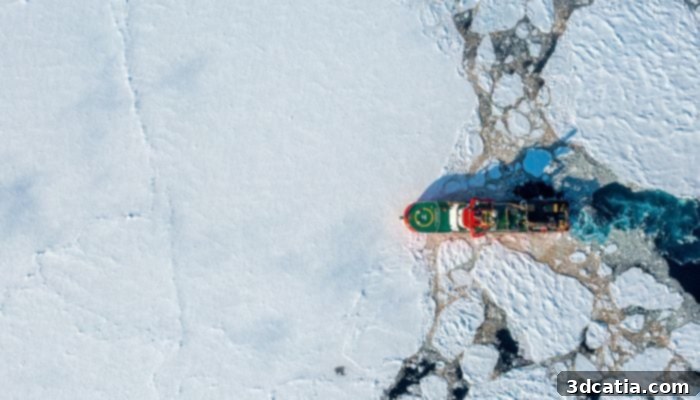
RRS Sir David Attenborough concludes its Ice Trials (photo credits: Jamie Anderson, British Antarctic Survey)
The advent of onboard 3D printing has, however, dramatically reshaped this paradigm. This innovative technology allows crew members to custom-make, replicate, or even invent entirely new parts directly on the vessel, significantly reducing both cost and turnaround time. This capability means that a broken component no longer necessitates an expedition-altering delay or a costly resupply operation. The adoption of 3D printing technologies aboard ships has witnessed a remarkable surge in popularity across various maritime sectors, mirroring trends set by leading naval forces. For instance, the US Navy has notably embraced 3D printed components on their nuclear submarines since last September, demonstrating the reliability and strategic advantage this technology offers in critical marine environments. While the benefits are clear, implementing additive manufacturing in such dynamic and isolated settings still presents unique challenges, particularly concerning connectivity and access to digital design files when reliable internet is virtually non-existent.
The Critical Role of DEFEND3D in Enabling Remote Onboard Manufacturing
How DEFEND3D Enables Seamless 3D Printing Aboard the RRS Sir David Attenborough
Implementing sophisticated 3D printing capabilities onboard a polar research vessel, operating in some of the most remote corners of the world, naturally comes with its own set of formidable challenges. Foremost among these is the pervasive obstacle of extremely limited bandwidth, which severely complicates the process of sourcing and downloading template designs for parts not already stored locally. This is where DEFEND3D emerges as an indispensable partner for the RRS Sir David Attenborough. DEFEND3D is a pioneering manufacturing solution specializing in secure and highly efficient data transmissions for remote 3D printing. Its innovative Virtual Inventory Communications Interface software directly addresses and effectively surmounts the connectivity constraints inherent in polar exploration, making real-time, on-demand manufacturing a practical reality.
What truly distinguishes DEFEND3D’s software is its unparalleled ability to overcome severe bandwidth limitations during the critical phase of template sourcing. It ensures an exceptionally seamless 3D printing process by allowing vessels to access a vast, central repository of engineer-grade parts, even with minimal connectivity. This groundbreaking capability is particularly vital in the most remote locations, such as the Antarctic ice sheets, where conventional internet access is either non-existent or incredibly slow. Without such technology, vital operations could grind to a halt due to a simple broken part. The end result is a dramatically enhanced operational efficiency for the research vessel, empowering the crew to create essential, high-quality parts on demand, thereby minimizing downtime and ensuring the continuity of vital scientific missions in challenging environments. Remarkably, achieving this robust access and functionality requires an incredibly modest data transfer rate of only 3kbps, an engineering marvel that underlines the software’s efficiency and resilience.
Real-World Success: A Peristaltic Pump Bracket Case Study
A recent and compelling testament to the tangible success and practical utility of DEFEND3D’s software involved the urgent creation of a bespoke part: a specialized bracket attachment for a peristaltic pump. This particular pump is crucial for testing the salinity of water samples, a fundamental aspect of oceanographic research. When the original bracket failed, potentially jeopardizing critical data collection, the crew aboard the RRS Sir David Attenborough was able to swiftly design and 3D print a replacement. Crew members reported that the DEFEND3D software operated flawlessly, allowing for the rapid production and prompt use of the part without any delays. Crucially, the newly printed bracket aligned precisely with the required design specifications, seamlessly integrating into the existing scientific equipment. This successful incident not only averted a potential disruption to valuable research but also validated the reliability and precision of the onboard 3D printing system, powered by DEFEND3D, in a high-stakes operational context.
Broader Implications for Polar Science and Maritime Innovation
The successful integration and deployment of 3D printing technology aboard the RRS Sir David Attenborough represent far more than just a convenient repair solution; it marks a monumental stride in maritime innovation and the future of polar scientific exploration. DEFEND3D’s intelligent software, adept at overcoming the formidable challenges of bandwidth constraints in the world’s most remote locations, delivers immediate, tangible benefits for on-demand repairs and critical component creation. This capability is pivotal for maintaining the continuous operation of complex scientific equipment and ensuring the safety and functionality of the vessel itself. Beyond immediate problem-solving, this technology establishes a robust foundation for sustained, uninterrupted research missions, enabling scientists to delve deeper and longer into the mysteries of the planet’s extreme environments without the constant threat of logistical interruptions.
This moment solidifies a profound commitment to advancing scientific endeavors under the most demanding conditions of polar exploration. By minimizing reliance on external supply chains and empowering onboard self-sufficiency, the RRS Sir David Attenborough sets a new benchmark for resilience and innovation in remote research. It significantly enhances the vessel’s capacity to conduct critical climate change studies, marine biology research, and oceanographic surveys, ultimately contributing invaluable data to global scientific understanding. This pioneering approach has far-reaching implications, not only for future polar expeditions but also for other industries operating in isolated or challenging environments, such as offshore energy, deep-sea exploration, and even humanitarian aid missions. The RRS Sir David Attenborough is not just breaking ice; it’s breaking new ground in the application of advanced manufacturing for the betterment of science and humanity. You can find out more on the British Antarctic Survey website HERE.
What are your thoughts on this revolutionary use of 3D printing technology aboard the RRS Sir David Attenborough and its impact on polar research? Let us know in a comment below or join the conversation on our LinkedIn, Facebook, and Twitter pages! Don’t forget to sign up for our free weekly Newsletter here, bringing the latest 3D printing news straight to your inbox! You can also find all our videos on our YouTube channel.
*Cover Photo Credits: British Antarctic Survey