
Navigating the Evolving Landscape: Key 3D Printing Trends of 2024 and What They Mean for the Future
As 2024 draws to a close and 2025 approaches, it’s a fitting moment for us at 3Dnatives to reflect on the dynamic shifts and defining trends that shaped the additive manufacturing industry over the past year. Twelve months ago, many indicators of what was to come were already apparent, most notably the brewing industry downturn. This year, before delving into the anticipated 3D printing trends for 2025, it’s imperative to thoroughly examine how the predictions from 2023 manifested and evolved throughout 2024.
Our retrospective last year prominently featured the discussion of Artificial Intelligence (AI) and its potential impact on the industry. True to form, AI software maintained a significant presence within additive manufacturing. However, the initial widespread optimism surrounding its all-encompassing capabilities has matured into a more grounded perspective. This isn’t to suggest that AI has fallen short of expectations, but rather that it is now more securely carving out its niche in applications where its utility is undeniable. For instance, AI continues to prove invaluable in medical applications, offering enhanced precision and efficiency, and solidifying its role in generative design processes for optimizing complex geometries. Looking ahead, we anticipate a continued, yet more discerning, adoption of AI – not as a universal solution, but strategically integrated into areas where it can genuinely revolutionize and differentiate, much like 3D printing itself. This strategic integration ensures that AI provides tangible benefits, moving beyond a mere buzzword to a fundamental tool that enhances specific aspects of the 3D printing workflow, from material optimization to post-processing automation.
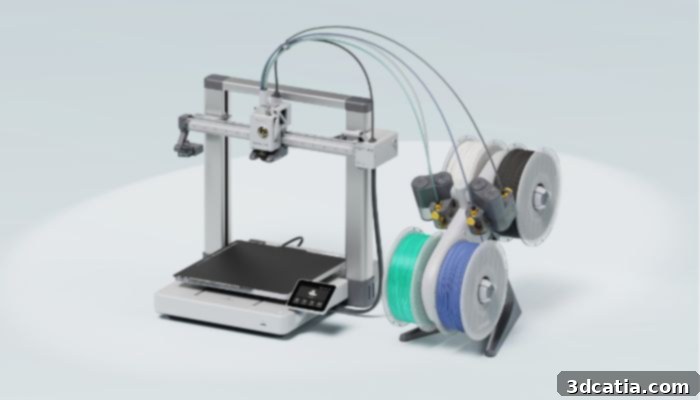
The Bambu Lab A1 was recalled this year, but the company still saw sharp growth (photo credits: Bambu Lab)
Affordability and budget constraints also remained a critical factor, mirroring trends from the previous year. In 2023, Bambu Lab made significant waves across the sector, capturing the attention of countless 3D printing enthusiasts who gravitated towards the company’s remarkably affordable and high-speed desktop solutions. This momentum not only carried into 2024 but intensified. Despite facing notable challenges, including a recall on its A1 3D printer, Bambu Lab continued its remarkable ascent, asserting itself as a dominant force in the industry. Its rapid expansion and broadened product portfolio underscored a clear market demand: for many 3D printing users, cost-effectiveness remains a paramount concern, driving widespread adoption and influencing purchasing decisions. This accessibility has disrupted traditional market segments, pushing established players to re-evaluate their pricing and product strategies. The success of affordable, yet powerful, desktop machines illustrates a broader shift towards democratized additive manufacturing, where the entry barrier for high-quality printing is continually lowered, bringing advanced capabilities to a wider audience, from hobbyists to small businesses and educational institutions.
Beyond these recurring themes, what other significant 3D printing trends emerged in 2024? What were the truly impactful developments that profoundly shaped the additive manufacturing landscape this year? From market consolidation to a renewed focus on practical applications and the undeniable rise of new global players, the year was ripe with shifts that demand closer examination. Let’s delve deeper into the defining moments and shifts that characterized the 3D printing industry in 2024, analyzing their implications for both present challenges and future opportunities.
A More Somber Market for Additive Manufacturing
It’s hardly a revelation that 2024 presented persistent challenges for the 3D printing industry. This challenging environment was a direct consequence of a broader global economic downturn, which disproportionately affected the technology sector. Many attribute this phenomenon to a “bubble burst” that became evident in 2023, leading to ongoing growing pains that continue to reverberate through the market. The optimism of previous years, often fueled by ambitious valuations and rapid expansion, was tempered by economic realities, forcing companies to re-evaluate strategies, streamline operations, and focus intensely on efficiency and profitability rather than sheer growth. This period of readjustment has been crucial for the industry to mature and identify sustainable paths forward amidst global uncertainties.
Our analysis of 2023 trends highlighted market instability, evidenced by a flurry of merger announcements and widespread layoffs across various tech segments. These very same trends regrettably continued to characterize the additive manufacturing sector throughout 2024, signaling a period of intense consolidation, strategic restructuring, and a clear shift towards financial prudence rather than expansive, unbridled growth. Companies sought synergies, divested non-core assets, and optimized their workforces in a bid to navigate the challenging economic climate and secure long-term viability.
Illustrating this instability, major industry players undertook significant strategic shifts. Stratasys, for instance, announced in September 2024 that it would be laying off approximately 15% of its workforce, a clear indicator of cost-cutting and strategic refocusing to maintain competitiveness. Similarly, 3D Systems divested its metrology software assets to sharpen its concentration on its core software portfolio directly related to 3D printing, aiming for greater synergy and efficiency in its primary business lines. The year also saw the bankruptcy of Shapeways, a significant online 3D printing service provider, though reports suggest a potential revival and even its acquisition of the popular model platform Thangs, showcasing the volatile and unpredictable nature of the market. Concurrently, Markforged faced increased difficulties, particularly after a court ordered it to pay Continuous Composites $17 million following an intellectual property lawsuit loss, highlighting the growing importance of IP in the competitive landscape. In the wake of previous leadership comments casting doubt on the company’s direction, Nano Dimension subsequently announced its impending acquisition of Markforged, a move that stirred considerable discussion and speculation about future market structures.
Indeed, Nano Dimension proved to be a significant catalyst for acquisition-related news this year, reflecting a broader attempt at consolidation within the industry. Beyond its designs on Markforged, the company also made headlines with its stated intention to acquire Desktop Metal, a firm that has grappled with financial struggles for several years. What initially appeared to be a straightforward acquisition quickly became mired in uncertainty following the dramatic ousting of Yoav Stern, the CEO of Nano Dimension, from both the company’s board and his executive position. This seismic shift coincided with a major victory for activist shareholder Murchinson Ltd., which, having steadily increased its stake to approximately 7.1%, succeeded in electing its nominated director candidates, Ofir Baharav and Robert Pons, to the board, culminating a prolonged and often acrimonious struggle for control over the company’s leadership and strategic direction.

Yoav Stern, CEO of Nano Dimension, was one of the participants in the Executive Perspectives series at RAPID + TCT 2024 where he highlighted his desire to help consolidate in the 3D printing industry through acquisitions (photo credits: 3Dnatives)
Further exacerbating this climate of uncertainty, six Nano Dimension directors tendered their resignations, leaving only four directors who were backed by Murchinson. The newly constituted board subsequently issued a statement confirming that, “As a newly reconstituted Board, we are committed to strong corporate governance and executing plans to maximize long-term value for shareholders.” This carefully worded declaration, when read between the lines, clearly signals a profound dissatisfaction with the strategic decisions and corporate governance practices that had been in place at Nano Dimension prior to the leadership change, particularly regarding its aggressive and often controversial approach to mergers and acquisitions. This internal upheaval underscores the immense pressure publicly traded additive manufacturing companies face to deliver shareholder value, even if it means challenging entrenched leadership.
Indeed, the protracted saga between Murchinson and Nano Dimension’s former leadership has been ongoing for some time, with Murchinson consistently advocating for Yoav Stern’s removal due to what it perceived as directorial incompetence and a lack of sound financial stewardship. In a strongly worded press release, Murchinson explicitly stated, “Nano’s Board has demonstrated that it is unable or unwilling to hold management accountable and lacks the necessary judgment to use Nano’s cash and other resources responsibly.” This public criticism highlighted a deep rift within the company regarding its operational efficiency and investment strategy, particularly the allocation of substantial cash reserves.
The activist shareholder further underscored its concerns, stressing that, “Nano’s commitment to questionable use of shareholder resources for mergers and acquisitions, without approval from its shareholders, continues unabated. We have substantial reservations about the acquisitions of Markforged Holding Corporation (NYSE: MKFG) (“Markforged”) and Desktop Metal, Inc. (NYSE: DM) (“Desktop Metal”) that Nano has not addressed. Both Markforged and Desktop Metal are cash-burning businesses with decelerating revenue growth, yet Nano is acquiring both at substantial premiums.” These assertions highlight Murchinson’s belief that Nano Dimension was pursuing financially unsound acquisitions detrimental to shareholder value, diverting capital towards struggling entities rather than fostering organic growth or more prudent investments.
So, what are the implications of this complex scenario for the wider additive manufacturing market? It unequivocally suggests that market stabilization, at least concerning major M&A activities and corporate governance, is not on the immediate horizon. As for the fate of the proposed Markforged and Desktop Metal acquisitions, predicting the outcome is challenging. While only Murchinson-backed members currently sit on the Nano Dimension board, it appears increasingly probable that these agreements will be rejected given their stated reservations. This likelihood is further compounded by Desktop Metal’s recent lawsuit against Nano Dimension, which asserts that, “Nano Dimension has breached its obligation to use reasonable best efforts to obtain regulatory approval as soon as practicable in connection with the merger agreement between the parties (the “Merger Agreement”).” The legal proceedings are scheduled for January 2025, adding another layer of uncertainty to an already intricate situation and promising further drama for these key players.
Despite a year characterized by a more conservative approach, where the emphasis was firmly on stability rather than aggressive growth, there were certainly positive indicators. The mood at Formnext 2024, for instance, was noticeably more buoyant compared to 2023, reflecting a cautious optimism rooted in practical advancements. Press releases highlighted numerous collaborations, with partnerships emerging as a particularly stressed theme across the industry. This renewed focus on strategic alliances and collaboration is widely seen as a crucial strategy to bolster and strengthen the additive manufacturing sector during these challenging economic times, fostering shared innovation, mitigating risks, and building collective market resilience against external pressures.
The Spotlight on 3D Printing Applications in 2024
The prevailing market downturn also catalyzed some other intriguing 3D printing trends in 2024. A notable and significant shift was the increased focus on concrete, demonstrable applications rather than solely on groundbreaking machine innovations or speculative future uses. This pivot is a clear signal that the market is actively responding to the diminished faith resulting from previous “over-promises” and the subsequent disappointment experienced by early adopters. By showcasing practical, real-world uses and quantifiable returns on investment, the industry aims to clearly demonstrate the tangible value and utility of additive manufacturing technology, moving beyond mere hype to verifiable, impactful solutions across various sectors.
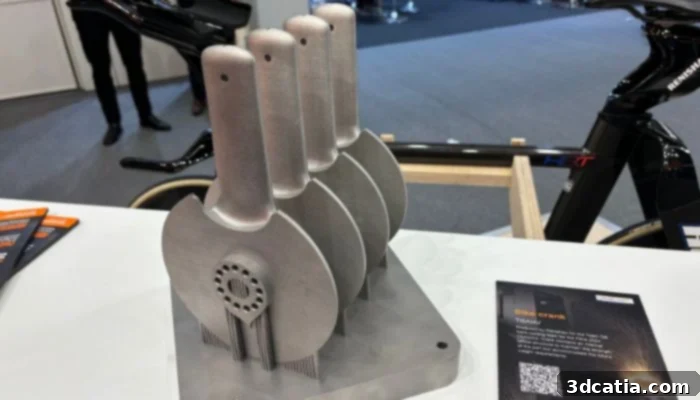
Renishaw had 3D printing applications at the forefront of its booth at Formnext 2024, including this one for bikes (photo credits: 3Dnatives)
This shift was particularly evident at major trade shows and industry exhibitions. While new machines were, of course, present and showcased, a significantly larger proportion of exhibition space was dedicated to displaying physical applications – actual parts and finished products demonstrating the quantifiable worth and functional benefits of additive manufacturing. Consider Renishaw, the prominent British manufacturer. Their booth featured numerous functional parts, including a bicycle component used in the Paris Olympics, a prime example of the innovative metal parts observed this year. Such tangible examples serve to educate and convince potential adopters of the technology’s readiness, reliability, and capability to solve real-world engineering challenges, fostering greater confidence in its industrial potential.
The emphasis on applications was also mirrored in industry press releases and corporate communications throughout the year. Across diverse sectors such as medical, aerospace, construction, and automotive, leading manufacturers consistently highlighted compelling and successful applications, often detailing case studies and return-on-investment metrics. This marks a notable departure from just a few years ago, when, despite the presence of applications, the spotlight often shone more brightly on technological innovations themselves or the raw capabilities of machines rather than their practical outcomes and business value. This strategic adjustment is a direct response to a persistent critique leveled against the additive manufacturing market: the perception that 3D printing often fails to deliver on its ambitious promises or struggles to translate laboratory breakthroughs into industrial-scale production and quantifiable benefits.
As previously discussed, while a general tech downturn has been observed, one specific reason for its amplified impact on the additive manufacturing (AM) market stems from user disappointment with machine performance and the gap between promised capabilities and actual results. This can largely be attributed to a classic “over promise and under deliver” scenario prevalent during earlier boom cycles. While 3D printers are undeniably transformative and capable of a vast array of purposes, realistic expectations regarding their specific capabilities, limitations, and integration challenges are crucial. Exaggerated claims in the past have led to skepticism and a cautious approach from potential enterprise users, making a grounded, application-focused approach to showcasing utility even more vital now for rebuilding trust and driving sustainable adoption.
By clearly presenting specific applications and demonstrable use cases, the industry directly addresses this challenge, illustrating the immediate and effective uses of 3D printing technology across various stages of product development and manufacturing. Another manifestation of this trend is the resurgence of prototyping and tooling as key 3D printing applications, alongside the growing interest in hybrid manufacturing, which combines additive and subtractive processes. The industry recognizes the imperative to concretely demonstrate to users how to effectively leverage additive manufacturing for specific needs and how to select the most appropriate technology for a given purpose, thereby building trust and driving practical, economically justifiable adoption rather than aspirational investment.
This renewed focus on practical utility and reliability has been further reinforced by a notable increase in certification efforts within the field. Certification has long been a significant hurdle to broader adoption in additive manufacturing, particularly in highly regulated industries like aerospace and medical. However, one of the most abundantly clear 3D printing trends observed at Formnext 2024 was a heightened concern with the certification of both parts and processes, signaling a collective effort to standardize and validate AM technologies. Major organizations, including those operating in specialized sectors like SAE International in aerospace, and broader manufacturing bodies, are making substantial advancements in developing robust certification frameworks and standards. These developments empower users to 3D print certified parts more directly and with greater confidence, streamlining workflows, reducing validation barriers, and accelerating the integration of AM into critical applications. This critical trend is poised to continue robustly into 2025 and will undoubtedly play a significant role in the additive manufacturing market’s eventual recovery and broader industrial integration, enhancing both credibility and operational feasibility.

The presence of SAE International at Formnext 2024, including in this presentation on design for 3D printed parts in automotive and aerospace, shows the importance of certification in the sector in 2024 (photo credits: 3Dnatives)
The Rise of China in Additive Manufacturing
China has long been a formidable presence in the additive manufacturing sector, steadily building its capabilities and market share. However, the past year witnessed a dramatic escalation in the influence and market share of Chinese manufacturers, extending significantly beyond consumer-grade machines into the highly competitive realm of industrial additive manufacturing. This accelerated growth within the region emerged as one of the most dominant and impactful 3D printing trends of 2024, profoundly reshaping global market dynamics and challenging the long-held dominance of Western players. China’s strategic investment in AM, coupled with a robust domestic market and manufacturing prowess, has positioned it as a global powerhouse in the making.
A compelling illustration of China’s expanding footprint was observed at Formnext, the world’s leading additive manufacturing exhibition held in Germany. While Chinese companies have always been present at the event in previous years, often centered around established players or those deeply integrated into the global supply chain, such as Creality or Farsoon, 2024 was qualitatively different. This year, we not only saw an unprecedented number of Chinese exhibitors – approximately 100 – but many of them commanded some of the largest and most prominent booths, signaling a new level of investment, technological maturity, and global ambition. Their physical presence alone conveyed a clear message of rising influence.
In stark contrast to many Western exhibitors who opted for more reduced footprints, perhaps in response to economic pressures, some of the most impressive and expansive stands belonged to Chinese manufacturers. Eplus3D, for example, showcased its industrial prowess with a two-floor stand, featuring sophisticated metal additive manufacturing applications, including an intricately designed rocket nozzle, demonstrating high-level engineering capabilities. Bambu Lab and Creality, strategically positioned adjacent to each other, also occupied comparatively vast spaces, drawing immense crowds and standing out as among the busiest booths at the entire show. This visual dominance at a global event underscored their growing market power, technological capabilities, and strategic intent to capture a larger share of the international AM market.
The burgeoning growth of China in 3D printing is further substantiated by compelling market data. A recent research report from Grand View Research highlighted that the Chinese 3D printing market, having generated an impressive $1.45 billion in 2023, is projected to surge to an astonishing $7.907 billion by 2030, representing a remarkable Compound Annual Growth Rate (CAGR) of 27.5% between 2024 and 2030. In comparison, the overall global 3D printing market is expected to grow at a CAGR of 23.5% over the same period, with North America, currently the largest market, forecast to expand at a slightly slower rate of 22.4%. These figures unequivocally position China as the fastest-growing major market in additive manufacturing, indicating a significant power shift in the global landscape.
Adding to this narrative, a report from CONTEXT in January 2024 specifically identified the entry-level 3D printing market in China as one of the most profitable worldwide. Companies like Bambu Lab in the FDM segment and ELEGOO in the resin segment were particularly singled out for their robust growth, defying a general trend of revenue downturn observed elsewhere. The report also made a critical observation: these increasingly capable entry-level printers are beginning to erode the market share of traditional industrial additive manufacturing. Their enhanced performance, coupled with significantly lower price tags, makes them increasingly viable for applications previously reserved for more expensive, industrial-grade systems, thus democratizing access to advanced additive manufacturing capabilities and putting pressure on high-end manufacturers.
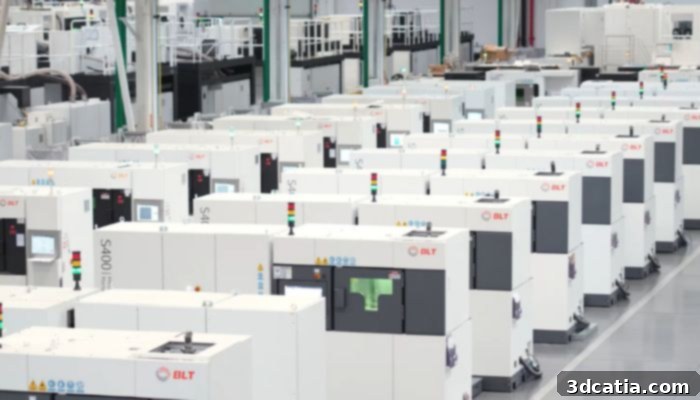
BLT is one of the Chinese 3D printing companies that has seen enormous growth in 2024 (photo credits: BLT)
Despite the continued soaring popularity of Chinese desktop and entry-level 3D printers, there is a clear and accelerating strategic pivot towards industrialization within the country. While China has dominated the consumer market, companies such as Bright Laser Technologies (BLT), Eplus3D, and Farsoon have not only showcased a flurry of exciting and advanced industrial applications this year but are also turning substantial profits. BLT, in particular, stands out as one of the most profitable additive manufacturing companies globally, having achieved a nearly 60% increase in revenue growth from 2022 to 2023, a formidable trajectory that was strongly sustained and reflected again in its 2024 performance. This indicates a growing maturity and capability in complex, high-value manufacturing segments.
Naturally, this rapid rise of China is not universally viewed as an entirely positive development by all international stakeholders. Alongside the intensified competition from Chinese manufacturers, there have been increasing claims of patent infringement, creating friction and legal battles within the global industry. A prominent example of this tension can be seen in the ongoing legal dispute between Stratasys and Bambu Lab, which captured significant attention this year.
This year, Stratasys initiated a patent infringement lawsuit against Bambu Lab, alleging that Bambu Lab’s 3D printers utilize patented technology without proper authorization. The lawsuit specifically cited features like purge towers and heated print beds as examples of these alleged violations, technologies that Stratasys claims are protected by its intellectual property. Still unresolved, this high-profile lawsuit ignited a fervent debate among 3D printing users and manufacturers, with opinions sharply divided. On one side, established manufacturers express growing concern over the protection of intellectual property rights, arguing for the necessity of safeguarding their substantial investments in research and development. On the other, enthusiasts and those championing open innovation often label companies pursuing such lawsuits as ‘patent trolls,’ suggesting these legal actions stifle progress and hinder the widespread adoption of new technologies rather than promote it.
Determining who is entirely “right” in such complex disputes is challenging, and the truth likely lies somewhere in the middle, reflecting the inherent tensions between intellectual property protection and rapid technological advancement in a globalized market. The outcome of such cases could set precedents for how innovation is protected and shared in the future of additive manufacturing. Regardless of the judicial outcome, it is undeniable that the remarkable rise of China and its concomitant challenges, including the complex issue of patent infringement, have been one of the most influential and defining 3D printing trends of 2024, shaping both market competition and legal landscapes globally.
Sensationalism on the Rise in 3D Printing Media
Amidst a turbulent and transformative year for additive manufacturing, we also observed a marked increase in sensationalism surrounding 3D printing. What precisely does this signify? It indicates a proliferation of trendy and attention-grabbing topics within the additive manufacturing sphere, issues that frequently spark heated discussions, particularly among mainstream media outlets and the broader public, who may be less familiar with the industry’s intricate nuances and everyday applications. This surge in attention, while sometimes beneficial, often distorts the true picture of AM’s capabilities and challenges.
A prime example of this phenomenon is the recurring discourse around 3D printed guns, which has been regularly featured by numerous news sources globally. While it is certainly true that 3D printed weapons have been involved in isolated incidents in recent years, providing a legitimate basis for government scrutiny into the phenomenon and calls for regulation, the media narrative often fails to present the complete and balanced picture. The issue of 3D printed guns, while concerning from a security perspective, largely remains a minor security threat in most regions globally, with traditional firearms posing a far greater danger. However, the intensity of the media furor and public discussion surrounding them is often disproportionately large when compared to their actual prevalence or impact, potentially creating undue alarm and an unfair perception of the entire 3D printing industry.

3D printed meat, such as this example from Steakholder Foods, has been widely discussed in 2024 (photo credits: Steakholder Foods)
However, it is crucial to recognize that sensationalism cannot be viewed solely as a negative force within the additive manufacturing context. While the sector has indeed witnessed an uptick in speculative discussions and even ‘tabloid-style’ reporting around certain controversial topics, there’s also a constructive dimension to sensationalism, particularly when it highlights truly groundbreaking or trendy applications as a means to draw broader public attention to additive manufacturing. This positive aspect is most clearly exemplified in the cases of food 3D printing and construction 3D printing, which often capture the public’s imagination and demonstrate tangible societal benefits.
Throughout the year, there has been a significant influx of positive news surrounding applications in both food and construction. In the latter case, the construction sector has definitively proven that additive manufacturing can be employed with remarkable effectiveness, with numerous 3D printed homes already on the market and available for occupation. Many examples from 2024 specifically centered on how construction 3D printing can be strategically utilized to create more affordable housing solutions, directly addressing the pressing global housing crisis by reducing costs, accelerating construction times, and offering design flexibility. This demonstrates a clear societal benefit that garners positive public and political attention, moving 3D printing from niche technology to a potential solution for widespread challenges.
Food 3D printing is also experiencing its moment in the spotlight, captivating consumers and investors alike. Innovative companies such as Revo Foods and Steakholder Foods are successfully developing and producing 3D printed meat and fish alternatives that are widely acclaimed for their environmental friendliness, reduced ethical concerns, and sustainability credentials compared to traditional animal agriculture. The increasing availability of some of these products in supermarkets further fuels public discussion and media interest, often sparking lively debates from non-additive manufacturing media sources questioning the safety, ethics, texture, or even desirability of consuming 3D printed meat. This ongoing conversation, while sometimes sensationalized, keeps the technology in the public eye and pushes the boundaries of food production and consumption, driving innovation and acceptance.
Ultimately, this heightened sensationalism serves a vital purpose. It re-engages public attention with 3D printing at a crucial time, especially from audiences who are not yet intimately familiar with these advanced technologies and their potential beyond industrial applications. This broader exposure can be instrumental in demystifying additive manufacturing, showcasing its versatility, and fostering wider acceptance and investment. Nevertheless, it would be prudent for all stakeholders in the industry to also acknowledge that a portion of the current market challenges and ‘woes’ could be partially attributed to the over-hyped and sometimes sensationalized expectations that proliferated during the post-COVID-19 boom. Balancing genuine innovation with realistic communication and carefully managing public perception remains a key and ongoing challenge for the entire additive manufacturing industry as it strives for sustainable growth and credibility.
Regardless of these complex dynamics and fluctuating market sentiments, 2024 has undeniably been a remarkably interesting and pivotal year for the 3D printing industry. It was a year of reckoning, consolidation, and a renewed focus on practical value, moving the sector further away from speculative hype and towards mature industrial application. It will be fascinating to observe whether the sector maintains its current trajectory of consolidation and pragmatic application focus, embracing incremental yet impactful innovations, or if significant new breakthroughs and disruptive changes are on the horizon as we move deeper into 2025, potentially ushering in another phase of rapid expansion.
What are your thoughts on these significant 3D printing trends from 2024? What other key developments would you add to this discussion, and how do you foresee these trends evolving in the coming year? We encourage you to share your valuable insights in a comment below or join the vibrant conversation on ourLinkedIn,Facebook, andTwitter pages! Don’t forget to sign up for our free weeklyNewsletter here to receive the latest and most comprehensive 3D printing news straight to your inbox! You can also explore all our engaging videos and in-depth interviews on our dedicatedYouTube channel, providing visual insights into the cutting-edge world of additive manufacturing.