
Revolutionizing Additive Manufacturing: The Promise of 6-Axis 3D Printing and Support-Free Production
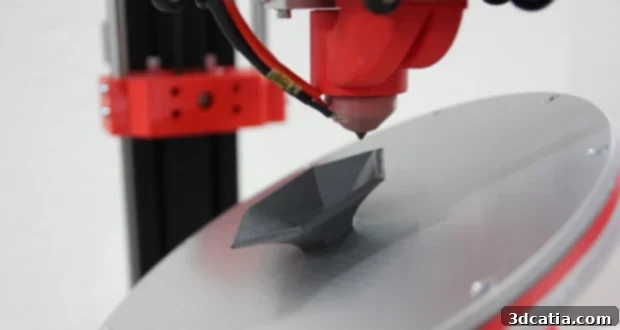
The landscape of additive manufacturing is continuously evolving, driven by innovations that push the boundaries of what’s possible. A groundbreaking development in this field comes from two visionary students at the University of Zurich of Applied Science, Oliver Tolar and Denis Herrmann, who have engineered a novel 6-axis 3D printer. This innovative system dramatically enhances the capabilities of conventional 3D printers by integrating an additional three axes for the printing plate, alongside the standard three axes controlling the print head. The primary goal? To facilitate the production of complex components entirely without the need for material supports – a significant step towards more efficient and sustainable 3D printing.
Traditional 3-axis 3D printers, which move only along the X, Y, and Z axes, often face inherent limitations when fabricating objects with overhangs, intricate internal structures, or complex geometries. These challenges typically necessitate the use of support materials, which are printed alongside the main part to prevent collapse during the printing process. While effective, these supports consume extra material, increase print time, and, critically, require tedious and often destructive post-processing steps for removal. This post-processing can lead to surface imperfections, added labor costs, and material waste, making it a major bottleneck in the broader adoption of additive manufacturing for certain applications.
Recognizing these limitations, Oliver Tolar and Denis Herrmann embarked on a mission to reimagine the Fused Filament Fabrication (FFF) process. Their initial prototype of the 6-axis 3D printer features a printing chamber designed to tilt along three additional axes, providing unprecedented control over the print orientation. This crucial innovation moves beyond simply manipulating the print head; it empowers the entire build platform to reorient itself dynamically. While the concept of multi-axis printing isn’t entirely new – for instance, the Japanese company ENOMOTO showcased a 5-axis 3D printer in 2016 also aiming for support-free production – the Zurich students’ 6-axis approach signifies a continued and intensified pursuit within the industry to overcome traditional printing constraints.
The core advantage of this multi-axis capability lies in its potential to eliminate material supports. By strategically tilting the print plate, the printer can ensure that every layer is deposited on a well-supported surface, even for geometries that would typically require extensive scaffolding. This not only conserves valuable printing material but also drastically reduces the post-processing effort and time. Furthermore, multi-axis printing opens the door to creating exceptionally smooth curves and organic shapes. By incrementally increasing the inclination of the printing plate as the filament is extruded laterally, the machine can build layers at angles that minimize the “stair-stepping” effect common in conventional 3-axis prints, resulting in superior surface finish and aesthetic quality.
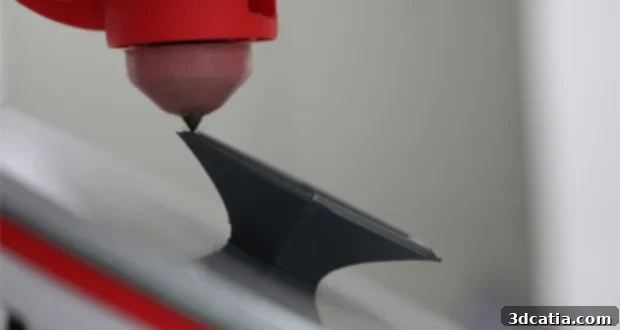
The pioneering work by Oliver Tolar and Denis Herrmann exemplifies the innovative spirit driving advancements in additive manufacturing. Their initial design successfully integrates the tilting print chamber with the standard X, Y, and Z axes for print head movement. However, as is common with early-stage prototypes, particularly those developed by students with limited resources, their current system operates with certain developmental constraints. The inventors acknowledge that they have not yet had the time or extensive resources to develop the sophisticated software required for simultaneous, real-time coordinated movement of both the print head and the tilting tray. Consequently, their printer can currently only tilt the tray to handle overhanging objects between printing operations, rather than dynamically adjusting the tray’s angle during the actual extrusion process to craft ultra-smooth curves and optimized layer deposition.
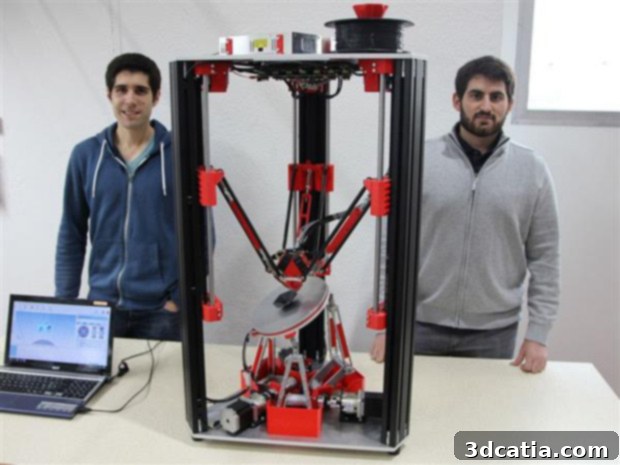
Oliver Tolar and Denis Herrmann with their innovative 6-axis 3D printer prototype.
Despite these early-stage limitations, the 6-axis 3D printer developed by these Swiss students offers significant, demonstrable advantages. A compelling example is its ability to print hexagonal structures with uniform strength across all sides. In a conventional 3-axis printer, printing diagonal or angled walls can sometimes lead to weaker areas due to anisotropic material properties and layer adhesion issues. With the tilting print plate, each side of a hexagon can be oriented to print optimally, effectively along its straight line relative to the filament deposition, rather than diagonally against the build plate’s fixed plane. This ensures that all walls receive consistent layer adhesion and material density, resulting in a part with significantly improved and uniform structural integrity.
The broader implications of support-free 3D printing extend beyond mere convenience. Eliminating support materials directly translates to a substantial reduction in material waste, contributing to more environmentally friendly manufacturing processes. For industries where material costs are high, such as aerospace or medical device manufacturing, this represents significant cost savings. Furthermore, the decreased need for post-processing not only saves time and labor but also minimizes the risk of damaging delicate parts during support removal, ensuring higher quality and reliability of the final product. This enhanced efficiency makes additive manufacturing more viable for mass customization and high-volume production of complex parts.
Beyond material and time savings, multi-axis 3D printing offers unparalleled design freedom. Engineers and designers are no longer constrained by the limitations imposed by gravity or the need for extensive supports. This opens up entirely new possibilities for creating highly optimized, organic, and functionally integrated designs. Parts can be designed with complex internal channels for fluid flow, lightweight lattice structures, or integrated functionalities that were previously impossible to manufacture with traditional methods. Such capabilities are transformative for industries requiring high-performance, lightweight components, like automotive and aerospace, where every gram of weight reduction can lead to significant efficiency gains.
However, the journey towards widespread adoption of 6-axis 3D printing is not without its challenges. The most critical hurdle, as highlighted by Tolar and Herrmann’s project, is the development of advanced Computer-Aided Manufacturing (CAM) software. Traditional slicing software is designed for 3-axis machines; developing algorithms that can effectively interpret a 3D model and generate optimal toolpaths for a 6-axis system, accounting for dynamic platform movements and extrusion angles, is immensely complex. This software must not only calculate the print head’s path but also the precise tilt and rotation of the print bed in real-time, ensuring continuous and stable material deposition. Overcoming this software barrier is paramount for unlocking the full potential of multi-axis additive manufacturing.
Furthermore, the increased mechanical complexity of a 6-axis system introduces challenges in terms of hardware precision, calibration, and overall cost. More moving parts require higher-precision engineering to maintain accuracy across all axes, leading to potentially higher manufacturing costs for the machines themselves. Despite these technical hurdles, the significant advantages in terms of material efficiency, part quality, and design freedom make continued research and development in this area highly promising. The work of Oliver Tolar and Denis Herrmann serves as a powerful testament to how student-led innovation can drive the next generation of manufacturing technologies, paving the way for more sophisticated, efficient, and sustainable production methods.
Do you believe these Swiss students have uncovered a vital key to simplifying and enhancing 3D printing? Are you intrigued by the profound potential of multi-axis additive manufacturing for future innovations? Share your thoughts and insights in the comments section below!
Don’t forget to add us on Facebook and Twitter to stay updated on the latest advancements in 3D printing!