
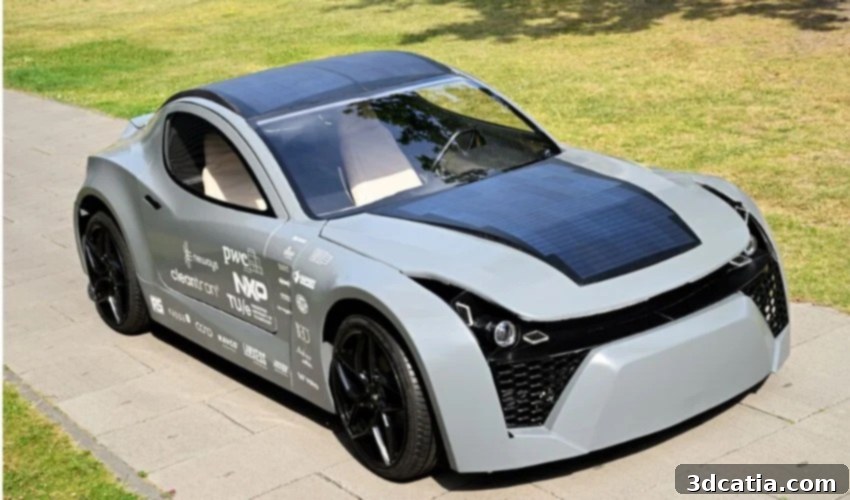
ZEM Car: Pioneering Zero-Emission Mobility Through Advanced Additive Manufacturing
The profound impact of additive manufacturing on the automotive sector is undeniable, continuously reshaping design, production, and material utilization. Amidst this technological evolution, a groundbreaking project from the bright minds at Eindhoven University of Technology (Netherlands) is poised to set a new benchmark for the industry. Their innovative vehicle, christened ZEM, stands out not only for its extensive use of additive manufacturing in its construction but, more remarkably, for its inherent design as a truly zero-emission car. This ambitious project signals a transformative shift towards a sustainable future for personal transportation.
In an era dominated by critical discussions on global warming and climate change, the advent of ZEM feels particularly timely and essential. The automotive industry has long been a significant contributor to carbon dioxide (CO2) emissions, with passenger cars, trucks, and light commercial vehicles collectively responsible for a substantial portion of global air pollution. A study by the European Parliament highlighted this challenge, indicating that passenger cars alone account for a staggering 60.6% of pollution within the transport sector, followed by trucks at 27.1%, and light commercial vehicles at 11%. These figures underscore the urgent need for radical innovation in vehicle design and propulsion. It is precisely this global imperative that drove the TU Eindhoven students to conceptualize and develop ZEM – a vehicle designed not merely to reduce its own environmental footprint but to actively contribute to cleaning the air we breathe.
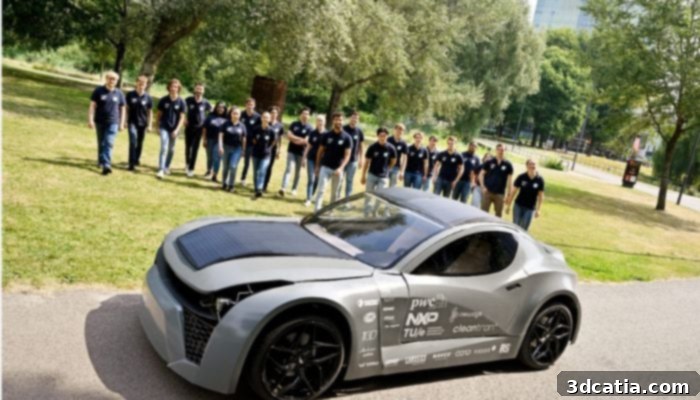
The students of TU Eindhoven proudly presenting ZEM (photo credits: TU Eindhoven)
ZEM: Ushering in the Climate-Neutral Driving Revolution
The concept of a car that actively captures more carbon dioxide than it emits might sound futuristic, almost like science fiction. Yet, this is precisely the monumental achievement of the student team behind ZEM. The name ZEM itself is an acronym for “Zero Emission Mobility,” a title it truly earns through its groundbreaking technology. At the heart of its innovation lies a specially designed filter system, which, in conjunction with direct air capture (DAC) technology, enables the car to actively purify the surrounding air. The operational procedure involves absorbing ambient CO2, which is then securely stored and subsequently neutralized within the car’s advanced filtration system. This means that as ZEM drives, it actively works to remove harmful CO2 from the atmosphere, creating a net positive environmental impact.
However, ZEM’s commitment to sustainability extends far beyond its operational phase. The vision of TU Eindhoven is to achieve climate neutrality across the entire lifecycle of the vehicle – from initial production processes to its eventual end-of-life. This comprehensive approach ensures that every stage of ZEM’s existence minimizes environmental harm. The success of this holistic strategy was rigorously verified through a comprehensive life cycle analysis (LCA), which meticulously assessed the environmental impacts associated with all stages of the car’s life. This successful LCA underscores ZEM’s profound dedication to genuine climate neutrality, setting a new standard for sustainable vehicle design and manufacturing.
Beyond its pioneering carbon capture filter, ZEM integrates another revolutionary technology: bidirectional charging. This innovative feature allows the car to not only draw power from the grid but also to feed electricity back into it, or even directly supply energy to homes. Imagine ZEM functioning as a dynamic, mobile power source, capable of supplying your home with green energy, especially during periods when renewable energy generation is low or grid demand is high. This capability is made possible by the strategically placed solar cells on ZEM’s roof, which continuously generate clean electricity. Consequently, ZEM contributes to sustainability even when it’s stationary, transforming a parked vehicle into an active component of a smart, green energy ecosystem. This bidirectional charging capability significantly enhances energy resilience and promotes greater integration of renewable energy sources.
Sustainability Driven by Advanced 3D Printing Technologies
Achieving ambitious sustainability goals, such as Europe’s aim to become the world’s first climate-neutral continent by 2050, demands innovation across all industrial sectors. For the ZEM project, environmental responsibility began right from the manufacturing phase. The students at TU Eindhoven unequivocally credit additive manufacturing, commonly known as 3D printing, as the pivotal force driving ZEM’s enhanced sustainability. Every body part of the ZEM prototype was meticulously fabricated using 3D printing technologies. While specific details about the precise additive manufacturing techniques employed were not disclosed, the students emphasized the profound benefits derived from this approach.
One of the primary advantages highlighted was the dramatic minimization of material waste. Traditional manufacturing methods often involve subtractive processes that generate significant scrap material. In contrast, additive manufacturing builds objects layer by layer, utilizing only the exact amount of material required for the final product. This “only what is needed” approach drastically reduces waste, aligning perfectly with circular economy principles. Furthermore, 3D printing enables the creation of highly complex geometries and lightweight structures that would be challenging or impossible to produce with conventional methods, contributing to the car’s overall efficiency and reduced energy consumption.
The material choice for ZEM’s body parts further reinforces its sustainable credentials. The students opted for circular plastic, a material specifically designed to be shredded and fully reused at the end of the car’s operational life cycle. This closed-loop material system represents a significant leap forward in automotive sustainability. By ensuring that materials can be reintegrated into the production stream, ZEM drastically reduces the demand for virgin resources and minimizes landfill waste. This circular approach, facilitated by the flexibility of additive manufacturing, is a cornerstone of ZEM’s environmental mission, demonstrating a tangible pathway towards a truly sustainable automotive industry.
The Circular Economy and ZEM’s End-of-Life Strategy
The commitment to climate neutrality in ZEM extends comprehensively to the car’s end-of-life phase. Here, additive manufacturing technology once again plays a crucial role in enabling a truly circular economy model. As previously mentioned, the materials utilized for ZEM’s construction are recycling-friendly plastics, specifically chosen for their ability to be either fully recycled or directly reused. This thoughtful material selection ensures that when a ZEM vehicle reaches the end of its service life, its components can be efficiently broken down and re-entered into the manufacturing cycle. This significantly reduces the need for new, virgin materials in the production of subsequent vehicles, embodying the principles of a closed-loop system.
By designing for recyclability and reuse from the outset, ZEM minimizes waste and maximizes resource efficiency, contributing to a substantial reduction in the overall environmental impact of vehicle manufacturing. This forward-thinking approach to material management, coupled with the inherent waste reduction capabilities of 3D printing during production, positions ZEM as a leading example of sustainable engineering. It illustrates how innovative design and manufacturing techniques can collaboratively address the pressing environmental challenges facing the automotive industry today. To delve deeper into the fascinating details of the ZEM car and its pioneering technologies, we encourage you to visit the official project page by clicking HERE.
What are your thoughts on ZEM and its potential to revolutionize the automotive industry? We invite you to share your insights in a comment below or engage with us on our LinkedIn, Facebook, and Twitter pages! Don’t forget to sign up for our free weekly Newsletter here to receive the latest 3D printing news directly in your inbox. You can also explore all our compelling videos on our YouTube channel for more innovative content.
*Cover Photo Credits: TU Eindhoven