
Top 5 3D Printing Innovations: A Weekly Dive into Additive Manufacturing’s Impact
Welcome to our weekly showcase of groundbreaking advancements in the world of 3D printing! This week, we’ve curated five exceptional videos that highlight how additive manufacturing is not just changing but revolutionizing diverse production landscapes. From concept to creation, 3D printing technology continues to infiltrate and redefine numerous sectors, demonstrating unparalleled versatility and efficiency. Whether it’s enhancing patient care in medical applications or driving innovation in the automotive industry, the pace of progress is truly astonishing. Our carefully selected videos offer a glimpse into these transformative innovations, ensuring you stay up-to-date with the latest developments. We encourage you to delve deeper into the fascinating world of 3D printing by exploring even more insightful videos on our dedicated YouTube channel. We hope you enjoy this insightful compilation and have a fantastic Sunday!
Top 1: EnvisionTEC – Pioneering Precision in Resin 3D Printing
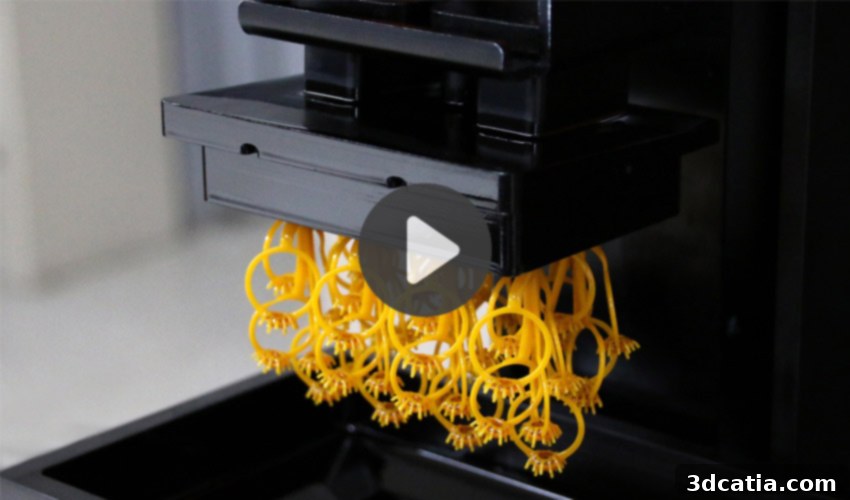
EnvisionTEC, a distinguished American manufacturer, stands at the forefront of resin 3D printing technology. With a comprehensive portfolio that spans office-grade, professional, and industrial machines, EnvisionTEC has carved out a significant niche, particularly within the demanding dental and jewelry industries. Their sophisticated machines leverage advanced resin-based additive manufacturing processes, such as Digital Light Processing (DLP) and Stereolithography (SLA), to produce parts with exceptional detail, smooth surface finishes, and high accuracy – qualities that are paramount in these sectors. In dentistry, their technology facilitates the rapid production of dental models, surgical guides, clear aligner molds, crowns, and bridges, significantly streamlining workflows and enhancing patient-specific care. For jewelers, EnvisionTEC printers are indispensable for creating intricate master patterns for casting, allowing for design freedom and rapid iteration of complex geometries.
Beyond these core markets, EnvisionTEC has demonstrated its innovative spirit by developing specialized bio-printers designed to address the unique and evolving needs of the medical sector. These bio-printers are capable of fabricating biocompatible structures and scaffolds, paving the way for advancements in tissue engineering, drug discovery, and personalized medical devices. The company’s commitment to research and development underscores its ambition to push the boundaries of additive manufacturing, offering solutions that meet the highest standards of performance and reliability. The video presented below offers an illuminating overview of EnvisionTEC’s strategic vision, its impactful projects, and the critical success factors that have cemented its position as one of the true pioneers in the additive manufacturing landscape. It highlights their continuous pursuit of innovation, their dedication to customer-centric solutions, and their integral role in shaping the future of industrial production through precision 3D printing. Discover the journey of a company that has not only adapted to the evolving market but has actively driven its transformation.
Top 2: HP & SOLIZE 3D Print Parts for a Record-Breaking Basketball Robot
In a remarkable demonstration of advanced robotics and additive manufacturing, SOLIZE Products Corporation, operating as Japan’s exclusive HP Digital Manufacturing Network (DMN) partner, played a pivotal role in the creation of Toyota Motor Corporation’s artificial intelligence basketball robot, “CUE3.” This project pushed the boundaries of what’s possible with robotic design and functionality, demanding components that were not only complex and uniquely shaped but also possessed exceptional strength and could be produced with unprecedented speed. The challenge was to manufacture intricate exterior parts for CUE3 that could withstand the rigorous demands of repeated motion and high-performance operation, all while adhering to tight production schedules and design iterations.
To meet these demanding specifications, Toyota and SOLIZE opted for the cutting-edge HP Multi Jet Fusion (MJF) technology. MJF stands out for its ability to produce highly functional, isotropic parts at production-level speeds, making it an ideal choice for manufacturing custom components. This technology operates by jetting fusing and detailing agents across a bed of powdered material, which is then fused by thermal energy, allowing for the rapid creation of complex geometries without the need for support structures in most cases. SOLIZE leveraged the power of MJF to 3D print a majority of the robot’s external parts, including critical components such as its legs, arms, specialized shoes, and even its face. The integration of these custom-printed parts enabled CUE3 to achieve an astonishing feat: scoring 2020 free throws in a row, an unparalleled record for any robot of its kind.
This collaboration between HP and SOLIZE, facilitated by the HP Digital Manufacturing Network, showcases the immense potential of 3D printing in advancing robotics, customized manufacturing, and high-performance product development. The ability to rapidly prototype, iterate designs, and produce end-use parts with superior mechanical properties allows for greater design freedom and accelerates the development cycle of complex machines like CUE3. This project not only highlights the technical prowess of all involved but also signals a future where robots are increasingly equipped with tailor-made, performance-optimized additive manufacturing components, driving new levels of automation and capability across various industries.
Top 3: Sandvik’s Titanium Powders Approved for Medical Use – Enhancing Patient Care
The landscape of the medical 3D printing industry is continuously evolving, with an increasing emphasis on the production of custom-made implants. Healthcare professionals are actively seeking innovative solutions that are precisely adapted to the unique morphology of each patient, ensuring not only a perfect fit but also exceptional durability and high performance over time. This demand for personalization and superior material properties has made additive manufacturing a critical technology in modern medicine, particularly for orthopedic and cranio-maxillofacial applications.
Against this backdrop, leading material manufacturer Sandvik has made a significant stride forward. The company recently inaugurated a state-of-the-art plant in Sweden, specifically designed to produce high-quality metal powders tailored for additive manufacturing. Sandvik’s expertise in material science and metallurgy is channeled into creating powders that meet the stringent requirements of medical applications. A crowning achievement in their efforts is the recent ISO 13485:2016 medical certification awarded to their renowned Osprey titanium powder range. This certification is a critical benchmark, signifying that Sandvik’s quality management system consistently meets regulatory requirements for medical devices and related services, ensuring product safety and efficacy.
Titanium is an inherently ideal material for medical implants due to its unparalleled biocompatibility, exceptional strength-to-weight ratio, and outstanding corrosion resistance within the human body. The combination of these properties with the precision and design freedom offered by 3D printing enables the creation of complex, porous structures that promote osseointegration – the direct structural and functional connection between living bone and the surface of a load-bearing implant. This capability is revolutionizing the manufacture of custom implants, prosthetics, and various other medical devices, leading to improved patient outcomes, faster recovery times, and a significant enhancement in the quality of life for individuals requiring medical interventions. Sandvik’s certified titanium powders are therefore poised to play a pivotal role in the ongoing advancement of personalized medicine through additive manufacturing.
Top 4: Optimizing Pediatric Cardiovascular Surgery with 3D Printed Models
There is an undeniable consensus that additive manufacturing is profoundly revolutionizing the medical sector. While ambitious bio-printing projects are continuously striving to develop functional human organs, the immediate and tangible benefits of 3D printing are already transforming other critical areas of medical practice. One such area where this manufacturing method offers invaluable advantages is in surgical planning, particularly for complex and delicate procedures like pediatric cardiovascular surgery. The ability to create highly accurate, patient-specific anatomical models is proving to be a game-changer for surgeons and patients alike.
In this specific case, we explore how the Stratasys J750 Digital Anatomy 3D printing technology is instrumental in optimizing the planning process for pediatric cardiovascular surgeries. The Stratasys J750 Digital Anatomy printer stands out for its unique PolyJet capabilities, allowing it to produce ultra-realistic anatomical models that accurately replicate the feel and biomechanical properties of human tissues, including bone, soft tissue, and even vascular structures. This multi-material, multi-color printing capability means surgeons can interact with models that precisely mimic the complex, often miniscule, and intricate structures found in a child’s heart, which are frequently affected by congenital defects.
These sophisticated models serve multiple crucial functions. They enable surgeons like Dr. Redmond Burke, Director of Cardiovascular Surgery at Nicklaus Children’s Hospital, to meticulously plan and rehearse complex surgical procedures before stepping into the operating room. By providing a tangible, three-dimensional representation of the patient’s unique anatomy, these models help identify potential challenges, refine surgical approaches, minimize risks, and ultimately improve surgical outcomes. Furthermore, these models are invaluable tools for patient and family education, allowing them to visualize and understand the surgical plan in a way that two-dimensional scans simply cannot convey. They also serve as powerful training aids for medical residents, offering a hands-on experience with complex pathologies. Discover below how these ultra-realistic anatomical models are making a significant difference in saving young lives and advancing the field of pediatric cardiac care, demonstrating the profound impact of 3D printing on personalized medicine.
Top 5: The World’s First NHL-Certified 3D Printed Helmet – Enhancing Athlete Safety and Performance
In a monumental leap forward for athlete safety and performance in professional sports, Carbon, a pioneer in digital manufacturing, embarked on a significant collaboration with CCM Hockey, one of Canada’s leading manufacturers of sports goods. This partnership resulted in the additive manufacturing of the world’s first NHL-certified hockey helmet. Named the Super Tacks X, this innovative helmet incorporates cutting-edge NEST (Next Evolution Sense Technology) designed to revolutionize head protection in high-impact sports.
The Super Tacks X helmet was produced using Carbon’s proprietary Digital Light Synthesis (DLS) technology. DLS is a breakthrough additive manufacturing process that uses a continuous liquid interface to rapidly grow parts from a pool of resin, resulting in isotropic mechanical properties akin to injection-molded parts. This technology allows for the creation of complex lattice structures that are otherwise impossible to manufacture with traditional methods. These intricate lattice designs, specifically optimized for impact absorption, are at the heart of the NEST technology. By precisely controlling the geometry and density of these structures, the helmet can effectively dissipate impact energy across a broader area, offering superior protection against both linear and rotational forces commonly experienced in hockey.
Beyond its enhanced safety features, the 3D printed Super Tacks X helmet delivers significant improvements in breathability and comfort. The open lattice design facilitates airflow, keeping athletes cooler and more comfortable during intense play, which can contribute to sustained performance. Moreover, the helmet can be customized to fit an individual athlete’s head with unparalleled precision, thanks to accurate 3D scanning. This personalized fit not only augments comfort but also plays a crucial role in maximizing the helmet’s protective capabilities by ensuring it stays securely in place and optimally interacts with the head during impacts. The NHL certification underscores the rigorous testing and validation this helmet underwent, confirming its readiness for the demanding environment of professional hockey and marking a new era for safety and customization in sports equipment through the power of additive manufacturing.
This week’s collection of videos truly underscores the incredible versatility and impact of 3D printing across a multitude of industries. From pushing the boundaries of medical device innovation and surgical planning to enhancing athletic performance and safety, additive manufacturing is consistently delivering groundbreaking solutions. We are excited to witness the rapid evolution of this technology and its continued capacity to solve complex challenges and redefine traditional production methods. We hope you enjoyed exploring these fascinating developments as much as we did curating them. Which one of these transformative applications was your favorite video of the week? We’d love to hear your thoughts and insights! Please feel free to drop a comment below or engage with us on our Facebook and Twitter pages. And to ensure you never miss out on the latest news, technological breakthroughs, and exciting applications in the rapidly expanding 3D printing industry, don’t forget to sign up for our free weekly Newsletter, delivered straight to your inbox!