
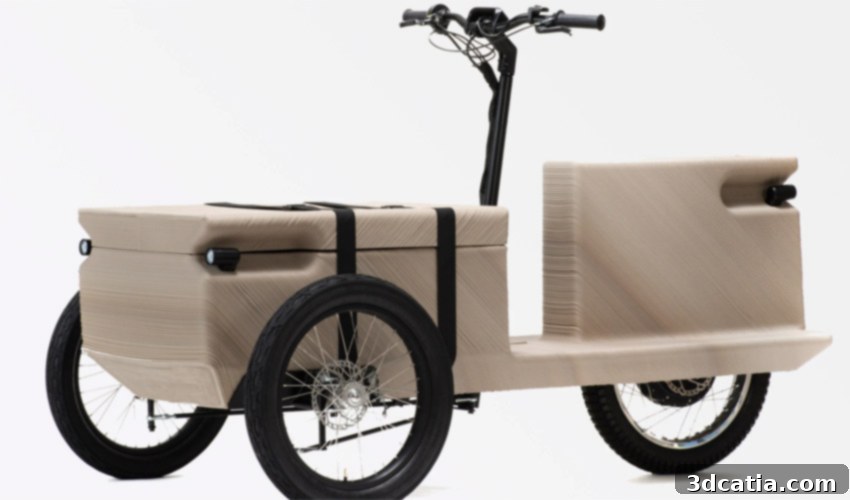
ZUV: The 3D Printed Electric Tricycle Paving the Way for Sustainable Urban Mobility with Recycled Materials
In a groundbreaking move towards revolutionizing sustainable transport, the Austrian design studio EOOS, in collaboration with the innovative association The New Raw, has unveiled a remarkable Zero-Emissions Utility Vehicle (ZUV). This pioneering electric tricycle stands out not only for its commitment to eco-friendliness but also for its innovative production method: 3D printing utilizing recycled materials. Crafted from an impressive 70 kilograms of post-consumer plastic waste collected directly from supermarkets within the bustling Austrian capital, Vienna, the ZUV embodies a powerful vision of the circular economy in action. Its ingenious design eliminates traditional pedals and chains, relying instead on an efficient rear-wheel hub motor for propulsion, offering a unique and simplified riding experience.
The core philosophy behind the ZUV transcends mere vehicle creation; it champions a radical decentralization of manufacturing. The objective is to empower individuals and communities globally by allowing them to 3D print the robust frame in a local fab lab – a community-based digital fabrication workshop – near their homes. Subsequently, users can equip their personalized ZUV with standard components such as wheels, brakes, handlebars, and the motor, readily available at any suitable bicycle store. This forward-thinking concept of localized production is gaining significant traction, primarily due to its immense potential to drastically reduce our collective ecological footprint, minimize transportation emissions, and foster a more resilient, community-driven approach to manufacturing.
The Genesis of Sustainable Transport: EOOS and The New Raw’s Vision
The collaboration between the Austrian studio EOOS and the acclaimed association The New Raw is pivotal to the ZUV project’s success and its profound ecological impact. The New Raw has made significant strides in the realm of circular design, famously initiating the “Print Your City” project. This innovative endeavor saw the creation of functional street furniture – benches, planters, and more – 3D printed from recycled plastic waste in Amsterdam. Their pioneering work has set a precedent for giving a vital second life to discarded materials that would otherwise end up in landfills or incinerators. It’s a testament to the fact that seemingly impossible ideas become tangible realities with the integration of advanced additive manufacturing technologies.
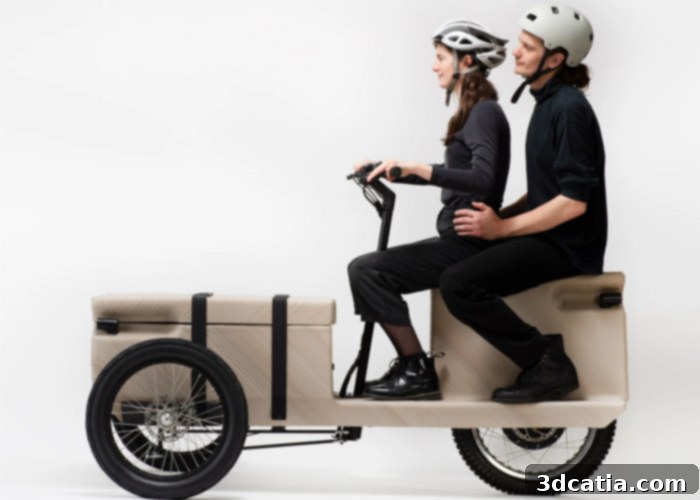
Photo Credits: EOOS
ZUV: A Locally Produced, Environmentally Conscious Vehicle
The inception of the ZUV project was driven by a clear and compelling ambition: to design an affordable, accessible, and locally manufacturable utility vehicle. 3D printing emerged as the ideal technology to realize this vision. The EOOS studio meticulously engineered a durable polypropylene frame, specifically designed for large-format additive manufacturing – most likely utilizing a robotic arm system capable of printing substantial structures. The choice of material is crucial to the ZUV’s sustainability narrative: it is sourced directly from the waste streams of Vienna’s supermarkets, transforming what was once considered trash into a valuable resource.
Harald Gründl, a leading figure at the EOOS studio, eloquently articulates the profound environmental benefits of this approach: “When supermarket plastic in Vienna goes to recycling, they’re just burning it. And this creates another three tonnes of CO2 emissions, which we could avoid. The reuse of post-consumer plastics is a big step towards net-zero carbon emissions. Every new vehicle will be, in a way, carbon neutral as long as the 3D printer is operated with energy coming from renewables.” This statement underscores the ZUV’s potential to not only repurpose waste but also to circumvent the significant carbon emissions associated with traditional waste management methods and conventional manufacturing processes. By tapping into renewable energy sources for the 3D printing process, the ZUV aims to be a genuinely carbon-neutral vehicle from its very inception.
Decentralized Manufacturing: A Blueprint for Future Mobility
The ZUV project offers a compelling blueprint for how manufacturing could evolve in a more sustainable and community-centric direction. Imagine a future where every city has the capability to 3D print the robust chassis of these utility tricycles, fostering local craftsmanship and economic independence. The beauty of this model lies in its modularity: once the core chassis is printed, the remaining components – wheels, brakes, motor, steering – can be easily integrated by local specialized equipment manufacturers or even by individuals in a bike shop setting. This not only simplifies the supply chain but also ensures that components can be sourced and assembled efficiently within the community.
This localized, modular approach extends significantly to the lifecycle management of the ZUV. Should any component fail or wear out, it can be effortlessly replaced – again, through local channels, reducing the need for costly and carbon-intensive global shipping. Even more remarkably, the 3D printed chassis itself is designed for ultimate circularity. If it reaches the end of its functional life or a user desires an upgrade, the chassis can be fully recycled and the material reused to 3D print an entirely new ZUV frame. This closed-loop system epitomizes the principles of the circular economy, minimizing waste and maximizing resource efficiency throughout the vehicle’s entire existence.
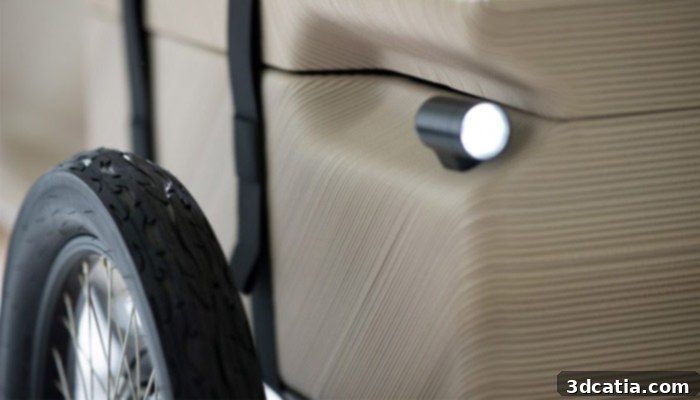
The frame is 3D printed while the other parts are to be fixed in a bike store (photo credits: EOOS)
Enhancing Urban Living: Practicality and Impact of the ZUV
Beyond its impressive sustainable credentials, the ZUV is engineered for practical utility in everyday urban environments. The studio emphasizes its robust construction, confirming that the tricycle is more than capable of comfortably carrying two adults. Alternatively, it can safely transport two children on a dedicated back seat, or serve as an excellent cargo solution, with a specially designed front box perfect for groceries, parcels, or personal belongings. The ZUV is explicitly conceived to address the common need for short-distance trips that are frequently, and often unnecessarily, made by car. By offering a convenient, zero-emission alternative, it aims to alleviate urban congestion, reduce local air pollution, and encourage healthier, more active lifestyles.
The concept of “zero emissions” inherent in the ZUV lies primarily in its innovative production method rather than solely in its operation. While the electric motor ensures emission-free travel, the truly transformative aspect is the ability to manufacture the frame locally using recycled materials and, ideally, renewable energy. This significantly curtails the environmental impact associated with conventional vehicle manufacturing, which typically involves resource-intensive processes and extensive global transportation networks. The ZUV’s design philosophy targets the entire lifecycle of the vehicle, from material sourcing and production to use and eventual recycling, representing a holistic approach to sustainable mobility.
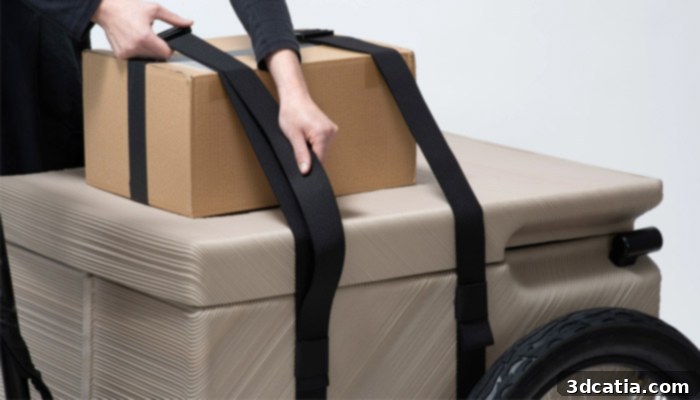
ZUV is convenient for shopping (photo credit: EOOS)
The ZUV stands as a powerful testament to what is possible when design, technology, and environmental responsibility converge. It challenges traditional manufacturing paradigms and offers a tangible solution for a more sustainable future. The critical question now remains: will this pioneering concept be embraced and implemented by other cities across Europe, and indeed, will it inspire a broader global adoption? The potential for the ZUV to transform urban landscapes, foster local economies, and significantly reduce our collective carbon footprint is immense, setting a new benchmark for eco-friendly transport solutions.
What are your thoughts on the ZUV 3D printed electric tricycle and its potential to reshape urban mobility? We invite you to share your insights in a comment below or join the conversation on our Facebook and Twitter pages. For all the latest innovations and news in 3D printing delivered straight to your inbox, don’t forget to sign up for our free weekly newsletter!