

UTA Engineers Develop Programmable 2D Materials That Transform into Complex 3D Shapes, Inspired by Nature
Groundbreaking research from the University of Texas at Arlington (UTA) is set to revolutionize the field of advanced materials. A team of innovative engineers has successfully devised a method to create synthetic two-dimensional (2D) materials that possess the remarkable ability to autonomously transform into intricate three-dimensional (3D) structures. This pioneering work draws direct inspiration from the natural world, specifically mimicking the sophisticated mechanisms by which living organisms expand and contract their soft tissues to achieve complex movements and functions. This capability to program 2D materials to morph into desired 3D configurations is rapidly emerging as a transformative paradigm within additive manufacturing and beyond.
At their core, 2D materials are ultra-thin sheets of material, often composed of just a single layer of atoms, effectively existing entirely as a surface. Despite their incredible thinness, these materials exhibit a unique combination of properties: they are typically highly flexible and porous, yet simultaneously robust and strong. A prime example is graphene, the thinnest known 2D material, which boasts a strength greater than steel, making it an ideal candidate for pushing the boundaries of material science. The ability to precisely control the shape-shifting behavior of such materials unlocks unprecedented possibilities for a new generation of smart, adaptive structures.
The innovative research effort at UTA was spearheaded by Kyungsuk Yum, an esteemed associate professor in the Materials Science and Engineering Department. A crucial aspect of their methodology involved leveraging digital light projection (DLP) lithography, a sophisticated 4D printing technique that Professor Yum had previously developed with his colleagues. This advanced printing method allows for the precise patterning of materials, laying the groundwork for programmed transformations. Professor Yum articulated the profound biological inspiration behind their work, explaining, “There are a variety of 3D-shaped 2D materials in biological systems, and they play diverse functions.” He further elaborated on the biomimetic approach: “Biological organisms often achieve complex 3D morphologies and motions of soft slender tissues by spatially controlling their expansion and contraction. Such biological processes have inspired us to develop a method that programs 2D materials with spatially controlled in-plane growth to produce 3D shapes and motions.” This direct emulation of nature’s design principles is what makes the UTA team’s breakthrough particularly significant, moving beyond mere replication to creating materials that inherently behave like biological structures.
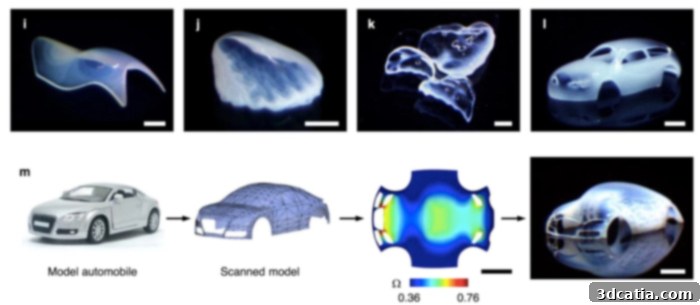
3D scanning and printing of a model automobile exemplifies the innovative capabilities of UTA’s programmable 2D materials. (Credit: UTA)
Expanding on the team’s ingenious methodology, Amirali Nojoomi, a former graduate student under Professor Yum and a key author of the published paper, provided deeper insight. He highlighted the unique advantages of their fabrication process: “Our 2D-printing process can simultaneously print multiple 2D materials encoded with individually customized designs and transform them on demand and in parallel to programmed 3D structures. From a technological point of view, our approach is scalable, customizable, and deployable, and it can potentially complement existing 3D-printing methods.” This multi-material, parallel transformation capability represents a leap forward, offering efficiency and versatility not readily available in traditional manufacturing. The integration of 4D printing concepts, where time is the fourth dimension enabling dynamic change, allows these materials to transition from their initial flat state into predefined, complex 3D forms. To validate their method, the research team successfully fabricated several intricate parts, including a detailed model of an automobile, using their novel approach in conjunction with a desktop 3D scanner (NextEngine). This tangible demonstration, as depicted in the image above, unequivocally proves the practical applicability and precision of their programmable 2D materials.
The profound implications of this discovery – the ability to program 2D materials to autonomously morph into sophisticated 3D shapes – are poised to usher in a new era of technological advancements. The repercussions will be felt across several high-impact sectors, particularly in soft robotics, deployable systems, and biomimetic manufacturing. In soft robotics, this technology could enable the creation of robots with unparalleled adaptability and dexterity, capable of interacting safely with humans or navigating complex, delicate environments. Imagine robotic grippers that can gently conform to irregularly shaped objects, or medical devices that can navigate the human body with unprecedented flexibility. For deployable systems, these programmable materials could lead to self-assembling structures for space exploration, emergency shelters that deploy automatically, or smart textiles that adapt to environmental conditions. Furthermore, in biomimetic manufacturing, this research opens doors for developing advanced prosthetics that more closely mimic natural tissue mechanics, creating scaffolds for tissue engineering that dynamically promote cell growth, or even designing self-repairing materials inspired by biological self-healing processes.
The significance of Professor Yum’s work has been widely recognized within the scientific community. Stathis Meletis, chair of the Materials Science and Engineering Department, enthusiastically commented on the potential impact: “Dr. Yum’s innovative research has many potential applications that could change the way we look at soft engineering systems. His pioneering work is truly groundbreaking.” This endorsement underscores the disruptive nature of the UTA team’s findings, highlighting their potential to fundamentally alter approaches to design and fabrication in numerous engineering disciplines. By bridging the gap between flat, static materials and dynamic, shape-changing structures, this research represents a critical step towards creating truly intelligent materials that can respond and adapt to their surroundings, much like living organisms.
This breakthrough not only expands our understanding of material science but also lays a robust foundation for future innovations in advanced manufacturing. The concept of 4D printing, where objects can change shape or function over time, is brought closer to reality through such controlled material transformations. The potential for creating materials that can self-assemble, self-repair, or adapt to changing environments promises a future where engineered systems are more resilient, efficient, and versatile. As researchers continue to explore the vast potential of programmable 2D materials, we can anticipate a surge in novel applications across various industries, from medical devices to aerospace, making previously theoretical concepts tangible realities.
What are your thoughts on this exciting new research from UTA? The full scientific paper offers even more detailed insights into their methodology and findings, and you can delve deeper into it HERE. We encourage you to share your perspectives and engage with our community! Let us know your comments below or join the discussion on our Facebook and Twitter pages. For the very latest updates in 3D printing news and material science breakthroughs, be sure to sign up for our free weekly Newsletter here, delivered straight to your inbox!