
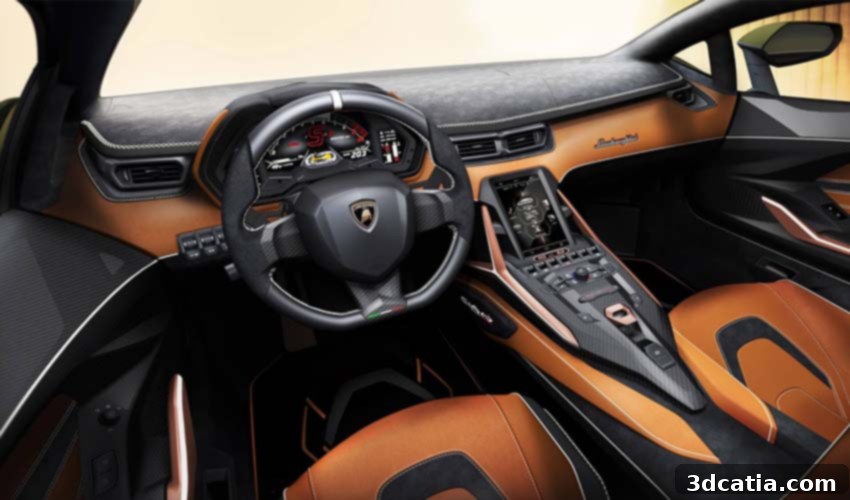
Revolutionizing Automotive Manufacturing: Lamborghini and Carbon 3D’s Groundbreaking Additive Partnership for the Sián FKP 37
The luxury automotive industry is constantly pushing the boundaries of innovation, seeking new ways to enhance performance, aesthetics, and efficiency. In this pursuit, cutting-edge manufacturing technologies play a pivotal role. A striking example of this forward-thinking approach is the transformative collaboration between Lamborghini, the iconic Italian supercar manufacturer, and Carbon, a leader in digital manufacturing using advanced 3D printing. This partnership, initially announced in February, has since evolved into a strategic alliance that is redefining how high-performance automotive components are designed and produced.
The journey began with Carbon’s involvement in creating various parts for the Urus, Lamborghini’s groundbreaking Super Sport Utility Vehicle. This initial success laid the groundwork for a deeper collaboration, focusing on integrating additive manufacturing into the production of Lamborghini’s first hybrid production car: the Sián FKP 37. The Sián, a limited-production hybrid supercar, represents a significant leap for Lamborghini, combining a V12 engine with a supercapacitor-based mild-hybrid system. For such a technologically advanced vehicle, conventional manufacturing methods often present limitations in terms of design complexity, material properties, and production speed. This is precisely where Carbon’s innovative 3D printing solutions come into play, offering unparalleled flexibility and performance.
Additive Manufacturing Takes Center Stage in the Sián FKP 37
A significant milestone in this collaboration was the recent announcement that the Sián FKP 37 will feature 3D printed air vents. These critical components, vital for both aesthetic integration and functional airflow management within the supercar, are produced using Carbon’s proprietary Digital Light Synthesis (DLS) technology. Designed meticulously by Lamborghini’s engineering teams, these air vents exemplify the advantages of additive manufacturing in creating complex, high-performance parts. The primary objectives for Lamborghini are clear: to produce superior quality parts that meet the rigorous demands of a luxury supercar, while simultaneously dramatically accelerating the product development lifecycle.
Carbon highlights that its technology effectively reduced the lead time for these components by an impressive 12 weeks. This acceleration is not merely about speed; it’s about enabling a more iterative design process, allowing engineers to refine and optimize parts rapidly. Maurizio Reggiani, Chief Technical Officer at Lamborghini, underscored this transformative impact, stating: “With the Carbon Digital Manufacturing Platform, we were able to go from an initial concept to showing the final part on a show car in only three weeks, passing through many different design iterations to get the best result. Just three months later, we were able to move into production.” This remarkable turnaround time showcases the efficiency and agility that Carbon’s platform brings to high-stakes automotive projects, facilitating a level of design freedom and optimization previously unimaginable with traditional manufacturing techniques.
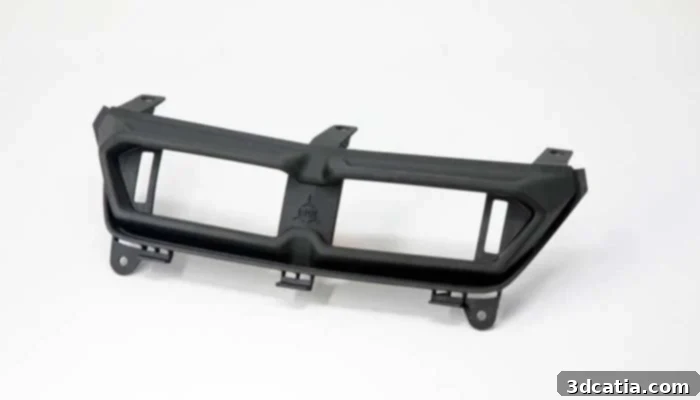
Lamborghini Sián FKP 37 Central Air Vent | Credits: Carbon
Carbon’s Digital Light Synthesis: A Game Changer for Automotive Production
The continued partnership between Lamborghini and Carbon signifies a mutual commitment to innovation and excellence. Stefan Gramse, a key figure in this collaboration, elaborated on the strategic importance: “Moving forward we are putting more effort and resources on using additive manufacturing technologies for production of parts for Lamborghini vehicles, and in working with Carbon, we have found a partner that shares our vision for creating best-in-class products that push the limits of what’s possible.” This statement encapsulates the shared ambition to not just adopt new technologies, but to actively redefine the benchmarks of automotive engineering.
Carbon’s success and the industry’s confidence in its technology are further evidenced by its recent funding round, where the company raised a substantial $260 million in growth funding. This capital injection underscores the optimism surrounding digital manufacturing and its potential to revolutionize various industries, including high-performance automotive. Carbon has cultivated an impressive portfolio of partnerships with other prominent brands, such as Riddell for custom football helmet liners, Adidas for innovative footwear (Futurecraft 4D), and Ford for automotive components, demonstrating its versatility and capability in delivering mass customization solutions.
At the core of Carbon’s transformative power is its Digital Light Synthesis (DLS) technology. Unlike conventional 3D printing methods that build parts layer-by-layer, often resulting in anisotropic properties and visible layer lines, DLS offers a fundamentally different approach. It functions more akin to injection molding in its ability to produce isotropic parts with exceptional surface finishes. DLS leverages digital light projection to cure liquid resins, working in conjunction with oxygen-permeable optics. This innovative process allows for the continuous production of parts from a programmable liquid resin, effectively “growing” the object without the discrete layering steps. The result is components with superior mechanical properties, unparalleled resolution, and an outstanding surface finish that rivals injection-molded plastics. This continuous liquid interface production (CLIP) process significantly reduces manufacturing time while enhancing part integrity and performance.
The implications of DLS for the automotive sector are vast. It allows for the creation of lightweight parts with complex geometries, which can directly contribute to improved vehicle performance, fuel efficiency, and safety. For a supercar like the Sián FKP 37, where every gram and every aerodynamic detail matters, the ability to rapidly produce optimized components with precise material properties is invaluable. Moreover, the design freedom offered by DLS enables engineers to integrate multiple functions into a single part, reducing assembly complexity and overall part count. This holistic approach to design and manufacturing ultimately leads to better, more integrated, and more reliable vehicles.
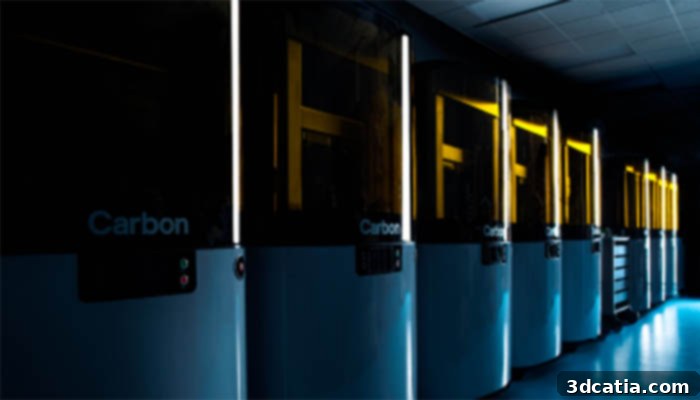
The Carbon L1 3D printer | Credits: Carbon
The Future of Luxury Automotive Manufacturing
The collaboration between Carbon and Lamborghini is more than just a partnership for specific parts; it’s a blueprint for the future of luxury automotive manufacturing. By embracing additive manufacturing technologies like DLS, Lamborghini is not only enhancing its current vehicle lineup but also positioning itself at the forefront of innovation. The ability to rapidly prototype, iterate, and produce end-use parts with exceptional quality and speed means that future Lamborghini models could feature an even wider array of additively manufactured components, pushing the boundaries of design, performance, and customization.
As we look forward, the potential for further integration of 3D printing in high-performance vehicles is immense. From custom interior components and lightweight structural elements to highly optimized aerodynamic features, the opportunities are boundless. This partnership serves as a powerful testament to the transformative potential of digital manufacturing, proving that it can move beyond mere prototyping to full-scale production of critical, high-value components in the most demanding industries. The automotive sector, particularly the luxury and performance segments, stands to gain significantly from these advancements, enabling faster development cycles, greater design freedom, and ultimately, superior products for discerning customers.
We eagerly anticipate witnessing the next innovations that will emerge from the continued synergy between Lamborghini and Carbon. You can find more comprehensive information about Carbon’s technologies and solutions HERE.
What are your thoughts on the groundbreaking collaboration between Carbon and Lamborghini? Do you believe additive manufacturing will become standard in luxury car production? Share your insights and comments below, or engage with us on our Facebook and Twitter pages! Don’t miss out on the latest advancements in 3D printing; sign up for our free weekly Newsletter here, delivering the most important industry news straight to your inbox!