
Revolutionizing Marine Technology: U.S. Navy Patents Biodegradable 3D Printing Polymer for Sustainable Ocean Operations
In a groundbreaking development poised to transform underwater exploration and defense, TechLink, the authorized intermediary for the U.S. Department of Defense, has announced a significant milestone. Scientists with the U.S. Navy have been granted an extensive 20-year patent for a pioneering 3D printable material. This innovative substance is crafted from a marine-based biodegradable polymer, ingeniously engineered to degrade over a precisely controlled period when deployed in the ocean. This advancement holds immense promise for various sectors, particularly within marine technology, offering an eco-friendly and economically viable alternative to existing solutions.
The implications of this invention are far-reaching. Imagine crucial equipment, strategically left in the vast expanses of the ocean, designed to simply break down without leaving harmful traces. This concept addresses a critical environmental challenge posed by conventional underwater devices. Many potential applications immediately come to mind, with autonomous underwater vehicles (AUVs) and unmanned underwater vehicles (UUVs) standing out. These vehicles, often tasked with housing and deploying sensitive oceanic sensors, cameras, and other electronic gear, could now be manufactured for single-use or to operate for a specific duration before naturally degrading. This eliminates the current problematic scenario where many such vehicles are either abandoned on the ocean floor, contributing to marine pollution, or necessitate costly and logistically complex retrieval missions.
The current practice of abandoning or retrieving underwater equipment presents a dual challenge: it is environmentally detrimental and financially burdensome. Abandoned vehicles, often made of non-biodegradable materials, become persistent pollutants, disrupting marine ecosystems and posing hazards to marine life. Conversely, the missions to retrieve these assets are expensive, requiring specialized vessels, skilled personnel, and significant operational costs. The new biodegradable material offers a compelling solution to both dilemmas, promising a future where marine operations are not only more sustainable but also more efficient and cost-effective. This innovative material was conceptualized and developed by an ingenious team: Josh Kogot, Ryan Kincer, and April Hirsch, operating within the Naval Surface Warfare Center’s Biotechnology Research and Development Lab. Their pioneering work has now been officially recognized and protected by this crucial patent.
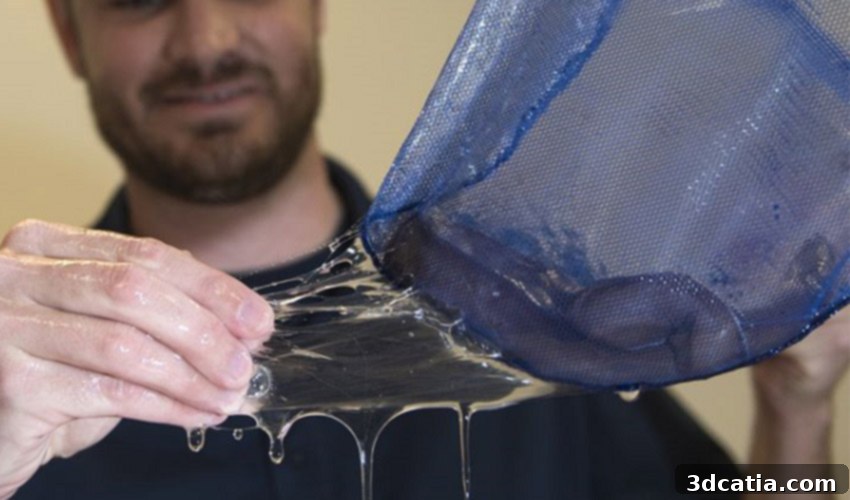
The scientific ingenuity behind this material lies in its sophisticated composition. The inventors meticulously tweaked a combination of specialized polymers, augmenting them with an agar gelling agent. Agar, a natural polysaccharide, is traditionally sourced from the cell walls of certain species of red algae, known for its gelling properties. What truly sets this material apart, however, is the incorporation of biological elements, such as the synthetic hagfish slime that the same lab famously developed. It is these carefully integrated microorganisms or enzymes that are pivotal to the biodegradation process. Upon deployment, these biological components begin to feed on the biodegradable polymers that form the structure of the equipment, orchestrating its controlled breakdown. This precise control over the degradation rate is the core innovation, as articulated in the patent itself: “There is currently no known way to design and produce these structures so that their rate of degradation can be controlled. There is an unmet need to produce marine biodegradable 3D printable structures for which the rate of degradation of each structure can be selected for a particular mission.”
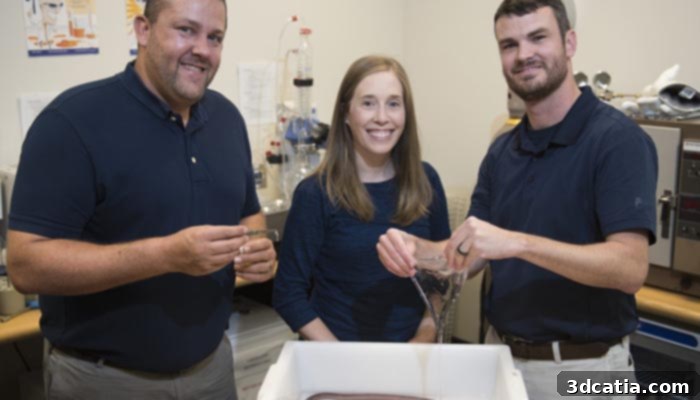
Drs. Josh Kogot, Michelle Kincer, and Ryan Kincer at the Naval Surface Warfare Center in Panama City show the synthetic hagfish slime they developed in 2016
This breakthrough opens up a new realm of possibilities for marine operations. UUVs, for instance, which are indispensable for housing and delivering sensitive electronics like sensors, cameras, and communication devices in harsh marine environments to monitor vast areas of the ocean, can now be constructed with an unprecedented level of control over their lifespan. Imagine deploying a fleet of low-cost, disposable sensors for temporary data collection following a specific event, knowing that they will simply vanish once their mission is complete. This capability not only reduces the ecological footprint of such operations but also offers significant strategic advantages, particularly for covert missions where recovery might be impossible or undesirable. The material’s ability to be 3D printed means that these devices can be custom-designed and manufactured on-demand, tailored to the exact specifications of any given mission, further enhancing operational flexibility.
Beyond UUVs, the potential applications for this biodegradable 3D printing material are vast and varied. Brian Metzger, a senior technology manager at TechLink, eloquently captures the essence of this innovation: “Not only can you 3D print this material into just about anything, but to finely control the rate at which it degrades is really useful. This technology has the potential to cut costs and benefit the environment, it could have many military and commercial applications for all types of underwater equipment.” Consider temporary training devices for naval exercises that safely dissolve, or emergency marine markers that disappear after their purpose is served. This technology could even revolutionize the design of certain fishing gear components, offering a proactive solution to the pervasive problem of ghost fishing, where abandoned nets and traps continue to ensnare marine life. Furthermore, it could pave the way for sustainable temporary infrastructure in marine biology, such as structures for coral reef restoration that naturally degrade once their role is complete.
The economic advantages are as compelling as the environmental benefits. By eliminating the need for costly retrieval missions, navies and commercial entities alike can realize significant savings in operational expenditures, including fuel, personnel hours, and specialized equipment. The ability to mass-produce disposable, mission-specific items opens up new paradigms for deployment and data collection, making formerly prohibitive operations feasible. This innovation also aligns perfectly with global pushes for sustainability and environmentally conscious technology, positioning the U.S. Navy and its partners at the forefront of green marine engineering. As Metzger further highlighted, the new printing material is not limited to UUVs; its versatility extends to any number of underwater applications. The immediate next step in bringing this revolutionary material to wider use is the licensing of the patent, inviting commercial partners to explore and develop its full potential. Detailed information about the patent can be found by following the link HERE.
While the promise is immense, like any novel technology, there are challenges to address. Balancing the desired degradation rate with the structural integrity required for a specific mission is paramount. Further research will be needed to scale production efficiently and cost-effectively, ensuring that the new material remains competitive with traditional alternatives. Furthermore, rigorous testing will be essential to guarantee that the degradation process yields truly harmless byproducts, fully integrating with marine ecosystems without unintended consequences. Despite these considerations, the long-term outlook for this biodegradable 3D printing polymer is exceptionally bright. It represents a significant leap forward in creating a more sustainable and responsible approach to ocean exploration, defense, and research.
This patent is not just about a new material; it’s about a fundamental shift in how we interact with our oceans. It champions a future where technological advancement goes hand-in-hand with environmental stewardship, where critical missions can be accomplished without leaving a lasting negative footprint. The potential for this technology to inspire further innovations in materials science and marine engineering is enormous, promising a cleaner, more accessible, and more sustainably managed marine environment for generations to come. We are eager to hear your thoughts on this groundbreaking marine application of 3D printing technologies. Let us know what you think in a comment below or connect with us on our Facebook and Twitter pages! Don’t miss out on the latest advancements and pioneering research in the world of 3D printing; remember to sign up for our free weekly Newsletter to get all the news straight to your inbox!