
Pioneering 3D Printed Artificial Skin: L’Oréal and University of Oregon Revolutionize Biomedical and Cosmetic Testing
A groundbreaking collaboration between researchers at the University of Oregon and scientists from the globally renowned French skincare giant L’Oréal has achieved a significant scientific milestone: the successful development of an artificial skin model that remarkably replicates the complexity and functionality of natural human skin. This innovative partnership is set to transform multiple industries, addressing the critical need for more accurate, ethical, and efficient testing methods for cosmetics and skincare products, while simultaneously opening vast possibilities for medical applications in tissue regeneration and therapeutic interventions.
This advanced artificial skin, meticulously engineered to mirror the intricate architecture and diverse cellular composition of human integument, is the direct outcome of a novel 3D printing technique. This pioneering method was invented by Paul Dalton, a distinguished professor at the University of Oregon’s Phil and Penny Knight Campus for Accelerating Scientific Impact. Dalton’s innovative approach enables the rapid creation of multilayered, skin-like cell colonies, drastically reducing the development time to an unprecedented 18 days. This speed and precision mark a significant leap forward in the field of tissue engineering, offering a robust platform for both scientific research and practical applications.
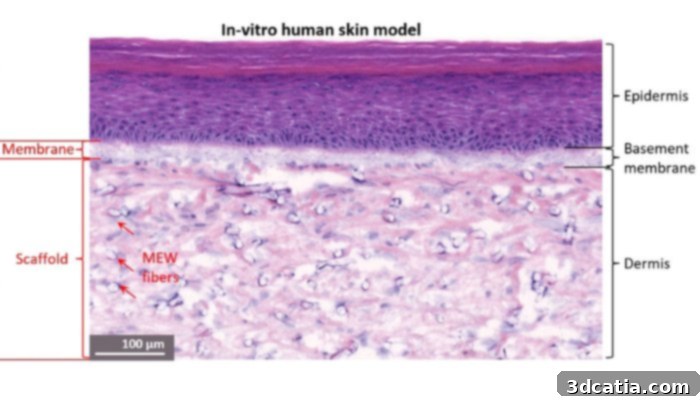
The two-layered artificial skin in-vitro, developed through a novel 3D printing technique. (Photo Credits: Paul Dalton)
A Multi-Layered Approach to Unprecedented Realistic Skin Models
Historically, the quest to accurately replicate human skin in an in-vitro environment has been fraught with immense challenges. The skin’s inherent complexity, characterized by its diverse array of specialized cell types and an intricate extracellular matrix (ECM), makes faithful mimicry extraordinarily difficult. The ECM, a dynamic network of proteins and carbohydrates, is not merely structural; it is fundamentally crucial for facilitating cell communication, growth, and overall tissue function. Previous attempts often fell short, struggling to achieve the necessary realism and functionality required for reliable testing or therapeutic use.
Unlike these prior methods, Professor Dalton’s pioneering technique, developed in collaboration with L’Oréal, achieves an unprecedented level of realism and functionality. To meticulously mimic the intricate, multi-layered structure of human skin, the research teams codeveloped an artificial skin model comprising two distinct layers, thoughtfully separated by a delicate membrane. This architecture directly addresses the complex organization of natural skin, which features an outer epidermis and an underlying dermis, each with unique cellular compositions and functions.
A critical innovation in this process involved the development of specialized plastic scaffolds that closely emulate the extracellular matrix. These scaffolds, meticulously constructed using finely structured 3D printed threads, provide the essential structural foundation and cues for cell growth and organization. The separating membrane plays a vital role, ensuring that distinct cell types within each layer can develop and mature without intermingling, thereby preserving the unique characteristics of each skin layer. This precise control over cellular architecture and environment is what allows Dalton’s technique to achieve such remarkable fidelity to natural human skin.
Commenting on this significant achievement, Professor Dalton remarked, “Other attempts don’t have the same layering—it actually looks like real skin.” Researchers in Dalton’s laboratory have proudly reported that this represents the first successful instance of “replicating quality skin tissue at full thickness,” underscoring the depth and breadth of their scientific breakthrough.
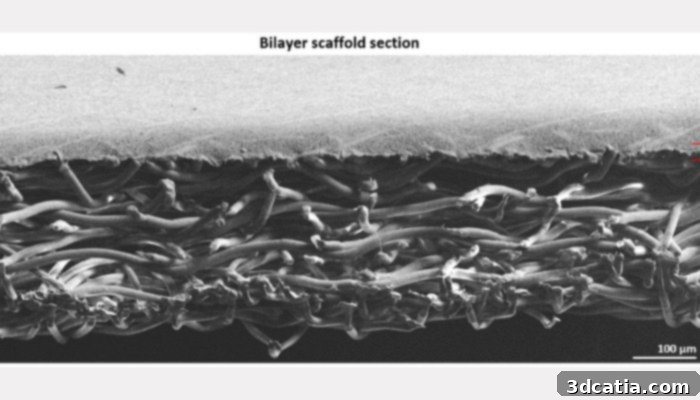
A high-resolution image showcasing a scaffold section within the full-thickness human skin model. (Photo Credits: Paul Dalton)
Melt Electrowriting: The Precision Engine Behind Artificial Skin
The creation of these intricate plastic scaffolds, foundational to the artificial skin model, leveraged a cutting-edge 3D printing technique known as melt electrowriting (MEW). This advanced method, which Professor Dalton had previously played a crucial role in developing, is a high-precision additive manufacturing process increasingly utilized in the medical industry. MEW excels at creating porous macrostructures with exceptionally fine detail from an electrically charged molten polymer. The process involves precisely extruding a polymer melt through a fine nozzle while applying a high voltage, which draws the polymer into incredibly thin fibers that are then precisely deposited layer by layer onto a substrate.
This sophisticated approach provided Dalton and his team with unparalleled control during the printing process. The ability to dictate the exact placement and diameter of each fiber enabled the construction of scaffolds with customized pore sizes and interconnected channels, mimicking the biological microenvironment of the extracellular matrix with remarkable accuracy. This precision was absolutely critical for achieving the necessary structural integrity and biological cues required for cellular growth and differentiation. Furthermore, MEW’s capacity for creating large-scale components without compromising quality proved essential for developing full-thickness skin models that are both robust and biologically relevant, overcoming a significant hurdle faced by other tissue engineering methods.
Transformative Applications for Cosmetics and Medicine
L’Oréal, a global leader in the beauty industry with a strong commitment to ethical innovation and advanced skincare research, plans to integrate this advanced artificial skin model into its rigorous product development and testing protocols. This technology offers a significant step towards reducing and ultimately replacing animal testing, aligning with growing global demand for cruelty-free cosmetic products. By providing a human-relevant testing platform, L’Oréal can more accurately assess the efficacy, safety, and potential irritancy of its wide range of products, leading to the development of safer and more effective skincare solutions for consumers worldwide.
Beyond its profound implications for the cosmetics industry, researchers envision a vast array of potential medical applications for this revolutionary 3D printed skin technology. One promising area is the treatment of chronic wounds, such as diabetic foot ulcers, which affect millions globally and often lead to severe complications, including amputation. The artificial skin could provide a biologically active dressing or graft that promotes faster healing and reduces infection risks. Similarly, it holds immense promise for burn patients, offering a viable alternative to traditional skin grafts, which often require painful procedures from donor sites and carry risks of scarring and rejection. The ability to custom-print skin patches tailored to individual patient needs could significantly improve outcomes and quality of life for burn victims.
Moreover, the versatility and biocompatibility of the scaffold material developed through MEW have sparked extensive discussions regarding its utilization for an even broader spectrum of biomedical applications. Researchers are exploring its potential in creating artificial blood vessels, offering solutions for vascular diseases and bypass surgeries. The finely structured scaffolds could also serve as guides for nerve regeneration, providing a pathway for damaged nerve tissues to regrow and restore function following injuries. This remarkable technological advancement by the University of Oregon and L’Oréal stands to revolutionize not only cosmetic testing but also the entire field of regenerative medicine and tissue engineering, promising innovative solutions for some of humanity’s most pressing health challenges. To delve deeper into the scientific details of this achievement, you can access the full research paper by clicking here.
What are your thoughts on this incredible achievement in 3D printed skin by L’Oréal and the University of Oregon? We invite you to share your insights and comments below, or connect with us on our LinkedIn, Facebook, and Twitter pages! Don’t miss out on the latest advancements in additive manufacturing—be sure to sign up for our free weekly newsletter here, delivering the freshest 3D printing news directly to your inbox! For more visual content, explore all our videos on our dedicated YouTube channel.
*Cover Photo Credits: University of Oregon