
Innovating Sustainability: Upcycling PLA Waste into High-Performance 3D Printing Resins
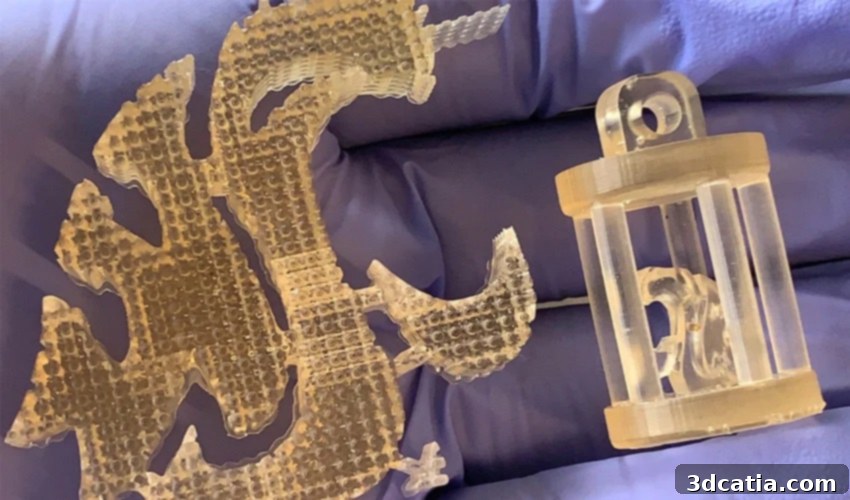
At Washington State University (WSU), a dedicated team of researchers is pioneering a groundbreaking approach to tackle plastic waste through upcycling. This innovative method focuses on transforming products or materials that have reached the end of their initial life cycle into new materials or objects of higher value. Their primary focus in this endeavor is Polylactic Acid, commonly known as PLA, a material widely used in various industries, including the rapidly expanding field of 3D printing. The WSU team has successfully developed a remarkably simple yet highly effective method to convert this ubiquitous polymer waste into high-quality 3D printing resin, thereby enabling the creation of new objects with significantly enhanced value and utility. This breakthrough not only addresses the growing concern of plastic accumulation but also paves the way for a more sustainable future in additive manufacturing, offering a viable second life to materials that would otherwise contribute to environmental pollution.
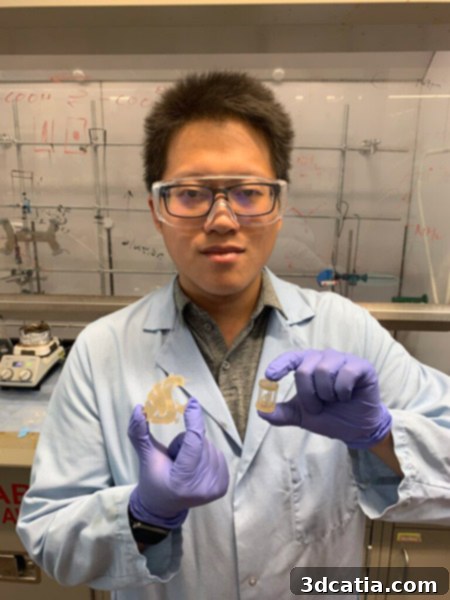
Researchers at Washington State University have successfully developed a 3D printing resin from PLA waste (Photo credits: WSU)
The concept of upcycling is gaining considerable traction globally, reflecting a collective shift towards more sustainable practices. Its synergy with additive manufacturing, or 3D printing, amplifies its potential impact. Three-dimensional printing technologies are inherently ideal for breathing new life into waste materials or objects that have lost their original purpose, allowing for precise material usage and customized product creation. Dr. Yu-Chung Chang and his team at WSU focused their efforts on PLA due to its widespread use and unique properties. While PLA is often touted as a naturally occurring and biodegradable plastic, its environmental credentials are more complex than they initially appear. Dr. Chang highlights a critical nuance: PLA is only able to break down under very specific conditions, which are rarely met in conventional waste disposal environments. He elaborated on this challenge, stating, “It’s biodegradable and compostable, but once you look into it, it turns out that it can take up to 100 years for it to decompose in a landfill. In reality, it still creates a lot of pollution. We want to make sure that when we do start producing PLA on the million-tons scale, we will know how to deal with it.” This statement underscores the urgent need for effective recycling and upcycling solutions, especially as global PLA production continues to escalate.
Understanding the environmental implications of ineffective PLA decomposition, the WSU researchers embarked on developing an innovative recycling method. Their solution is a fast, efficient, and remarkably catalyst-free process for PLA recycling. The fundamental principle behind their method is elegant in its simplicity: they effectively break down the long, complex chains of molecules that constitute the PLA polymer into their basic building blocks, known as monomers. To achieve this molecular deconstruction, the team utilized aminoethanol, an organic compound that is both readily available and relatively inexpensive. This chemical process facilitates the depolymerization of PLA, transforming it back into its monomeric constituents. The entire decomposition process is surprisingly rapid, taking approximately two days, which is a significant improvement over traditional, often energy-intensive recycling methods that can involve more complex chemical inputs or require high temperatures. This efficiency makes the WSU method particularly promising for large-scale industrial application and widespread adoption in the quest for truly circular material economies.
To help illustrate the elegance and effectiveness of their process, the research team employed a compelling and relatable metaphor that resonates with a broad audience. They explained their method with an analogy many can understand:
“If you want to rebuild a Lego castle into a car, you have to break it down brick by brick. That’s what we did. The aminoethanol precision-cut the PLA back to a monomer, and once it’s back to a monomer, the sky’s the limit because you can re-polymerize it into something stronger.”
This analogy perfectly captures the essence of their scientific achievement. Just as Lego bricks can be endlessly reconfigured, the individual monomers recovered from PLA waste serve as versatile building blocks. Once the PLA is returned to this fundamental monomeric state, the possibilities for its re-purposing are vast and exciting. The WSU researchers demonstrated this potential by successfully reconstructing the plastic into a liquid, light-curable form, essentially creating a novel resin. This newly developed resin is fully compatible with stereolithography (SLA) 3D printing, a popular additive manufacturing technique known for its ability to produce highly detailed and accurate parts. The ability to transform waste PLA into a usable SLA resin represents a significant leap forward for sustainable 3D printing. Furthermore, once the manufacturing process using this recycled resin was complete, the team conducted rigorous testing. Their findings indicated that the resulting materials exhibited thermal and mechanical properties that were either equivalent to or, in some cases, superior to those of commercially available resins. This achievement not only validates the effectiveness of their upcycling process but also suggests that recycled PLA can compete, and even surpass, virgin materials in performance, adding significant economic and environmental value to what was once considered waste.
The success with PLA has inspired the WSU team to expand their ambitions, setting their sights on replicating these promising results with Polyethylene Terephthalate (PET). PET is another incredibly common plastic, famously used in packaging like water bottles, and it poses even greater challenges when it comes to effective recycling on a global scale. The sheer volume of PET waste generated worldwide makes it a critical target for innovative upcycling solutions. Successfully transforming PET waste into valuable 3D printing resins or other high-value materials would represent an even more monumental stride towards combating plastic pollution and fostering a truly circular economy. The potential of this research extends far beyond just PLA and PET; it lays the groundwork for a scalable, efficient, and environmentally friendly method for managing various types of plastic waste, offering a beacon of hope for a future where waste materials are viewed not as a problem, but as a valuable resource. The researchers believe that their catalyst-free depolymerization method, initially developed for PLA, could be adapted for other difficult-to-recycle plastics, opening up new avenues for material reclamation and advanced manufacturing. This research highlights the critical role universities play in addressing pressing global environmental issues through scientific innovation and engineering ingenuity. You can find out more about their continued efforts and findings HERE.
What are your thoughts on utilizing PLA waste to develop a high-performance, 3D printable resin? Do you believe this innovative upcycling method could revolutionize the additive manufacturing industry and significantly contribute to global sustainability efforts? We encourage you to share your perspectives and insights in a comment below or join the conversation on our LinkedIn, Facebook, and Twitter pages! Don’t forget to sign up for our free weekly Newsletter here to receive the latest 3D printing news directly in your inbox. You can also explore all our compelling videos and interviews on our YouTube channel for more in-depth content on cutting-edge 3D printing innovations.