
Unlocking Advanced Manufacturing: A Deep Dive into Composite 3D Printing with Industry Experts
Additive manufacturing (AM), commonly known as 3D printing, has revolutionized production across numerous industries by offering unprecedented design freedom and customization capabilities. The range of compatible materials is vast, spanning from traditional thermoplastics to high-performance metals, ceramics, and photosensitive resins. These materials provide a diverse spectrum of properties tailored to the demanding requirements of sectors like aerospace, automotive, and medical. Within the expansive family of polymers, composite materials—specifically, fiber-reinforced plastics—have emerged as game-changers. Available in both powder and filament forms, these advanced materials deliver significantly enhanced mechanical characteristics compared to conventional polymers, including superior rigidity, improved impact resistance, remarkable lightness, and exceptional strength-to-weight ratios. Consequently, an increasing number of companies are integrating composite materials into their additive manufacturing workflows to push the boundaries of performance and design. But how can businesses effectively incorporate composite 3D printing into their production chains? What factors should guide the choice of composite materials? To answer these critical questions, we consulted three leading experts in the field of composite additive manufacturing who shared their invaluable insights.
Our panel of experts begins with François Edy, the technical manager of the Kimya Factory, which represents the additive manufacturing service arm of the ARMOR group. François plays a pivotal role in ensuring the quality of manufactured parts, overseeing production deadlines, and providing expert consultation to clients. His particular focus in this discussion is on composite additive manufacturing using extrusion techniques, specifically highlighting the intricacies of composite filaments. Next, we have Fedor Antonov, the visionary CEO and co-founder of Anisoprint, a pioneering company renowned for its continuous fiber 3D printing solutions. Anisoprint is at the forefront of developing innovative technologies that enable the creation of highly robust and lightweight components. Completing our esteemed panel is Dr. Farbod Nezami, one of the managing directors at CIKONI. CIKONI is a specialized engineering service provider dedicated to lightweight design, with a core expertise in the hybridization of additive manufacturing processes and the strategic integration of load path reinforcements through advanced fiber technologies.
- François Edy
- Fedor Antonov
- Dr. Farbod Nezami
Understanding Composite Materials in 3D Printing
At its core, a composite material is engineered by reinforcing a base material, known as the matrix, with fibers. This synergistic combination imparts significantly enhanced mechanical properties that neither component could achieve on its own. The matrix material is typically a polymer, selected from the vast array available in the additive manufacturing market, such as ABS, Nylon, or PEEK. The integration of fibers results in a hybrid material boasting superior characteristics, most notably increased strength and stiffness. The most prevalent composite materials used in 3D printing are those reinforced with carbon fiber and glass fiber, though other fibers like aramid (Kevlar) are also gaining traction for specialized applications.
Parts manufactured from carbon fiber reinforced plastic (CFRP) are highly valued for their exceptional strength-to-weight ratio. They are incredibly strong yet remarkably lightweight, making CFRP a material of choice across a diverse range of high-performance applications. These include critical components in the aerospace industry, structural parts in automotive manufacturing, and high-end sporting goods where performance and weight reduction are paramount. In contrast, glass fiber reinforced plastics (GFRP) offer a different set of advantages. While not quite as robust as CFRP in terms of ultimate tensile strength, GFRPs exhibit excellent chemical resistance and superior dielectric properties, making them ideal for applications in the electrical industry, marine environments, and certain structural components where cost-effectiveness and good insulation are required.
A crucial distinction within composite materials for 3D printing lies in the type and length of the reinforcing fibers, which profoundly impact both the printing process and the final mechanical properties of the part. Fibers can be categorized into short fibers, long fibers, or continuous fibers. Short fibers, typically a few millimeters in length, are pre-mixed directly with the base polymer pellets or powder to create a composite filament or powder. This composite material is then extruded by a standard Fused Deposition Modeling (FDM) machine, much like printing with unreinforced thermoplastics. Continuous fibers, on the other hand, are deposited simultaneously with the matrix material during the printing process. This method requires specialized 3D printers equipped with multiple nozzles and advanced deposition mechanisms to ensure proper fiber alignment and impregnation. Understanding the fundamental differences between short and continuous fibers is paramount for selecting the appropriate material for a specific application.
Compared to short-fiber-reinforced materials, which can be readily processed by modifying conventional thermoplastic printing, continuous-fiber composites present a more complex and often more costly production challenge. However, this increased complexity is justified by the significantly higher stability and superior mechanical performance they achieve. Traditionally, continuous fiber composite components are manufactured using labor-intensive methods that often involve manual layer-by-layer layup, requiring expensive molds and extensive curing equipment. Additive manufacturing, particularly with dual-nozzle systems, offers a transformative advantage by automating this process, drastically reducing lead times and eliminating the need for costly tooling, thus making high-performance composite parts more accessible.
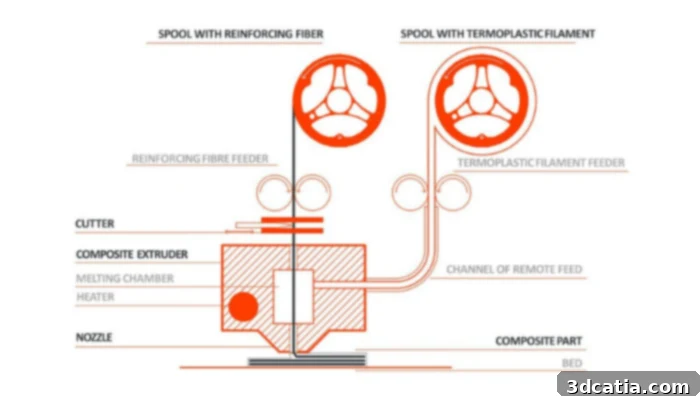
Printing with continuous fiber filaments needs to meet additional requirements (photo credits: Anisoprint)
Critical Criteria for Successful Composite 3D Printing
Integrating composite materials into a 3D printing workflow demands careful consideration of several key criteria. For short fiber composites, the barrier to entry is relatively low. As François Edy from Kimya Factory explains, “Short fibers are more common in additive manufacturing and will print on any FDM machine. However, make sure you have a steel nozzle because composites are abrasive.” This seemingly minor detail is critical, as the embedded fibers can quickly wear down standard brass nozzles, leading to inconsistencies and print failures. Dr. Farbod Nezami from CIKONI further emphasizes that material properties dictate machine selection, stating, “users should understand that processing requirements are determined by both the selected fiber and the matrix materials. Considering that there is an extremely wide range of available materials for both, he mentioned that composites should be printed on adapted systems.” This highlights the importance of matching the printer’s capabilities to the specific composite formulation for optimal results.
When transitioning to continuous fiber composites, the technical demands escalate significantly. While most FDM machines can handle short fiber composites with some modifications, they are generally unsuitable for continuous fiber printing. Fedor Antonov of Anisoprint firmly believes that while short fiber reinforced plastics can be printed using FDM printers, this type of machine is not designed for continuous fibers. He stresses the necessity of investing in a specialized 3D printer specifically engineered to deposit continuous fibers precisely, impregnate them with the matrix, and cut them to the required lengths. These specialized machines ensure proper fiber alignment and a robust bond between the fiber and the matrix, which are crucial for achieving the superior mechanical properties associated with continuous composites.
Beyond machine capabilities, the orientation of the printed part within the build chamber is a paramount factor that directly influences the final mechanical performance. François Edy elaborates, “The orientation of your part is important: the carbon fibers are deposited in the direction of extrusion, so you will have better mechanical resistance in the direction of the nozzle.” Dr. Farbod Nezami strongly concurs, emphasizing that “it is primarily the orientation of the fiber that determines the engineering-relevant characteristics. From strength to thermal expansion, there is a large anisotropy – that is, a directional dependence of the properties.” This anisotropic behavior means that a part’s strength, stiffness, and thermal stability will vary depending on the direction of applied load relative to the fiber orientation. According to Nezami, designers working with fiber composites must first define the required properties in specific directions to effectively design the composite structure and maximize its performance.
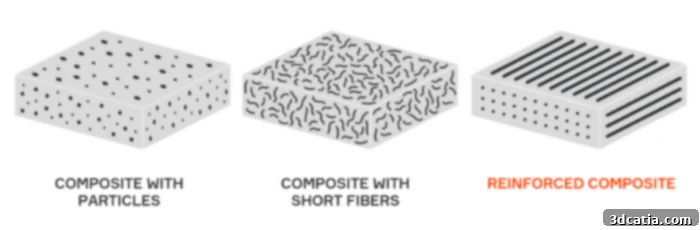
The differences between composites with short fibers and long fibers (photo credits: Anisoprint)
Fedor Antonov further elucidates this point, distinguishing between short and continuous fiber behavior: “The main difference is that continuous fibers are always oriented, while short fibers are distributed randomly within the polymer. Orienting fibers allows the fiber properties to focus in one direction, while a random mixture dissolves the properties in every direction. That’s why continuous fiber reinforced composites have extremely high properties in the direction of the fibers and short fiber reinforced polymers have fairly modest properties in all directions.” This fundamental difference underscores why continuous fiber composites offer superior performance when designed with a clear understanding of load paths and directional requirements. Antonov also highlights the importance of employing specialized design approaches for composite parts, differing significantly from traditional metal or plastic designs, to fully leverage their inherent high properties. He advises, “The best results will be obtained for the parts or structures that have certain dominant force directions applied to them. There are also several other physical limitations such as relatively low operating temperatures (up to 150 °C) and low surface hardness, which leads to severe wear in certain frictional applications.” This calls for careful application assessment and material selection.
The Advantages and Limitations of Composite 3D Printing
Composite 3D printing inherits many of the compelling advantages of “classic” additive manufacturing, including accelerated production times, significant material reduction through optimized geometries, and the unparalleled ability to customize parts with complex designs. However, it distinguishes itself profoundly through its capacity to dramatically enhance a part’s intrinsic properties, whether concerning mechanical strength, stiffness, or temperature resistance. The core differentiator lies in its ability to selectively reinforce components, allowing engineers to tailor strength and performance precisely where needed. Furthermore, the designer can choose the type of reinforcement—isotropic (uniform in all directions, often with short fibers) or anisotropic (directional, like with continuous fibers)—depending on the specific application’s demands. François Edy confirms this, stating that “the use of carbon fiber greatly improves the rigidity of the part.” He also points out that other composite materials, such as wood-filled filaments, can provide unique aesthetic and tactile properties for consumer goods or architectural models, expanding the versatility of composite AM beyond purely functional components.
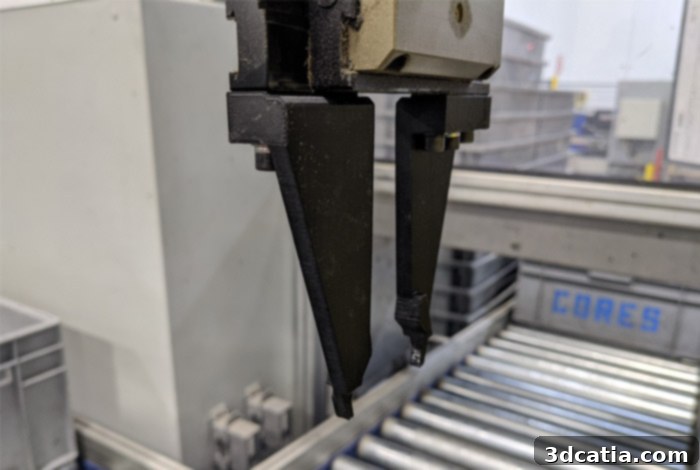
A 3D printed part in Kimya ABS Carbon, installed on an ARMOR USA production line (photo credits: Kimya)
The advantages of composite 3D printing are particularly striking with continuous fiber reinforced composites, as highlighted by Fedor Antonov. He notes that this technology “enables production of parts that are several times lighter than metal counterparts given the same operational conditions.” This weight saving is a critical benefit for high-performance applications in industries such as aerospace, robotics, sports, and healthcare. Lighter parts translate directly into substantial operational efficiencies: reduced energy consumption for propulsion or movement, lower transportation costs, and ultimately, higher quality and more efficient end products. For instance, in aerospace, even a slight weight reduction can lead to significant fuel savings over an aircraft’s lifespan, while in robotics, lighter components allow for faster movements and increased payload capacity.
Looking to the future, Dr. Farbod Nezami expresses optimism regarding the rapid advancement of this technology. He anticipates significant developments in the use of 3D-printed composites over the coming years, particularly in terms of increasing part size, enhancing productivity, and achieving even higher mechanical performance. This projected growth is corroborated by market analyses, such as one from SmarTech, which forecasts a substantial 22.3% increase in the global market for composites within the next five years. This indicates a strong industry trend towards greater adoption and innovation in composite additive manufacturing.
Despite its numerous advantages, composite 3D printing also presents certain limitations. While continuous fibers offer superior performance, they introduce a higher level of complexity into the manufacturing process compared to short fibers. François Edy explains that continuous fibers adhere to “more restrictive rules and present need more technical considerations in terms of slicing and nozzle trajectory.” This requires advanced software and highly skilled operators to ensure proper fiber placement and avoid defects. This inherent complexity underscores why intelligent design is so crucial. In Fedor Antonov’s words, “Obviously the right design is the key to unlocking the high properties of 3D printed composites. Such design approaches as fiber reinforced lattices, fiber steering, local reinforcements would give the best results. It is also important to distinguish which parts are fit for design with composites based on the shape and the loading conditions.” Without optimized designs that account for anisotropy and fiber orientation, the full potential of continuous fiber composites cannot be realized. Other limitations can include relatively higher material costs for specialized filaments and, in some cases, challenges with post-processing due to the material’s inherent strength and toughness.
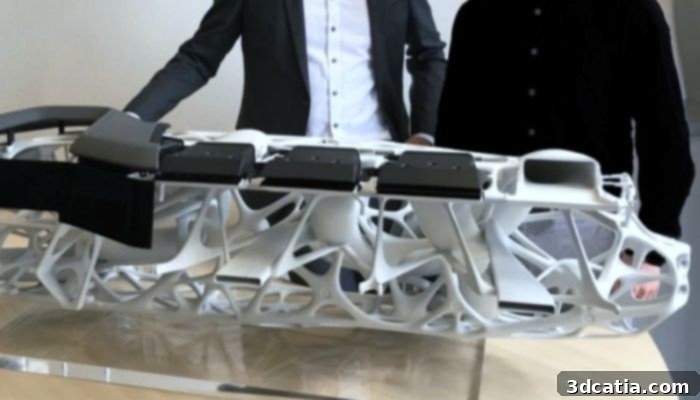
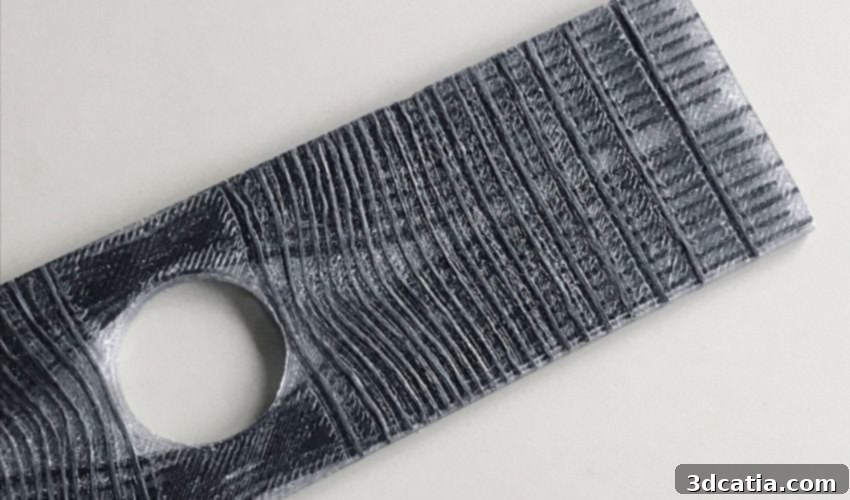
Composite materials can be used to produce strong yet lightweight components in 3D printing (photo credits: CIKONI)
Overall, there is a strong consensus among experts that fiber-reinforced materials, when integrated with 3D printing, empower the production of parts that are remarkably strong, rigid, and lightweight. Additive manufacturing further enhances this capability by offering rapid and cost-effective production, particularly for intricate geometries and customized components. While manufacturing with short fiber reinforced materials provides greater technological flexibility and cost-effectiveness for many 3D printing applications due to their simpler integration into the polymer matrix, they generally cannot compete with the peak performance offered by continuous fiber composites. Ultimately, the optimal choice of composite material—and the corresponding printing strategy—hinges entirely on the specific application’s performance requirements, budget constraints, and desired mechanical properties.
A Few Last Words of Advice from Our Experts:
“I would advise you to test more traditional materials first. Then switch to FDM with short fibers because the printing process is similar. In fact, in some cases, composite 3D printing is even easier to implement, depending on your base matrix.” –François Edy
“Think hybrid. Our requirements in the industrial environment are now so advanced that very few challenges can be slain by one material or one manufacturing process. I’m convinced that we’re still in the very early stages of additive manufacturing hybridization.” -Dr. Farbod Nezami
“Printing with composite materials is the newest big trend in AM and it might be challenging, but the benefits you can get are impressive. Parts can be made easily 2-3 times lighter compared to metal-made at a fraction of a cost, but certain knowledge and expertise is required to succeed. Lightweighting helps to significantly save resources at every stage of the lifecycle – lighter structures means less resources for production, lower energy consumption during transportation, end-use, and recycling.” -Fedor Antonov
Do you currently utilize composite 3D printing in your operations, or are you considering its adoption? We invite you to share your experiences and insights in a comment below! Connect with us on our Linkedin, Facebook, and Twitter pages to join the conversation. Don’t miss out on the latest advancements in 3D printing – sign up for our free weekly Newsletter here, delivering the most pertinent news directly to your inbox! For visual content and deeper dives into the world of additive manufacturing, explore all our videos on our dedicated YouTube channel.