
Unlocking the Future: Top 5 Groundbreaking 3D Printing Innovations This Week
This week, we delve into the most exciting advancements in 3D printing technology and explore how additive manufacturing is fundamentally reshaping various production processes and industries. From high-performance automotive components to life-changing medical devices and revolutionary consumer products, 3D printing continues its relentless infiltration across numerous sectors. The versatility and precision offered by these innovative technologies are pushing the boundaries of what’s possible, enabling new designs, materials, and efficiencies that were once unimaginable. This carefully curated selection highlights some of the most impactful and inspiring innovations we’ve discovered recently, demonstrating the dynamic evolution of this field. We invite you to explore these captivating developments and stay abreast of the rapid progress defining the future of manufacturing. For those eager to dive deeper, an extensive collection of 3D printing videos awaits on our YouTube channel. Get ready to be inspired and have a fantastic Sunday!
The transformational power of 3D printing lies not just in its ability to create complex geometries, but in its capacity to optimize performance, reduce waste, and accelerate product development cycles. Each story below exemplifies a unique facet of this power, showcasing how designers, engineers, and researchers are harnessing additive manufacturing to solve real-world problems and introduce groundbreaking solutions. From enhancing vehicle performance to improving patient comfort and streamlining industrial workflows, these examples paint a vivid picture of a future shaped by intelligent design and advanced fabrication techniques.
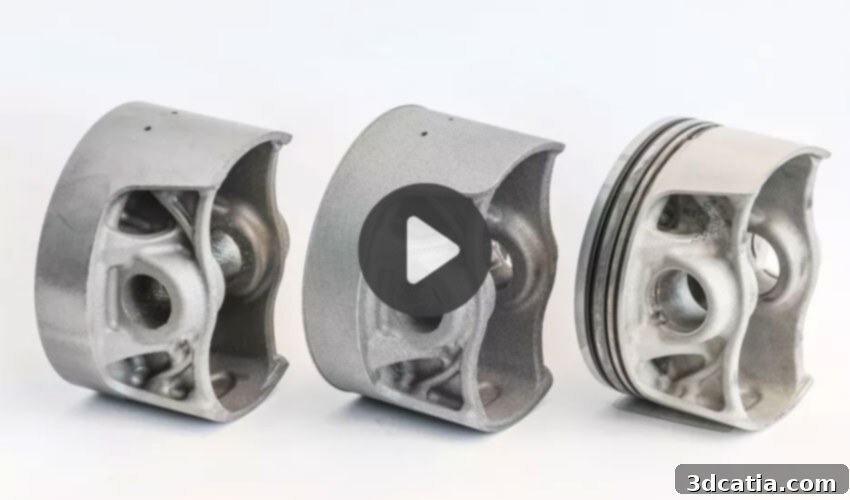
Top 1: Porsche Pioneers 3D Printed Pistons for Enhanced Performance
In a monumental leap for the automotive industry, Porsche has announced a pioneering application of additive manufacturing: the production of pistons for the formidable high-performance engine of the Porsche 911 GT2 RS. This marks a significant milestone, as it’s the first time such critical, high-stress components are being fabricated using 3D printing for series production, even if limited. The adoption of additive manufacturing allows Porsche to engineer pistons with an intricately optimized internal structure, specifically tailored to withstand and perform under extreme loads.
The advantages of this innovative approach are substantial. The new 3D printed pistons are an impressive ten percent lighter than their conventionally manufactured counterparts. This reduction in weight directly contributes to improved engine dynamics, allowing for quicker acceleration and potentially higher RPMs. Furthermore, the customized internal lattice structures achievable through 3D printing result in significantly higher stiffness. This increased rigidity enhances the piston’s durability and resistance to deformation under the intense pressures within an engine cylinder, ultimately boosting overall engine efficiency and longevity. This development underscores how 3D printing is not just for prototyping but is increasingly becoming a viable solution for producing robust, performance-critical parts in demanding sectors like luxury automotive manufacturing. It opens new avenues for lightweighting and performance optimization across the entire vehicle.
Top 2: Superstrata Introduces the Revolutionary 3D Printed Unibody Bike
Innovation in personal mobility has taken a significant leap forward with Arevo and Superstrata’s unveiling of their new 3D printed unibody bicycles. These bikes are truly unique, not only in their strikingly minimalist design but also in their unparalleled properties and construction. By ingeniously utilizing carbon fiber reinforced thermoplastics, Superstrata has engineered a bicycle that boasts extreme impact resistance while remaining remarkably lightweight. According to the company, a single Superstrata bike weighs less than two standard water bottles, coming in at an astonishing 1.3 kg – a feat that redefines expectations for high-performance bicycles.
Beyond its impressive strength-to-weight ratio, the Superstrata bike leverages advanced Directed Energy Deposition (DED) 3D printing technology to offer an unprecedented level of customization. Each frame can be meticulously custom-produced to perfectly fit the individual rider’s body type and preferences. This bespoke manufacturing process eliminates the need for joints or welds, resulting in a true unibody construction that enhances both aesthetic appeal and structural integrity. This level of personalization, combined with the superior material properties, positions the Superstrata bike as a game-changer for cyclists seeking optimal performance, comfort, and a truly tailored riding experience. It exemplifies how additive manufacturing can deliver consumer products that are both high-tech and deeply personal.
Top 3: Automating Post-Processing for Industrial Metal Additive Manufacturing
While the spotlight often shines on the marvels of 3D printing itself, one critical yet frequently overlooked stage of the additive manufacturing process is post-processing. Particularly for metal additive manufacturing (AM), post-processing is an extremely vital and often labor-intensive step that can significantly impact the final part’s quality, performance, and cost. It involves a range of operations from support removal, surface finishing, and heat treatment to inspection, and it’s far from easy to execute consistently and efficiently on a large scale.
Recognizing this bottleneck in industrial adoption, a significant two-year research and development project was undertaken by Inspire AG, ETH Zurich, and Gressel. Their ambitious goal was to automate the post-processing workflow for metal AM components. The challenges are numerous, including handling complex geometries, varying material properties, and ensuring repeatable results. By automating these tasks, manufacturers can expect to see dramatic improvements in throughput, reduced manual labor costs, enhanced safety, and greater consistency in part quality – all essential factors for scaling metal AM into mainstream industrial production. The results of this collaborative endeavor promise to unlock new levels of efficiency and cost-effectiveness in additive manufacturing, making it a more attractive option for high-volume, high-value metal part fabrication. The video below showcases the innovative solutions and the remarkable progress made in streamlining this crucial manufacturing phase, proving that the future of 3D printing is as much about the finishing touches as it is about the initial print.
Top 4: The Revolutionary 3D Printed Cast for Enhanced Patient Comfort
The medical field is continually being transformed by 3D printing, and a prime example of this is the development of a new additively manufactured cast. This innovation offers a stark contrast to traditional plastic casts, which are notorious for being heavy, uncomfortable, and severely restricting airflow to the skin, often leading to irritation and discomfort. The new 3D printed cast, developed by a Hungarian IT expert, addresses these long-standing issues with remarkable ingenuity. It is crafted entirely from biodegradable plastic, aligning with growing demands for sustainable healthcare solutions, and is significantly lighter than conventional casts, thereby improving patient mobility and comfort.
Perhaps its most significant advantage is its open, lattice-like structure, which allows the skin to breathe freely. This dramatically reduces issues like sweating, itching, and skin maceration, enhancing overall hygiene and patient well-being during the healing process. Already in use at a hospital in Budapest, this innovative medical device has garnered positive feedback. The hospital’s chief medical officer praises the new cast for its superior patient comfort and its efficiency. It can be printed in approximately one hour, a considerable reduction compared to the time-consuming process of fitting traditional casts. Furthermore, its approximate cost ranges from 50 to 100 euros, making it a cost-effective alternative that delivers superior patient outcomes. This development highlights the immense potential of 3D printing to revolutionize patient care by providing customized, comfortable, and efficient medical solutions.
Top 5: Advancements in Powder Bed Deposition and Metrology at Oak Ridge National Laboratory
To truly push the boundaries of additive manufacturing, foundational research into core technologies and rigorous validation methods are essential. Material Scientist Mike Kirka from Oak Ridge National Laboratory provides an insightful overview of the powder bed manufacturing and metrology capabilities housed within the Department of Energy’s Manufacturing Demonstration Facility. Powder bed fusion (PBF) is a crucial 3D printing process, widely used for producing high-precision, complex metal and polymer parts, by selectively fusing powdered material layer by layer.
The facility at Oak Ridge is at the forefront of exploring and refining these technologies, engaging in vital industrial collaborations with leading machine manufacturers such as GE Additive. These partnerships are critical for transitioning cutting-edge research into practical industrial applications. Mr. Kirka candidly discusses some of the inherent challenges faced in this advanced field, particularly in the areas of qualifying and certifying additively manufactured components. Unlike traditional manufacturing methods, 3D printing often introduces novel material behaviors and microstructures, necessitating new standards and rigorous testing protocols to ensure reliability and performance in critical applications. Overcoming these hurdles through advanced metrology – the science of measurement – and robust qualification processes is paramount for the widespread adoption of additive manufacturing in demanding sectors. The work at Oak Ridge underscores the importance of ongoing research and collaboration in maturing 3D printing into a fully industrialized and trusted manufacturing paradigm.
These five groundbreaking videos offer just a glimpse into the dynamic and ever-evolving world of 3D printing. From revolutionizing high-performance automotive parts and personalized consumer goods to streamlining medical care and industrial processes, additive manufacturing is clearly at the forefront of innovation. The advancements in materials, process automation, and quality control are continually expanding the horizons of what this technology can achieve. We hope you found these insights compelling and informative. What were your favorite innovations from this week’s selection? We encourage you to share your thoughts and insights by dropping a comment below or engaging with us on our Facebook and Twitter pages! To ensure you never miss out on the latest news and developments shaping the 3D industry, don’t forget to sign up for our free weekly Newsletter, delivered straight to your inbox.