
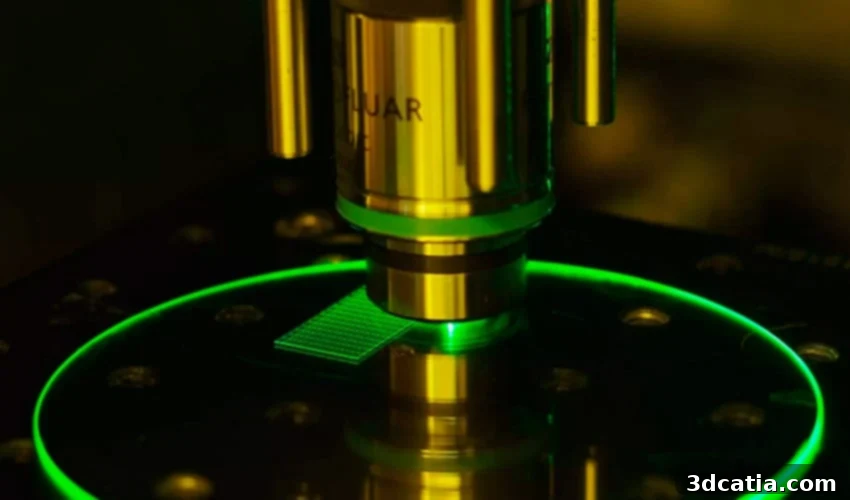
Two-Photon Polymerization (2PP): Revolutionizing Micro and Nanoscale 3D Printing
The advent of nano- and microscale 3D printing has ushered in an era of unprecedented design freedom and manufacturing efficiency. This advanced form of additive manufacturing is rapidly catalyzing pioneering innovations across a multitude of sectors, most notably in the demanding fields of micro-optics and micromechanics. These groundbreaking achievements, in turn, become the fertile ground for new technological developments, propelling forward the frontiers of scientific and industrial progress. Consequently, the commercialization of sophisticated 3D printing techniques capable of producing these intricate micro- and nano-objects has surged dramatically in recent years. Among these cutting-edge processes, Two-Photon Polymerization (2PP) stands out as one of the most pivotal and versatile.
Often referred to simply as 2PP, this innovative technology is also known by several other names within the scientific and industrial communities, including two-photon lithography, direct laser writing, and sometimes even two-photon polymerization graphene when specific materials are involved. 2PP is fundamentally categorized under the umbrella of microscale 3D printing and is widely regarded as an advanced additive manufacturing technology. Its foundational principles were first established and developed by a pioneering team comprising Shoju Maruo, Osamu Nakamura, and Satoshi Kawata at Osaka University in Japan, back in 1997. Since then, numerous companies and research institutions globally have dedicated efforts to further developing and refining this technology, subsequently bringing their sophisticated equipment to market under a variety of patented names and proprietary systems. These ongoing advancements underscore 2PP’s critical role in shaping the future of high-precision manufacturing and miniature component fabrication.
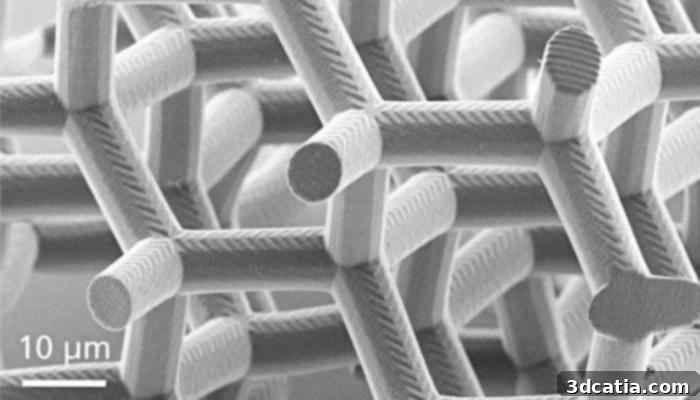
A 3D printed microstructure: two-photon polymerization can be used to produce complex structures at the micro- and nanometer scale (photo credits: Fraunhofer ISC)
How Does Two-Photon Polymerization Work? The Science Behind the Precision
At its core, two-photon polymerization, as the name inherently suggests, operates on the fundamental principle of photopolymerization. This process involves the targeted exposure of a light-sensitive material, typically a synthetic resin, to light. This light exposure initiates a polymerization reaction, a chain reaction where individual monomer molecules link together to form long, robust polymer chains. This molecular bonding causes the material to solidify and harden, ultimately forming a desired 3D model. While all light-curing processes share this basic mechanism, they differ significantly in the specifics of how the light interacts with the material and the methodology of hardening.
To understand 2PP more deeply, it’s often helpful to compare it with stereolithography (SLA), another prominent resin-based 3D printing technology. In SLA, a laser beam is used to selectively harden liquid resin point by point, building an object layer by layer. The crucial distinction between SLA and 2PP lies in the precise interaction of light (photons) with the photopolymer resin. In traditional stereolithography, polymerization is typically achieved by the absorption of a single photon of light, usually from a UV laser, which has enough energy to initiate the curing process. In two-photon polymerization, however, a different approach is taken, utilizing visible or infrared laser radiation.
The name “two-photon polymerization” itself is derived from the unique mechanism by which the material solidifies. Instead of a single photon, 2PP relies on the simultaneous absorption of *two* photons by a light-sensitive molecule within the resin. While individually, these lower-energy photons (e.g., from infrared light) would not possess enough energy to initiate polymerization, their simultaneous absorption effectively sums their energies, providing the necessary activation energy. This non-linear optical process means that the activation of the resin molecules, and thus the hardening, only occurs where the laser intensity is extremely high. The intensity of the laser beam reaches its maximum at the precise center of the focal spot, often referred to as a “voxel.” This ensures that two-photon absorption predominantly takes place only within this tiny, highly localized volume, allowing for unparalleled precision.
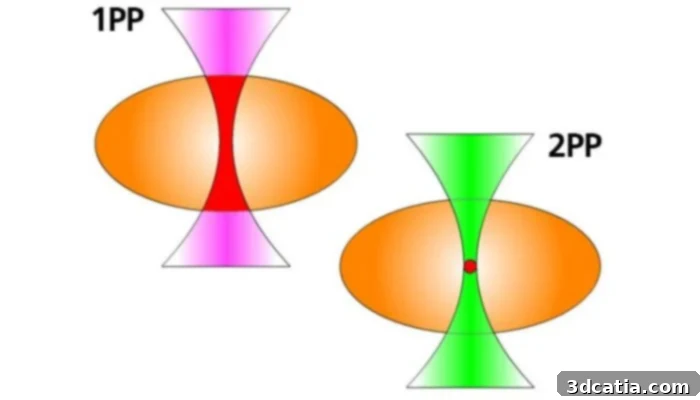
Two-photon polymerization utilizes the effect of two-photon absorption. (Credits: Fraunhofer ISC)
To achieve this effect with a sufficiently high probability, the laser beam employed in 2PP must possess extremely high intensity. This is typically accomplished using ultrashort pulsed lasers, often femtosecond lasers, which emit pulses lasting only a few quadrillionths of a second. While the average power of these lasers can be relatively low, their peak power during each pulse is incredibly high, concentrating immense energy within a tiny temporal window. This high peak power is critical for generating the photon density required for two-photon absorption at the focal point without causing bulk curing of the surrounding resin. Normally, the longer wavelengths used (e.g., infrared) would not be absorbed by the resin, allowing the beam to pass harmlessly through the material. However, the extreme focusing and the nature of the ultrashort pulse irradiation induce the two-photon absorption effect precisely within the focal volume. This unique phenomenon ensures that curing is strictly confined to this minute focal volume, enabling the creation of extraordinarily complex 3D microstructures and nanostructures that would be impossible with conventional methods due to the diffraction limit of light.
The localized nature of the curing process is a defining characteristic of 2PP. The resin reacts and solidifies exclusively at the laser beam’s focal point. Crucially, the laser beam can be directed through multiple layers of the liquid resin without affecting the material outside the focus. This means that only the desired specific spot, irrespective of its depth within the resin vat, is cured. Computer-controlled guidance systems precisely manipulate the laser’s focal point, allowing 3D structures to be “written” point-by-point, giving rise to the alternative name “laser direct writing.” This meticulous process ensures that both the strong laser focus and the intense laser power are decisive factors in achieving the solidification of complex structures with diameters down to the nanometer scale. After the exposure phase, a crucial post-treatment step involves immersing the printed part in a solvent. This solvent effectively dissolves and washes away all the unexposed, liquid resin, leaving behind only the solidified, highly precise 3D-printed structure. The final parts produced using 2PP boast exceptionally high precision and resolutions often less than 25 nanometers, setting a benchmark for additive manufacturing at these minute scales.
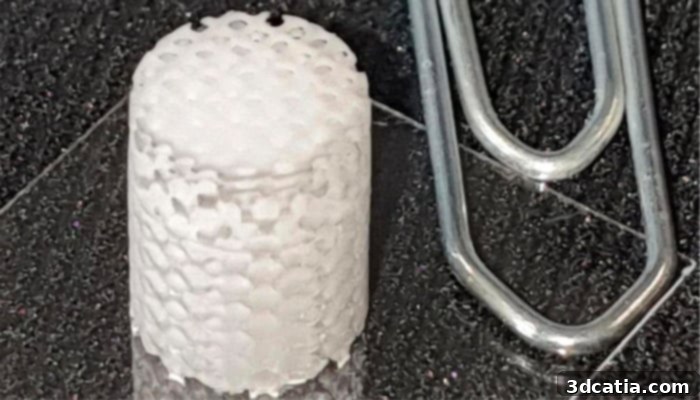
In two-photon polymerization, the laser “writes” a structure and pattern in the liquid resin. (Credits: Heidelberg Instruments)
While 2PP offers unparalleled resolution, it is important to acknowledge its inherent trade-offs, particularly regarding production time. The exquisite precision and the point-by-point curing mechanism, while enabling intricate geometries, translate into a relatively long production time, especially for macroscopic prints. This makes the 2PP process generally more suitable and economically viable for producing extremely small objects of limited mass, where the value of precision far outweighs the speed of fabrication. For larger-scale applications, other additive manufacturing technologies are typically preferred.
Despite this limitation, in the micro and nano ranges, two-photon polymerization has opened up a vast array of new applications and possibilities. One of its most significant advantages is the absence of design restrictions; virtually any arbitrary, complex 3D structure can be produced at these minute scales. The scalability of 2PP is impressive, ranging from structures as small as 100 nanometers up to several centimeters. Furthermore, unlike many conventional additive manufacturing techniques that rely strictly on layer-by-layer fabrication, 2PP benefits from an inherent volumetric process where specific spots within the resin are polymerized, allowing for truly free-form 3D construction without limitations imposed by layer adhesion or stair-stepping effects.
Compatible Materials and Notable Applications: Expanding the Horizons of Innovation
The versatility of two-photon polymerization is perhaps best exemplified by its diverse areas of application, primarily those demanding the highest possible precision in the tightest of spaces. A prime example is the field of micro-optics, where 2PP is revolutionizing the manufacturing of components such as intricate fiber ends for advanced microscopy, highly efficient microlenses for imaging and sensing, waveguides, and even complex photonic crystals. In micromechanics, the process is instrumental in fabricating incredibly small and precise chips, micro-gears, actuators, and miniature sensors. Beyond these, 2PP is also extensively utilized in the production of numerous microelectronic components and sophisticated microfluidic devices, which are critical for lab-on-a-chip technologies and various analytical systems.
Another rapidly expanding and profoundly impactful field of application for 2PP is the medical sector. Here, the technology’s ability to create structures at the cellular and subcellular level is transformative. 2PP can be precisely used to create custom-designed scaffold structures that provide a biomimetic environment for cell growth, thereby initiating and guiding tissue formation for regenerative medicine. It is also being explored for highly localized implants at the cellular or molecular level. For instance, sophisticated drug delivery systems, meticulously designed to release therapeutic agents at specific rates and locations within the body, can be produced with unmatched precision. The potential to produce implants based on a patient’s own tissue or to micro-imprint patient-specific material is particularly exciting, as it significantly limits rejection reactions and could, in the near future, alleviate the persistent shortage of donor implants. Thus, two-photon polymerization is not merely a manufacturing tool; it is a catalyst for major advancements across countless sectors, especially in healthcare, driving critical progress and innovation.
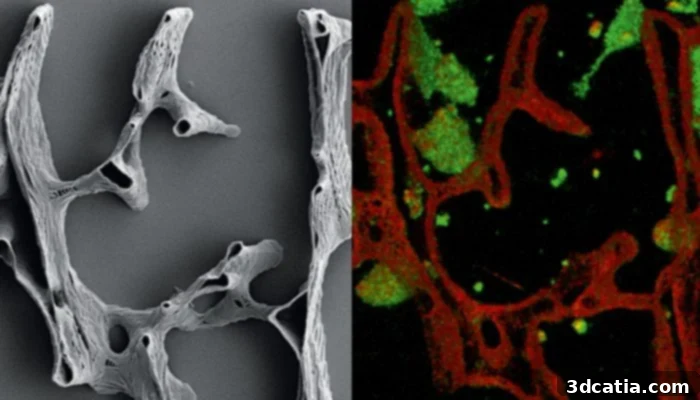
A High-precision reproduction of a trabecular human bone structure from a 3D µ-CT scanner (left). Bone cell culture in “Osteoprint” (right). (Credits: A. Marino, IIT Pontedera)
The selection of materials for 2PP is intrinsically linked to the intended application, with ongoing research continually expanding the compatible material landscape. Currently, epoxy resins, various photoresists, and hydrogels are among the most commonly utilized materials due to their excellent photopolymerization properties and availability. However, the trend is moving towards an increased use of advanced organic materials, especially those designed for biocompatibility, and novel hybrid materials. For instance, specialized hybrid polymers are being developed and utilized to produce ceramic or preceramic structures. These hybrid materials offer significantly enhanced stability, mechanical strength, and thermal resistance compared to traditional polymers, opening doors to even more demanding applications in fields like high-temperature micro-devices or robust micromechanical components. This continuous innovation in material science is crucial for unlocking the full potential of 2PP technology.
Leading Two-Photon Polymerization 3D Printer Manufacturers and Future Outlook
The market for two-photon polymerization 3D printing systems is characterized by innovation and specialization, led by a cadre of pioneering manufacturers. Among the most prominent names in this highly specialized field are Nanoscribe (Germany), UpNano (Austria), Microlight (France), Multiphoton Optics (Germany), and Moji-Nano-Technology (China). These companies are not only developing advanced hardware but are also contributing significantly to the refinement of 2PP processes and materials.
Nanoscribe, for example, has garnered significant recognition for its proprietary process known as Two-Photon Grayscale Lithography (2GL), an evolution of 2PP that offers enhanced speed and versatility for certain applications. Their Nanoscribe Quantum X stands as a testament to industrial innovation, being acclaimed as the world’s first industrial 3D printer to integrate 2GL technology. Another notable offering from Nanoscribe is the Quantum X Shape, specifically designed to accelerate rapid prototyping and facilitate mass production of micro-components. UpNano has also made significant strides, announcing what they claim is the world’s fastest high-resolution printing system, the NanoOne series, which is pushing the boundaries of throughput in 2PP. Furthermore, UpNano has unveiled the NanoOne Bio System, a specialized printer meticulously engineered for advanced 3D bioprinting applications involving living cells, opening new avenues in tissue engineering and regenerative medicine.
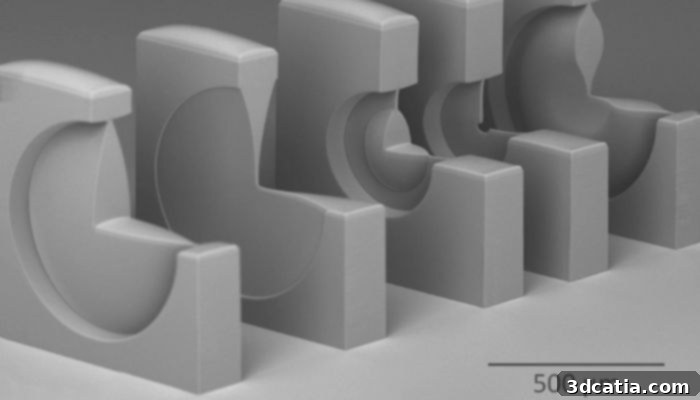
A vertical microlens system manufactured by 2PP. (Credits: Heidelberg Instruments)
Beyond hardware, many of these leading 3D printer manufacturers also dedicate substantial resources to developing and offering their own specialized printing materials, often optimized for their specific systems. UpNano, for instance, has innovated with UpBlack, a unique black 2PP material that is exceptionally suited for creating high-performance optical systems. In a collaborative effort with Cubicure, they also developed UpThermo, a temperature-resistant plastic that expands the operational temperature range for 2PP-printed parts. Similarly, Microlight 3D provides its range of microFAB materials, tailored for seamless integration with their printers, such as the MicroFAB-3D. The Fraunhofer Institute, a renowned research organization, continues to excel in both materials development and the overarching advancement of two-photon polymerization technology. Their efforts extend from developing biocompatible materials for biological applications to a strategic goal of establishing two-photon polymerization as a widely adopted, proprietary process domain technology.
The demand for 3D printing capabilities in the micro and nano ranges is steadily escalating, driven by the increasingly stringent requirements of various high-tech industries. Two-photon polymerization stands out as an exceptionally versatile process, which explains its rapid adoption and expanding applications across more and more sectors. This sophisticated technology is not just enabling but actively catalyzing pioneering innovations and significant breakthroughs in critical fields such as medicine, micro-optics, and microelectronics. By providing the tools to create intricate, high-precision structures at unprecedented scales, 2PP is making substantial contributions to numerous exciting and transformative developments across modern industry and scientific research. The future of miniaturized manufacturing is undoubtedly being shaped by the ongoing advancements in two-photon polymerization, promising even more incredible applications in the years to come.
What are your thoughts on the groundbreaking potential of two-photon polymerization? Share your insights and opinions in a comment below or connect with us on our LinkedIn, Facebook, and Twitter pages! Don’t forget to sign up for our free weekly Newsletter here to receive the latest 3D printing news straight to your inbox! You can also find all our compelling videos on our dedicated YouTube channel.
*Cover Photo Credits: Heidelberg Instruments