
Embedded Magnet Printing: Revolutionizing Functional Components with Integrated Magnetism in 3D Printing
The landscape of additive manufacturing is continuously evolving, pushing the boundaries of what is possible in design and functionality. A groundbreaking innovation emerging from the Zurich University of Applied Sciences (ETH) promises to significantly advance this field. In a pioneering effort, a doctoral student in the process engineering and mechanics department, Kai von Petersdorff-Campen, has successfully developed an additive manufacturing technique capable of creating objects with fully integrated magnets in a single, streamlined process. This innovative approach, which Petersdorff-Campen has aptly named “Embedded magnet printing,” represents a critical leap forward. To vividly illustrate the potential and efficacy of his method, he successfully fabricated a prototype heart pump, a complex device where integrated magnetic components are absolutely crucial. This new magnetic 3D printing process holds the power to fundamentally alter the way engineers approach the development, prototyping, and rigorous testing of their intricate designs, unlocking unprecedented levels of design freedom and functional integration.
While the concept of magnetic 3D printing is not entirely new, its practical application and widespread adoption have been somewhat constrained. Researchers globally have been diligently exploring avenues to integrate advanced functionalities into 3D printed objects. Previous initiatives have, for instance, paved the way for the development of hybrid materials, combining different properties within a single print, and even the direct 3D printing of electronics onto surfaces, including human skin. However, the direct and seamless embedding of strong, functional magnetic elements into structural components during the printing process itself has remained a significant challenge. The Swiss PhD student, Kai von Petersdorff-Campen, specifically focused his research on overcoming this hurdle by developing a novel magnetically charged plastic filament. His innovative approach to integrating magnetic properties directly into the feedstock for 3D printing has garnered considerable attention and discussion within the global scientific and engineering communities, marking a significant milestone in functional additive manufacturing.
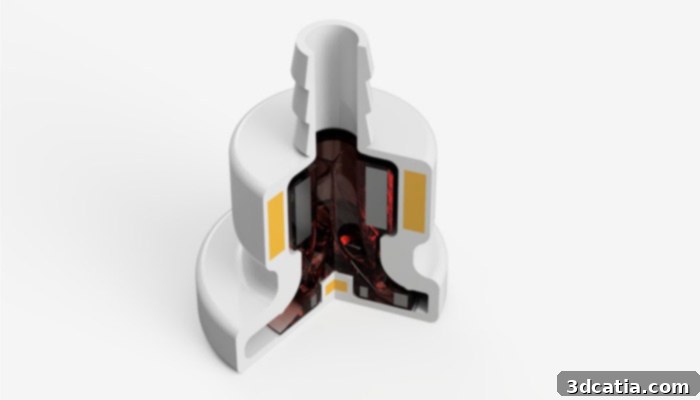
The prototype of the heart pump, showcasing integrated magnetic components.
Unveiling the “Embedded Magnet Printing” Process: A New Paradigm for Functional Additive Manufacturing
The ingenuity of the “Embedded magnet printing” process lies in its elegant simplicity coupled with sophisticated material science. At its core, the technique involves thoroughly mixing a finely ground magnetic powder with a polymer-based plastic material. This composite mixture is then meticulously processed to form a uniform 3D printing filament, ready for use in conventional extrusion-based additive manufacturing systems. The technology leveraged for this process is Fused Deposition Modeling (FDM), a widely accessible and robust 3D printing method. Utilizing a modified Prusa i3 3D printer, these specially formulated filaments are precisely extruded, layer by layer, progressively building up the desired three-dimensional object. Once the printing phase is complete, the entire printed part is subsequently subjected to a powerful external magnetic field. This post-processing step is crucial; it magnetizes the integrated magnetic particles within the composite material, imbuing the printed object with its intended magnetic properties.
Petersdorff-Campen emphasizes that the primary challenge during the development of this unique magnetic filament was not just the integration of magnetic particles, but critically, finding the optimal proportions for the mixture. This involved a delicate balancing act. He discovered that while a higher concentration of magnetic powder certainly boosted the magnetic force within the plastic pellets, it concurrently had a detrimental effect on the mechanical integrity and flexibility of the resulting filament. An overly brittle filament would be impossible to extrude smoothly, leading to print failures. Conversely, a filament with insufficient magnetic material would not yield the desired magnetic performance. Through extensive experimentation and iterative refinement, the researcher finally achieved a remarkable balance between maximizing the magnetic power of the filament and ensuring it retained adequate flexibility and strength for reliable 3D printing. “We tested various plastics and mixes until the filaments were flexible enough for printing but still had enough magnetic force,” Petersdorff-Campen elaborated, highlighting the rigorous material science investigation behind his breakthrough. This careful optimization is key to making functional magnetic components feasible through additive manufacturing.
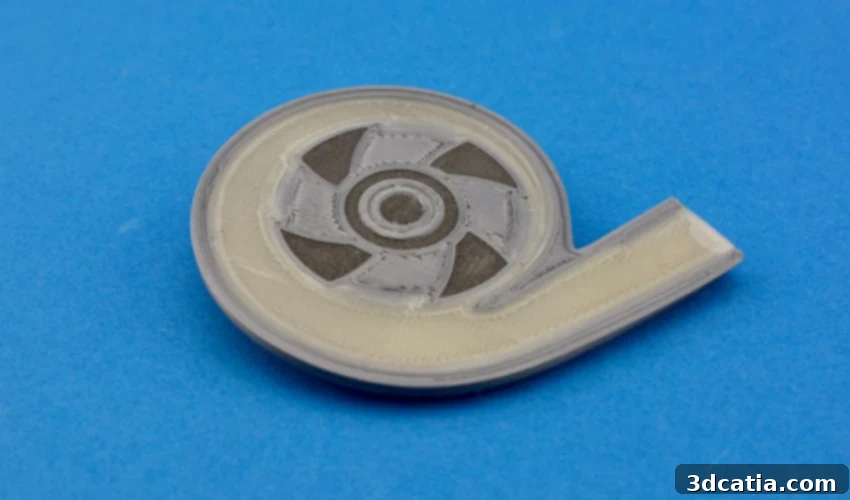
To comprehensively validate his methodology and demonstrate its capabilities, Petersdorff-Campen embarked on the ambitious project of creating a prototype rotating heart pump. This specific choice of demonstration was deliberate, as a heart pump inherently relies on highly precise and integrated magnetic components for its functionality, making it an excellent test case for both geometric and magnetic complexity. The prototype was designed not merely for functional performance but to push the limits of what “Embedded magnet printing” could achieve in terms of intricate geometries and the exact placement of multiple magnetic elements. Petersdorff-Campen clarified his primary objective: “My goal was not to make a good heart pump, but to demonstrate the principle of how it can be produced in a single step.” This underscores the focus on process validation rather than immediate medical application. The entire artificial heart pump prototype, consisting of ten distinct pieces, eight of which intricately contained embedded magnets, was successfully printed in approximately 15 hours. This achievement highlights the potential for significantly reducing assembly time and complexity, which is often a bottleneck in traditional manufacturing processes for devices with embedded functionalities.
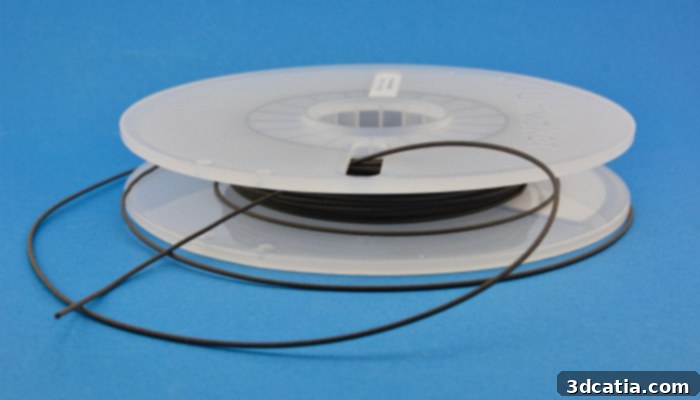
Photo credits: ETH Zurich, illustrating the successful integration of magnets within a complex structure.
From Proof of Concept to Future Frontiers: The Testing Stage and Beyond
While the successful demonstration of the heart pump prototype is undoubtedly a significant achievement, the Swiss researcher openly acknowledges that his current work remains firmly within the realm of fundamental research and proof of concept. The primary aim of his extensive investigations is to rigorously test and validate the principle of integrated magnetic printing, confirming its feasibility and identifying critical parameters. Consequently, Petersdorff-Campen explicitly states that the specialized filaments developed during his research are not, at this stage, commercially available for sale. He candidly concludes, “There is still a lot to improve in terms of material and processing; I wouldn’t want to have such a device implanted.” This statement reflects a responsible and realistic assessment of the technology’s current maturity, emphasizing that while the foundational principles are sound, further extensive development, material optimization, and rigorous testing will be required before such devices could be considered for sensitive applications like medical implants.
Despite the nascent stage of commercialization, the potential applications for this “Embedded magnet printing” method are vast and transformative, extending across numerous industries. This innovative technique could revolutionize the manufacturing of various electromechanical components. For instance, it could be extensively utilized in the production of more compact, efficient, and custom-designed electric motors, which are ubiquitous in modern life – powering everything from essential home appliances and intricate hard drives to high-fidelity speakers and advanced robotics. The ability to precisely integrate magnets directly into the structure of these motors during the printing process opens up new avenues for miniaturization, performance enhancement, and rapid prototyping of specialized designs that are currently challenging or impossible to create with traditional manufacturing techniques.
Beyond these conventional applications, the implications of functional 3D printing with embedded magnets are even more profound. Consider the field of soft robotics, where integrated actuators could lead to more agile and compliant robotic systems that mimic biological movement. In the realm of biomedical engineering, while direct implantation may be years away, this technology could facilitate the creation of custom diagnostic tools, sophisticated sensors, or even external prosthetic devices with embedded magnetic functionalities for better control or sensing. Furthermore, the ability to print custom magnetic patterns could be instrumental in developing advanced micro-electromechanical systems (MEMS) for new generations of sensors and actuators. This technology promises to unlock unparalleled design freedom, allowing engineers to create complex, multi-functional components that are lighter, more compact, and potentially more cost-effective due to reduced assembly steps. The paradigm shift towards manufacturing objects with inherent magnetic properties rather than assembling them from discrete components marks a significant step towards truly intelligent and functional additive manufacturing.
As research continues to progress, the integration of smart materials and advanced functionalities into 3D printed objects will undoubtedly accelerate. Kai von Petersdorff-Campen’s work at ETH Zurich serves as a compelling example of this exciting frontier, demonstrating the feasibility and immense potential of embedding active magnetic elements directly within 3D printed structures. This innovation is not just about making existing products better; it’s about enabling entirely new categories of products and applications that were previously unimaginable. While there are still material science and engineering challenges to overcome, the foundation has been laid for a future where functional components are born from the printer, fully integrated and ready for action. You can find more comprehensive information on the ETH Zurich website, and for a visual insight into the process, explore the video demonstration provided below:
What are your thoughts on this revolutionary magnetic 3D printing process and its potential to transform various industries? We invite you to share your perspectives and insights in the comments section below, or engage with us on our social media platforms via Facebook and Twitter! Don’t miss out on the latest advancements and breaking news in the world of additive manufacturing. Be sure to sign up for our free weekly Newsletter, delivering all the essential updates directly to your inbox!