
Discover the Future: Top 5 Weekly 3D Printing Innovations You Can’t Miss
Welcome to our weekly dive into the fascinating world of additive manufacturing! Each week, we scour the landscape of innovation to bring you the most groundbreaking and inspiring videos related to 3D printing. This collection is designed not only to keep you informed but also to spark your imagination about the endless possibilities this technology offers. From transforming construction methods to enhancing medical devices and even challenging digital security, 3D printing continues to push boundaries across diverse industries. We’ve curated the Top 5 videos that caught our attention this week, showcasing incredible advancements and practical applications. Get ready to explore the cutting edge of design and fabrication, right here. For even more insightful content and discussions, make sure to visit our dedicated YouTube channel, where a broader universe of 3D printing videos awaits. We also encourage you to share your thoughts, insights, and even your own 3D printing projects by commenting on this article or engaging with us on 3Dnatives’ Facebook or Twitter accounts. We hope you find these innovations as captivating as we do and have a fantastic day exploring the forefront of additive manufacturing!
Top 1: Building a Sustainable Future with a 3D Printed House
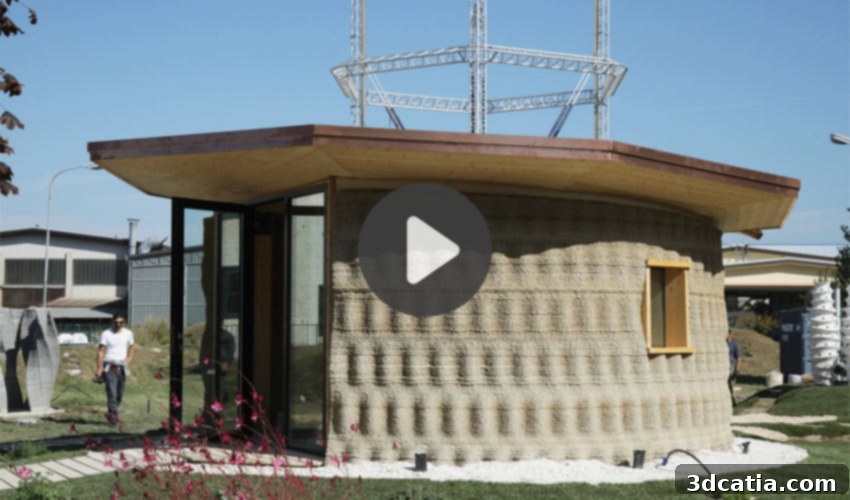
The construction industry is ripe for disruption, and 3D printing is leading the charge towards more sustainable and efficient building methods. For several years, the innovative Italian manufacturer WASP has been at the forefront of this revolution, offering groundbreaking environmentally friendly alternatives to conventional construction. Their approach leverages local materials and advanced additive manufacturing techniques to create structures that are both cost-effective and ecologically conscious. A standout example of their pioneering work is Gaia, a remarkable 3D printed house constructed almost entirely from earth and rice by-products. The core objective behind Gaia was to demonstrate the immense potential of utilizing readily available, raw materials found directly in the local environment, giving them significant added value through sophisticated manufacturing processes. This project showcases how waste materials can be transformed into robust and livable spaces. After an impressive 100 hours of continuous printing and the extrusion of 27 kilometers of material, the dedicated WASP team successfully completed Gaia, resulting in a functional 9-cubic-meter living space. This achievement not only highlights the speed and efficiency of 3D printing in construction but also its capacity to deliver sustainable housing solutions that could address global housing shortages while minimizing environmental impact. The ability to use locally sourced earth dramatically reduces transportation costs and carbon footprint, making such projects highly replicable in various regions around the world. Gaia represents a significant step towards a future where housing is more accessible, sustainable, and tailored to local resources.
Top 2: How 3D Technologies Accelerate Medical Device Innovation
Additive manufacturing has undeniably become a cornerstone of the modern medical industry, fundamentally transforming how devices and implants are designed, prototyped, and produced. Its unparalleled capabilities offer tremendous opportunities for customization, drastically reducing manufacturing times, and significantly lowering costs, ultimately benefiting both patients and healthcare providers. Recognizing this immense potential, the forward-thinking company PrinterPrezz has strategically invested in a suite of advanced 3D printers, including state-of-the-art Carbon machines. This substantial investment enables them to manufacture a wider array of prototypes and complex medical devices with unprecedented speed and precision, accelerating the product development lifecycle from concept to clinical application. The ability to rapidly iterate designs and produce intricate geometries is crucial in the medical field, where devices often require personalized adjustments for individual patient anatomies or specific surgical needs. PrinterPrezz’s commitment extends beyond manufacturing; the American company places significant emphasis on fostering the next generation of talent. They actively contribute to the education and training of young engineers and doctors, equipping them with a robust and comprehensive training program focused on additive manufacturing techniques and their medical applications. This holistic approach ensures that the industry not only continues to innovate with advanced technology but also cultivates a skilled workforce capable of pushing the boundaries of medical science. By combining cutting-edge technology with dedicated educational initiatives, PrinterPrezz is playing a pivotal role in shaping the future of personalized medicine and efficient healthcare solutions.
Top 3: 3D Printing vs. Facial Recognition Security: A Critical Test
In an increasingly digital world, the security of our personal devices, particularly smartphones, relies heavily on advanced biometric authentication systems like facial recognition. But what if these sophisticated security measures could be deceived? This intriguing question was put to the test in an experiment conducted by Forbes, yielding fascinating and somewhat unsettling results. Journalist Thomas Brewster embarked on a mission to rigorously assess the facial recognition systems across several popular smartphone models. His method was ingenious yet straightforward: he utilized 3D printing technology to create a highly accurate, lifelike model of his own head. This 3D printed replica was then strategically positioned in front of the cameras of various smartphones, simulating a real user attempting to unlock their device. The outcome of this experiment provided valuable insights into the varying levels of security implemented by different manufacturers. It appears that only a select few, specifically the LG and the iPhone models tested, had invested sufficient resources and developed robust enough algorithms to properly secure their phones against such sophisticated spoofing attempts. Many other devices failed to differentiate between Brewster’s actual face and its 3D printed counterpart, allowing unauthorized access. This experiment underscores the ongoing “arms race” between security developers and those seeking to bypass these systems. It highlights the critical importance of continuous innovation in biometric security, particularly as 3D printing technology becomes more accessible and capable of producing highly detailed replicas. For consumers, it raises awareness about the inherent vulnerabilities that might exist in their device’s security features and the need for manufacturers to prioritize more resilient authentication methods to protect personal data.
Top 4: Revolutionizing Automotive Design with 3D Printed Car Parts
The automotive industry, a realm synonymous with innovation and precision engineering, is undergoing a profound transformation thanks to the integration of additive manufacturing technologies. Leading this charge is Techniplas, a company that is expertly leveraging 3D printing to redesign and rethink the very essence of transportation. Their vision extends beyond merely creating components; Techniplas is focused on developing innovative products, such as their concept of a connected car, engineered to dramatically enhance the user experience and propel automotive innovation to unprecedented levels. By seamlessly combining the design freedom and material efficiency of additive manufacturing with the intelligence of cognitive technologies, Techniplas is unlocking new possibilities for vehicle design and functionality. The results of their pioneering efforts are proving to be exceptionally promising. 3D printing allows for the creation of intricate, lightweight parts that would be impossible or prohibitively expensive to produce with traditional manufacturing methods. This capability is crucial for improving fuel efficiency, reducing vehicle weight, and optimizing performance. Furthermore, the integration of cognitive technologies means that these 3D printed components can be smarter, capable of collecting data, adapting to user preferences, and even enhancing safety features. This approach enables mass customization, allowing car manufacturers to produce tailor-made parts and interiors more efficiently. Techniplas’s work illustrates how additive manufacturing is not just about making parts, but about creating an entirely new paradigm for mobility – one that is more efficient, personalized, and intelligently integrated with the digital world, shaping the cars of tomorrow.
Top 5: Advancing Material Science with Ceramic 3D Printing
Ceramic materials, renowned for their exceptional heat resistance, hardness, and chemical inertness, have traditionally been challenging to process with conventional manufacturing techniques, especially when intricate geometries are required. However, the advent of ceramic 3D printing is opening up a vast new frontier for these advanced materials. HAGE3D, a prominent European leader in industrial 3D printing solutions, is at the forefront of this exciting development. They have played a crucial role in the ambitious “cerAMfacturing” project, which is dedicated to advancing the additive manufacturing of ceramic parts for a wide range of high-performance applications. As we’ve previously highlighted, major players like Canon have also made significant strides in ceramic 3D printing technology, underscoring the growing importance of this niche. The cerAMfacturing project, however, distinguishes itself by focusing specifically on enabling new and efficient ways for the serial production of 3D printed consumer goods and critical medical products from ceramics. This focus on mass production for ceramics addresses a key challenge in additive manufacturing: scaling from prototyping to industrial-grade output. For consumer goods, this could mean highly durable, custom-designed items with superior properties. In the medical field, ceramic 3D printing offers immense potential for creating biocompatible implants, dental crowns, and surgical instruments with unprecedented precision and durability, tailored to individual patient needs. The ability to reliably and cost-effectively produce ceramic components in larger quantities will unlock numerous applications where the unique properties of ceramics are essential, driving innovation in sectors from aerospace to electronics and healthcare. HAGE3D’s involvement in cerAMfacturing signifies a critical step towards mainstream adoption of ceramic additive manufacturing, promising a future of high-performance, complex ceramic parts that were once unimaginable.
We trust you enjoyed this week’s TOP 5 videos, featuring incredible insights into a 3D printed house, the intriguing challenge of 3D printing against facial recognition, and the transformative potential of additive manufacturing across various industries. These highlights offer just a glimpse into the dynamic world of 3D printing and its continuous evolution. If you’re eager for more captivating content and wish to stay at the forefront of this innovative field, we invite you to explore a wealth of additional videos on our official YouTube channel. Your engagement is invaluable to us; please feel free to drop a comment below this article to share your thoughts, questions, or experiences. Alternatively, you can join the conversation on our Facebook and Twitter pages, where our community actively discusses the latest trends and breakthroughs. And don’t forget a crucial step to ensure you never miss out on the most vital updates: sign up for our free weekly Newsletter. This curated newsletter delivers all the latest news, expert analyses, and exclusive content from the 3D printing industry straight to your inbox, keeping you fully informed and connected to the pulse of innovation!