
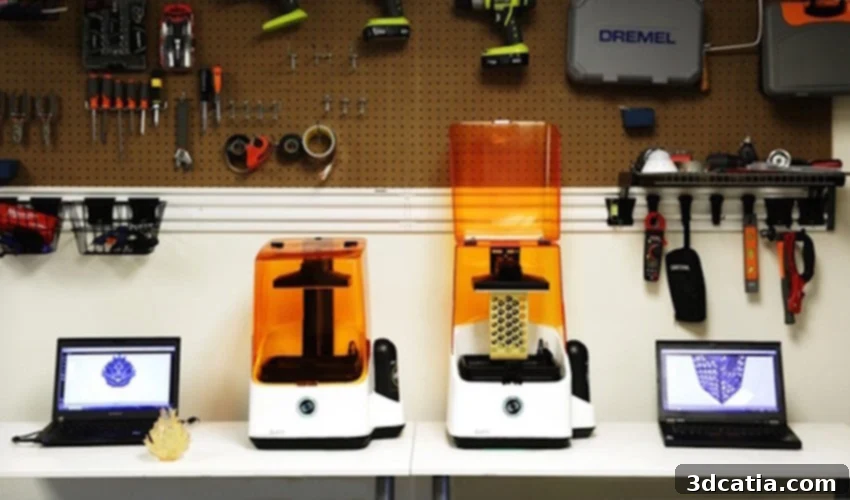
UniZ SLASH OL: Redefining Desktop 3D Printing Speed and Accessibility with UDP Technology
Emerging from San Diego in 2014, UniZ entered the additive manufacturing landscape with a clear vision: to push the boundaries of 3D printing speed and make advanced technology more accessible. Founded by a dynamic team of engineers, entrepreneurs, and designers, UniZ has steadily built a reputation for innovation. Their journey began with the release of their acclaimed SLASH and SLASH+ UDP 3D printers, which quickly garnered attention for their impressive performance. These initial models laid the groundwork for what was to come, showcasing UniZ’s commitment to developing rapid prototyping solutions.
The excitement surrounding UniZ reached a fever pitch with the launch of their Kickstarter campaign for the new SLASH OL series. This campaign, designed to introduce an even more affordable and versatile range of their high-speed printers, quickly surpassed all expectations. With just one day remaining, the initiative had already garnered over eight times its initial funding target, a clear testament to the market’s demand for faster, more efficient, and cost-effective 3D printing solutions. The SLASH OL is positioned to be a game-changer, offering an enticing alternative to their existing lineup without compromising on their signature speed.
UniZ boldly claims that their printers, despite a significant price difference, can compete head-to-head in speed with Carbon 3D’s esteemed CLIP technology – a benchmark for rapid resin printing. This assertion alone challenges the conventional wisdom that ultra-fast 3D printing must come with a prohibitively high price tag. By democratizing access to such advanced speeds, UniZ aims to empower a wider range of users, from small businesses and dental clinics to individual designers and educational institutions, to leverage the full potential of additive manufacturing.
The Quest for Speed: UniZ’s UDP Technology Takes On the Market
When considering affordable stereolithography (SLA) or digital light processing (DLP) 3D printers, the name Formlabs often comes to mind. They are widely recognized as pioneers in the desktop SLA market, having successfully brought this sophisticated technology to a broader audience. Their Form 2 3D printer, in particular, has achieved widespread adoption, especially within specialized sectors such as dental and hearing aids, where precision and reliability are paramount. Formlabs has set a high bar for quality and user experience in desktop resin printing.
However, UniZ enters this established arena with an audacious claim: their desktop SLA 3D printers are not only more affordable but also boast speeds that are reportedly over 100 times faster than many conventional desktop resin printers. This bold statement, if substantiated, represents a monumental leap forward in 3D printing capabilities. The implications of such a speed increase are far-reaching, promising to revolutionize workflows in numerous industries where rapid prototyping and on-demand manufacturing are critical.
It is crucial to approach these figures with the understanding that they originate directly from UniZ. While we, as observers, do not independently verify these specific metrics, the potential impact of such capabilities cannot be overstated. Imagine the transformative effect if UniZ truly possesses the ability to 3D print complete models of teeth in mere seconds – specifically, 45 seconds for the SLASH OL model and an astonishing 13.5 seconds for the ZSLTV15 variant. This level of speed is not just an incremental improvement; it is a fundamental shift that could entirely redefine existing paradigms.
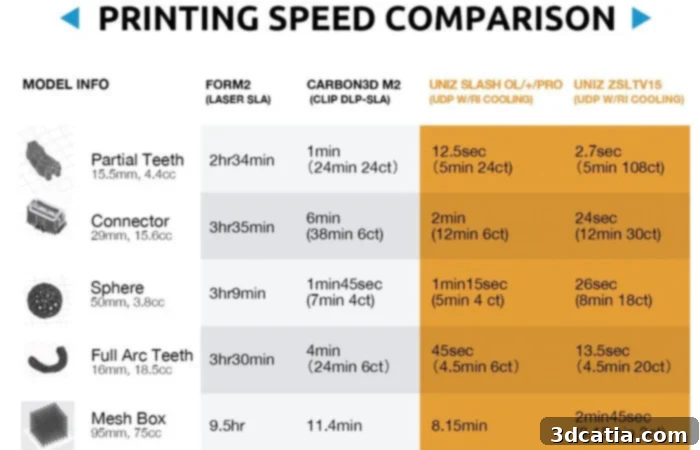
A speed comparison from UniZ’s Kickstarter page, illustrating their claims against competitors.
For the dental industry, in particular, this speed could prove invaluable. The ability to produce full sets of teeth or highly detailed orthodontic models during a single patient appointment offers unparalleled efficiency. This means reduced waiting times for patients, increased throughput for dental practices, and the potential for a more personalized and immediate service. Beyond dentistry, industries like product design, rapid prototyping, and custom manufacturing could see drastically shortened development cycles, allowing for quicker iteration and faster market entry for new products. The graphical comparisons shared by UniZ on platforms like their Kickstarter page vividly illustrate these speed advantages, inviting potential users to envision a future where complex prints are completed in a fraction of the time typically expected.
Quality and Resolution: Debunking the Speed-Quality Trade-Off
A natural concern arises when discussing such extraordinary printing speeds: surely, there must be a compromise in print quality or resolution. This is a common assumption in additive manufacturing, where increased speed often correlates with a reduction in detail or surface finish. However, UniZ directly challenges this notion. They contend that their UDP technology is engineered to deliver not just unparalleled speed, but also exceptional quality that stands up to, and in some cases surpasses, industry benchmarks.
To underscore this point, UniZ provides compelling data, including comparison charts that pit the resolutions of their 3D printers against established players like Formlabs, Moonray, and even high-end systems from Carbon 3D. While UniZ acknowledges that their printers may not match the absolute highest accuracy of Carbon 3D’s top-tier, quarter-million-dollar machines, they assert that the difference is remarkably small, especially when considering the vast disparity in price points. This position suggests that UniZ is carving out a niche where users can access near-industrial-grade resolution without the prohibitive investment typically associated with it.
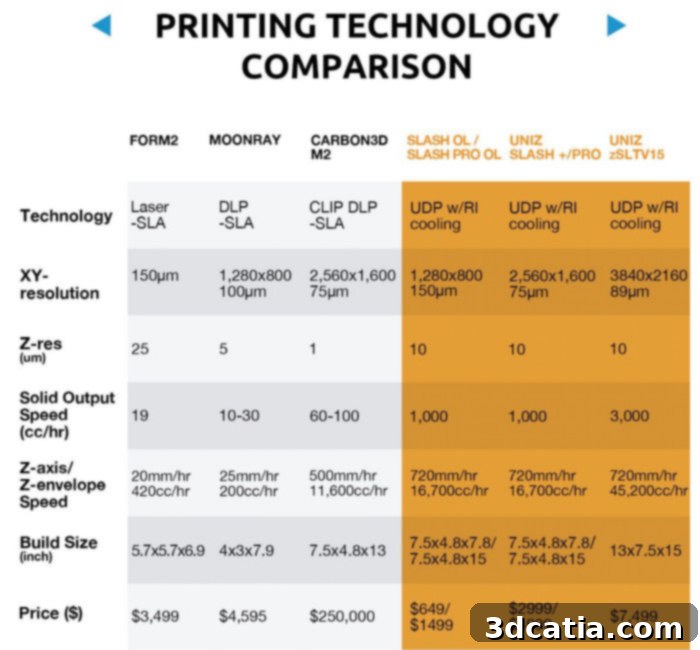
This emphasis on maintaining high resolution at high speeds is critical for applications demanding fine details and smooth surfaces, such as jewelry manufacturing, intricate miniature creation, or precise engineering prototypes. If UniZ can indeed deliver on these promises, it effectively removes one of the biggest trade-offs users typically face in resin 3D printing, making their solutions incredibly attractive across a broad spectrum of professional and prosumer applications. The detailed charts presented by UniZ serve as a powerful visual argument, inviting a closer look at their technology’s capabilities.
The UniZ Revolution: Impact and Future Outlook
The success of the UniZ Kickstarter campaign for the SLASH OL printers is more than just a financial victory; it’s a strong indicator of market validation for their approach. Exceeding funding targets by over eight times signifies a collective belief from the additive manufacturing community in UniZ’s potential to disrupt the status quo. This overwhelming support suggests that there is a significant, unmet demand for desktop resin 3D printers that offer both extreme speed and competitive pricing, particularly the new low-priced alternative that makes the technology even more accessible.
The potential for UniZ’s UDP 3D printers to revolutionize the landscape of additive manufacturing, particularly with these super-fast speeds, remains a captivating prospect. If the figures and claims made by UniZ prove to be as robust and consistent in real-world applications as they suggest, it’s difficult to envision a scenario where widespread adoption doesn’t occur. The barriers to entry for high-speed, high-resolution resin printing have traditionally been cost and complexity. UniZ appears to be directly addressing these obstacles, thereby expanding the potential user base exponentially.
While Formlabs currently enjoys a dominant position in the desktop resin 3D printing market, UniZ’s innovative UDP technology presents a formidable challenge. This isn’t just about offering an alternative; it’s about setting a new performance benchmark. As more industries and individuals realize the tangible benefits of dramatically reduced print times, UniZ could swiftly carve out a substantial niche, potentially transforming how rapid prototyping, custom manufacturing, and even end-use part production are approached on a desktop scale. The ongoing development and refinement of their UDP technology promise to keep UniZ at the forefront of this exciting evolution.
To further illustrate the groundbreaking capabilities of their printers, UniZ has also shared compelling visual evidence. This video demonstration provides a direct look at their 3D printers in action, showcasing the speed claims firsthand and allowing potential users to witness the rapid production of complex models:
The advent of such high-speed, high-resolution, and increasingly affordable desktop 3D printing solutions like those offered by UniZ heralds an exciting new era for additive manufacturing. It suggests a future where the constraints of time and cost are significantly lessened, opening up unprecedented opportunities for innovation across countless sectors. Whether UniZ can sustain this momentum and truly stake its place as a dominant force will depend on continued innovation, consistent product performance, and robust customer support. However, their initial foray with the SLASH and SLASH OL series has certainly sent a powerful message to the industry: the race for speed and accessibility in desktop 3D printing has just intensified dramatically.
What are your thoughts on UniZ’s super-fast 3D printers and their potential to disrupt the market? We encourage you to share your insights and predictions in the comments section below! You can also join the conversation on our Facebook and Twitter pages. Don’t forget to sign up for our free weekly Newsletter to receive all the latest news and developments in the world of 3D printing directly in your inbox!