

GE Unveils ATLAS: Revolutionizing Large-Scale Metal 3D Printing for Aerospace and Industry
The landscape of the 3D printing industry has been electrifying over recent weeks, with a relentless stream of exciting news emanating from major companies showcasing their latest advancements and ambitious projects at global expos and trade shows. Hot on the heels of HP’s significant announcements at Die & Mould China 2017, industrial giant General Electric (GE) has once again captured headlines. Following their substantial investment in Concept Laser and the launch of a new education program aimed at nurturing future additive manufacturing talent, GE has now unveiled a groundbreaking new machine that promises to redefine the future of 3D printing, particularly for the demanding aerospace sector.
This latest venture into cutting-edge 3D printing technology is a testament to GE’s deep commitment to additive manufacturing, a collaboration that leverages the expertise of Concept Laser. The result of this synergistic partnership is the ‘ATLAS’ – heralded as the world’s largest laser-based powder bed metal 3D printer. Its grand unveiling took place this week at the prestigious Paris Airshow, an ideal platform to introduce a machine with such profound implications for aviation. GE representatives explained that the ATLAS is the culmination of an intensive two-year development effort, designed from the ground up to surpass existing benchmarks. It is specifically engineered to significantly exceed the capabilities of Concept Laser’s well-regarded XLine 2000R, which boasts an impressive build volume of 800 x 400 x 500 mm. The introduction of the ATLAS signals a major leap forward, setting new standards for industrial-scale additive manufacturing.
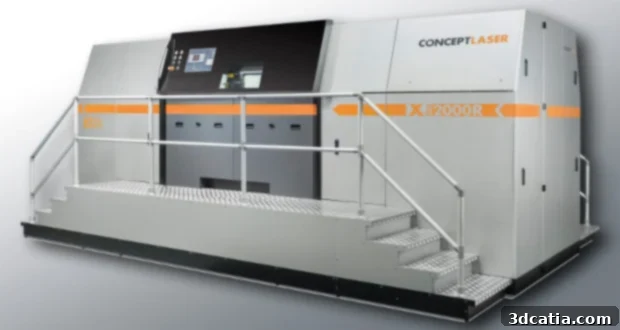
The Concept Laser XLine 2000R
The ATLAS is set to fundamentally transform what is possible in metal additive manufacturing with its colossal build envelope, capable of producing parts up to 1000 x 1000 x 1000 mm. This monumental increase in size is not merely about scale; it opens doors to entirely new classes of components and consolidated assemblies previously deemed impossible with traditional 3D printing methods. A critical feature of the ATLAS is its remarkably flexible building geometry, which can be fully customized and scaled to meet the precise requirements of individual customer projects. This adaptability ensures that the machine can cater to a diverse range of complex industrial applications. Furthermore, the ATLAS is designed to be highly versatile in its material compatibility, capable of processing both non-reactive and highly reactive materials. This includes critical aerospace alloys such as lightweight aluminum and robust titanium, which are essential for manufacturing high-performance, durable, and fuel-efficient components. The ability to handle these advanced materials safely and effectively underpins the ATLAS’s potential to revolutionize multiple industrial sectors.
Impact on Aerospace and Beyond
Mohammad Ehteshami, Vice President and General Manager of GE Additive, articulated the profound implications of this new technology. “The machine will 3D print aviation parts that are one meter in diameter, suitable for making jet engine structural components and parts for single-aisle aircraft,” Ehteshami explained. This capability is groundbreaking because it enables the creation of larger, more integrated parts, reducing assembly time, minimizing material waste, and allowing for optimized designs that enhance performance and reduce weight – factors that are paramount in the aerospace industry. For jet engines, the ability to print complex, single-piece components means fewer welds and joints, leading to stronger, more reliable structures that can withstand extreme operational conditions. Similarly, for single-aisle aircraft, this technology can lead to lighter airframes and more efficient component designs, translating into significant fuel savings and reduced emissions over the aircraft’s lifespan.
Beyond its immediate and transformative impact on aerospace, the ATLAS is envisioned to have a broad applicability across various heavy industries. “The machine will also be applicable to manufacturers in the automotive, power, oil and gas industries,” Ehteshami added. In the automotive sector, it could enable the rapid prototyping and production of large, lightweight structural components or specialized tooling. For the power generation industry, particularly in turbines and complex energy systems, the ATLAS offers the potential to create intricately designed parts with enhanced cooling channels or optimized internal structures, leading to greater efficiency and durability. In the oil and gas industry, where components often operate in harsh environments and require custom geometries, the ability to print large, robust parts from advanced alloys on demand could significantly streamline supply chains and maintenance operations, reducing downtime and operational costs.
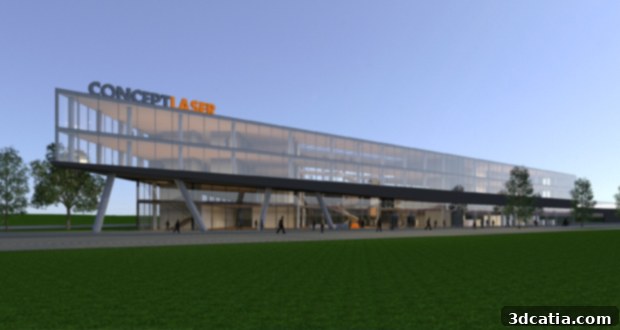
GE has invested €100 million into Concept Laser
GE’s Vision for Additive Manufacturing Leadership
GE’s strategic investments in additive manufacturing, exemplified by the €100 million commitment to Concept Laser and the establishment of GE Additive, underscore a clear vision: to lead the industrial revolution brought about by 3D printing. This isn’t just about acquiring technology; it’s about integrating additive manufacturing into their core production processes and making it accessible to a wider industrial base. By developing machines like the ATLAS, GE is not just building printers; they are forging pathways to faster innovation, more complex designs, and more sustainable manufacturing practices. The ability to print parts on demand, reduce material waste, and consolidate multiple components into single, lighter units has profound economic and environmental benefits. It streamlines supply chains, reduces inventory needs, and allows for rapid iteration of designs, accelerating product development cycles significantly.
The technical challenges overcome in developing a large-format metal 3D printer like ATLAS are substantial. Ensuring uniform thermal distribution across a one-meter build plate, managing stress and deformation in large metal prints, and maintaining precision over such an expansive volume require sophisticated engineering and advanced control systems. GE’s collaboration with Concept Laser, a pioneer in laser-based additive manufacturing, was crucial in addressing these complexities and pushing the boundaries of what’s possible with powder bed fusion technology. This partnership represents a synergy of industrial application expertise and deep additive manufacturing know-how, critical for developing solutions that are not just innovative but also robust and reliable for demanding industrial use.
Future Outlook and Market Availability
Further intricate details regarding the ATLAS system, including its full technical specifications and advanced features, are eagerly anticipated and set to be officially revealed at the upcoming Formnext show later this year. Formnext is globally recognized as a leading international exhibition and conference dedicated to additive manufacturing and industrial tooling, making it the perfect venue for GE to provide a more comprehensive deep dive into this revolutionary machine. GE is maintaining an aggressive timeline for market entry, aiming for the first production version of the ATLAS, though currently unnamed, to be commercially available for purchase by next year. This rapid commercialization strategy highlights GE’s confidence in the machine’s readiness and market demand. In a move to foster early adoption and gather crucial real-world feedback, GE’s network of collaborators and strategic partners are slated to receive beta versions of the ATLAS by the end of the current year. This phased rollout ensures that the technology can be rigorously tested and refined in diverse industrial environments, setting the stage for a seamless and impactful full market launch.
The introduction of the ATLAS is more than just another product launch; it represents a significant milestone in the journey towards fully industrialized additive manufacturing. It underscores a shift in how large, complex, and high-performance components will be conceived, designed, and produced across multiple critical sectors. This machine embodies the transformative potential of 3D printing to move beyond prototyping and into mainstream, high-volume, and large-scale production, fundamentally reshaping global manufacturing capabilities. Its impact is poised to extend from aerospace innovation to driving efficiencies in automotive, power, and oil & gas, making GE and Concept Laser pioneers in this new era of industrial production.
For those interested in witnessing the excitement from the event, check out the video below showcasing GE’s presence at the Paris Airshow 2017:
What are your thoughts on this monumental announcement from GE? How do you foresee the ATLAS printer revolutionizing the aerospace industry and influencing other industrial sectors? We invite you to share your insights and comments below, or engage with us on our Facebook and Twitter pages. To stay completely updated with all the latest news, innovations, and developments in the rapidly evolving world of 3D printing, don’t forget to sign up for our free weekly Newsletter, delivered directly to your inbox!