
University of Buffalo Drives Manufacturing Evolution: Integrating AI and Cyber-Physical Systems for Industry 4.0 and 3D Printing
The global manufacturing landscape is undergoing a profound transformation, spearheaded by the principles of Industry 4.0. At its very core, Industry 4.0 champions the modernization and optimization of traditional production methods through advanced digital technologies. This paradigm shift emphasizes interconnectedness, real-time data analysis, and intelligent automation to create more efficient, flexible, and resilient manufacturing systems. Recognizing this critical need for innovation, a pioneering research team at the University of Buffalo (UB) has embarked on an ambitious project, recently bolstered by a significant $2.3 million grant from the National Science Foundation. This substantial funding underscores the national importance of their work, which aims to revolutionize manufacturing systems, including the rapidly expanding field of 3D printing, by integrating complex processes and operational steps under sophisticated computer control. The primary objective is to streamline the entire production lifecycle, not only for commercial products but also to enhance educational outreach and foster a new generation of skilled professionals in advanced manufacturing.
The UB team’s groundbreaking initiative, christened “STREAM” (an acronym for a systematic framework for future manufacturing, though its full expansion isn’t provided, implying its focus on continuous flow and integration), is meticulously designed to harness the power of cutting-edge technologies. Central to the STREAM framework is the strategic deployment of artificial intelligence (AI), advanced simulation techniques, and other sophisticated digital tools. The researchers envision a future where manufacturing operations are not merely automated but truly intelligent and self-optimizing. A crucial component of this project involves the establishment of a public online repository. This innovative platform is intended to serve as a collaborative hub, enabling researchers, engineers, and manufacturing professionals from around the world to share invaluable experiences, comprehensive datasets, advanced models, and critical insights. This open-access approach will accelerate learning, foster innovation, and build a collective knowledge base for the entire industry.
Beyond this collaborative platform, the STREAM project is structured around three distinct, yet interconnected, research tasks, each vital for achieving its overarching goals:
- Developing Advanced Software for Cyber-Manufacturing Systems: This task focuses on creating robust and intuitive software solutions designed to facilitate seamless, efficient communication and computing within complex cyber-manufacturing environments. This involves developing algorithms and interfaces that can integrate disparate systems, ensuring data flows effortlessly and real-time insights are readily available across the entire manufacturing chain. The goal is to break down informational silos and enable a truly unified operational view.
- Establishing a Comprehensive Modeling System for Process Control: The second task is dedicated to constructing an accurate and highly efficient modeling system for process control. This involves creating digital twins and predictive models that can precisely simulate manufacturing processes, anticipate potential issues, and provide proactive control mechanisms. Such a system will allow for meticulous fine-tuning of parameters, leading to enhanced product quality, reduced waste, and optimized resource utilization, moving beyond reactive problem-solving to predictive optimization.
- Implementing a Simulation and Production Control System for Continuous Improvement: The third, and arguably most forward-looking, task involves creating a dynamic simulation and production control system aimed at the “continuous improvement of quality, manufacturability, and productivity of future multistage and distributed manufacturing systems.” This system will leverage AI and machine learning to constantly analyze performance data, identify areas for enhancement, and automatically implement process adjustments. This creates a self-learning, self-optimizing manufacturing ecosystem, capable of adapting to changing demands, materials, and technologies, ensuring sustained excellence across geographically dispersed and complex production networks.

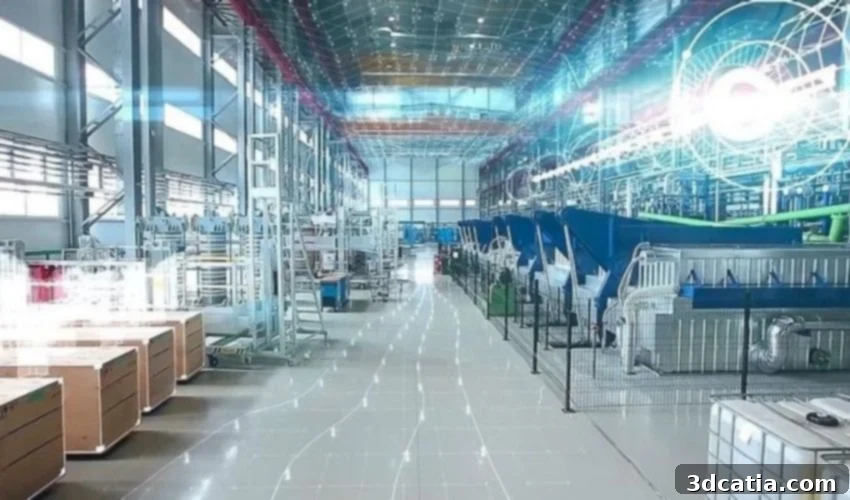
The project is being led by researchers from the University of Buffalo, focusing on integrating AI and advanced computing into manufacturing (photo credits: UB-SPPS, CC BY-SA 4.0, via Wikimedia Commons)
The Imperative of Cyber-Manufacturing Systems in the Modern Era
The concept of integrating advanced digital intelligence into manufacturing processes, often termed “cyber-manufacturing,” is not entirely new, but its application is rapidly evolving. We have witnessed a growing trend of artificial intelligence (AI) and machine learning (ML) bringing transformative benefits to additive manufacturing (AM). Both AI and AM are foundational pillars of Industry 4.0, representing a synergistic relationship where AI enhances the capabilities of 3D printing, and 3D printing provides the flexibility needed for AI-driven design and production. AI has demonstrably provided tangible advantages, particularly in optimizing software for 3D printing to create more complex, lightweight, and functionally superior parts. As additive manufacturing transitions from prototyping to full-scale industrialization, the integration of AI and ML into various software solutions becomes not just an advantage, but a necessity for achieving unprecedented levels of precision, speed, and cost-effectiveness. This project aligns perfectly with the University of Buffalo’s strategic vision to emerge as a preeminent global leader in advanced manufacturing, with a specific and intensive focus on driving the advancements inherent in Industry 4.0.
The adoption of these “watchful” software systems, characterized by their ability to monitor, analyze, and learn from production data, is becoming increasingly pervasive across a multitude of industries. This trend is particularly pronounced in sectors dealing with the production of highly intricate or customized commercial products. Dr. Hongyue Sun, PhD, the principal investigator for the grant and an esteemed assistant professor of industrial and systems engineering at UB, eloquently articulated the profound importance of this research. She highlighted its particular relevance for commercial products, including those produced through 3D printing, which often involve a convoluted and multifaceted manufacturing journey.
Dr. Sun elaborates, “A commercial product is the end result of a long chain of interwoven steps that may span geography, industries and different manufacturing processes. Each step may be optimized, but that doesn’t always mean it’s for the greater good of the overall production process. What we’re doing is creating an analytical framework that connects and coordinates all these processes. The end result will be a cyber-physical system that uses artificial intelligence and other tools to optimize and ultimately improve manufacturing systems.”
Her insight pinpoints a critical flaw in traditional manufacturing paradigms: localized optimization often fails to yield global efficiency. A single step, while perfectly tuned in isolation, might inadvertently create bottlenecks or inefficiencies further down the production line. This is where the STREAM framework, with its holistic “analytical framework,” becomes a game-changer. It seeks to transcend these siloed optimizations by creating a comprehensive, interconnected system that can perceive, analyze, and coordinate every single step of the manufacturing process as a unified entity. This framework will culminate in the development of sophisticated “cyber-physical systems.” These systems are essentially integrations of computational algorithms and physical components, where real-time data from the physical world (e.g., sensor readings from a 3D printer) is continuously fed into digital models, analyzed by AI, and then used to drive precise actions in the physical world. This creates a powerful feedback loop, enabling unprecedented levels of control, adaptability, and continuous improvement across the entire manufacturing ecosystem. While the project currently places significant emphasis on foundational research, educational outreach, and fostering academic collaboration, its potential applications in the commercial realm of 3D printing and beyond are undeniably vast and transformative. We will be closely monitoring the progress and future developments of this exciting initiative as it unfolds. For those eager to delve deeper into the specifics of this project, additional information can be found HERE.
The Future of Manufacturing: A Connected and Intelligent Reality
The University of Buffalo’s pioneering efforts signify a major leap forward in the digital transformation of manufacturing. By spearheading research into cyber-manufacturing systems and leveraging the power of artificial intelligence, they are not only addressing current industrial challenges but also laying the groundwork for future innovations. This initiative promises to make manufacturing processes, including those in 3D printing, more intelligent, efficient, and responsive to the dynamic demands of the market. The establishment of a public repository will further democratize access to advanced manufacturing knowledge, fostering a collaborative environment that can only accelerate technological progress. Ultimately, the STREAM project aims to usher in an era where manufacturing is characterized by seamless integration, predictive capabilities, and continuous self-optimization, ensuring higher quality products, reduced environmental impact, and greater economic competitiveness.
What are your thoughts on the University of Buffalo’s innovative attempts to computerize and optimize processes like 3D printing through advanced cyber-physical systems? Share your insights and join the conversation in a comment below, or connect with us on our LinkedIn, Facebook, and Twitter pages! Don’t miss out on the latest advancements and news in additive manufacturing by signing up for our free weekly Newsletter here, delivered directly to your inbox. You can also explore our comprehensive video content on our YouTube channel for more in-depth analyses and demonstrations of cutting-edge 3D printing technologies.