
Unlocking Industrial Scale: A Comprehensive Guide to Large Format 3D Printing Technologies and Applications
Large format 3D printing, also known as industrial or large-scale additive manufacturing, is rapidly transforming various industries by enabling the creation of exceptionally big objects with unprecedented speed and precision. From manufacturing true-to-scale car panels and intricate aerospace prototypes to massive billboards and bespoke architectural elements, a growing number of companies are leveraging this advanced manufacturing method. While it’s technically possible to construct large structures by assembling multiple smaller 3D printed parts, the inherent advantages of printing large, monolithic components in a single build volume are undeniable. These benefits include reduced assembly time, improved structural integrity, and often, superior aesthetic quality.
Today’s market offers an impressive array of large format 3D printers, with build volumes commonly reaching up to 1 cubic meter and even significantly larger for specialized systems. The predominant technology powering these substantial machines is Fused Filament Fabrication (FFF), where thermoplastic materials are extruded layer by layer onto a build plate to form an object. However, FFF is not the sole player in this field. Other sophisticated technologies, such as Laser Beam Powder Fusion (LBPF) for metals, also facilitate the creation of large structures, albeit with different material properties and application focuses. A prime example is Concept Laser’s X Line 2000R, a metal 3D printer utilizing LBPF technology, boasting a substantial build volume of 800 x 400 x 500 mm. Over the past few years, the development of large format 3D printers has accelerated, with manufacturers continuously innovating to meet increasingly demanding industrial needs. But what exactly defines large format 3D printing? What are its core benefits? And how does it differentiate itself from more conventional, smaller-scale 3D printing? To shed light on these crucial questions, we’ve engaged with three leading experts in the field, gathering their invaluable insights.
Our first distinguished expert is Martin Back, the Managing Director at BigRep GmbH. BigRep is a German pioneer renowned for developing and commercializing some of the world’s largest FFF 3D printers, and Martin is instrumental in steering the company’s corporate strategy and operations. Our second expert is Pierre-John Bernard, Prototype Assembly Workshop Supervisor at Volvo Construction Equipment. Pierre-John oversees the dedicated teams responsible for the assembly phase of prototypes, where large 3D printed components play a critical role in accelerating design validation. Last but certainly not least, we had the privilege of speaking with Dr. Habib Dagher, the Executive Director of the Advanced Structures and Composites Center (ASCC) at the University of Maine. The ASCC stands as a world-leading institution dedicated to research, education, and economic development, with a strong focus on advanced material sciences, manufacturing processes, and the engineering of innovative composites and structures, including groundbreaking large-scale additive manufacturing initiatives.
-

- Martin Back

-
- Pierre-John Bernard
-
- Dr. Habib Dagher

Pioneering Technologies and Advanced Materials for Large Format 3D Printing
As previously highlighted, the majority of 3D printers capable of delivering large build volumes are Fused Filament Fabrication (FFF) machines. This technology is popular due to its relative simplicity, cost-effectiveness, and the wide range of compatible materials. While other additive manufacturing technologies such as Stereolithography (SLA) or Multi Jet Fusion (MJF) are indeed available and offer distinct advantages, they generally come with higher costs and greater complexity in terms of adoption for large-scale production. Focusing initially on FFF 3D printers, a standout pioneer in this sector is the German manufacturer BigRep. This company has consistently pushed the boundaries of what’s possible, developing industrial-grade machines with impressive printing volumes that can reach up to 1 cubic meter, making them a cornerstone for many large-scale projects.
The most commonly utilized materials in the FFF segment for large format printing include accessible and versatile thermoplastics like PLA (Polylactic Acid) and PETG (Polyethylene Terephthalate Glycol-modified). However, the demand for more robust, high-performance applications has spurred innovation in material science. Several 3D printer manufacturers are now producing machines specifically engineered to handle advanced engineering-grade materials. Martin Back from BigRep elaborates on this development: “In collaboration with BASF, we are in a continuous process of developing high-performance materials tailored for demanding industrial use cases. PLX and PA6/66, for instance, are two of our recently introduced materials. These are meticulously engineered to fully capitalize on the inherent speed, precision, and overall quality capabilities of our large format 3D printers, enabling new levels of performance and durability for industrial parts.”
Beyond these, even higher-performance polymers such as PEEK (Polyether Ether Ketone), PEKK (Polyetherketoneketone), and ULTEM can present significant challenges when employed in large format 3D printing. The primary reason is their requirement for a highly controlled, often heated, build chamber to manage thermal expansion and contraction, which helps prevent warping and delamination. Naturally, maintaining a uniform and elevated temperature within a chamber of several cubic meters is considerably more complex and energy-intensive than in a small desktop 3D printer. The larger the build volume, the more difficult it becomes to precisely control the myriad parameters that are crucial for successfully printing with these technical-grade materials. Nevertheless, continuous advancements mean that some state-of-the-art 3D printers, including select BigRep machines, are indeed capable of working with these demanding materials, pushing the boundaries of what’s achievable in terms of strength and thermal resistance. Tractus3D is another innovative 3D printer manufacturer that has focused its efforts on developing a specialized range of machines for high-performance applications, demonstrating the growing maturity of the large-format market.
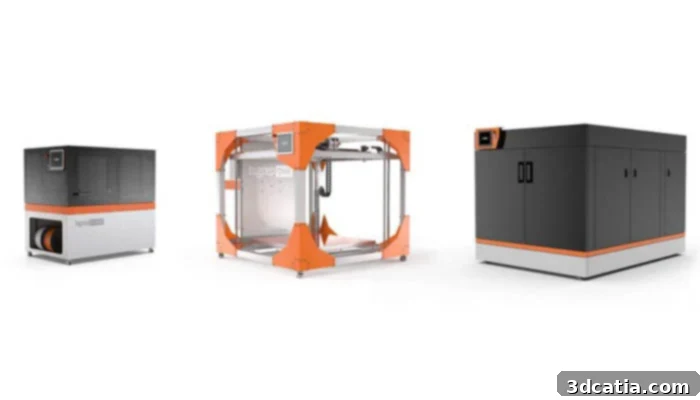
BigRep 3D printers | Image via BigRep
Shifting focus to cutting-edge material innovation, researchers at the University of Maine have made headlines by creating what they claim to be the world’s largest thermoplastic 3D printer. This monumental machine is capable of printing objects up to an astonishing 60 feet long, 22 feet wide, and 10 feet high (approximately 18 meters by 6 meters by 3 meters). The University’s Advanced Structures and Composites Center (ASCC) leverages over two decades of extensive experience in the extrusion-based processing of bio-based thermoplastics. Their pioneering research has centered on the development of entirely bio-based and 100% recyclable materials specifically formulated for large format 3D printing, addressing critical environmental concerns and fostering sustainable manufacturing practices. Dr. Habib Dagher explains their material philosophy: “Our primary focus is on developing innovative bio-based resins, which are significantly strengthened with naturally occurring bio-based fibers, cellulose, and nanocellulose. The specific material system we select is always contingent on the intended application, allowing us to precisely tailor the strength and stiffness properties of the materials for optimal performance. We operate our own material pellet production in the lab, capable of generating pellets at a rate of 500 pounds per hour, which then directly feed our high-capacity 3D printer.” This commitment to bespoke material development underscores the vast and expanding choice available in large format additive manufacturing. In certain scenarios, especially for highly intricate or extremely large components, it can still be more practical and cost-effective to produce several pieces separately on smaller machines and subsequently assemble them into the final large structure.
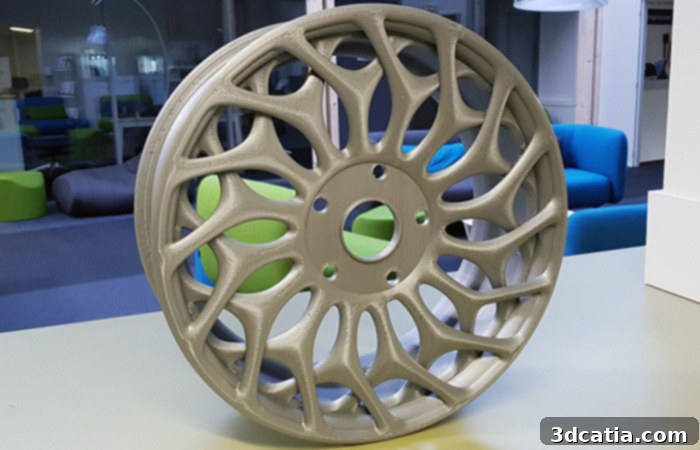
A 3D printed wheel rim in one piece
Key Considerations When Choosing an Industrial Large Format 3D Printer
When venturing into the realm of large format 3D printing, the selection of the right machine is paramount. Our comprehensive listing of XXL 3D printers showcases a diverse array of FFF machines with expansive build volumes. However, for those aiming to print substantial parts, several critical factors must be rigorously evaluated. Fundamentally, the differentiating aspects among these industrial machines boil down to two main performance indicators: the ultimate quality of the printed parts and the speed at which they can be produced. These aspects are largely influenced by the sophistication and quality of the extruder system and the precision of the stepper motors, which dictate the accuracy of movement and material deposition. Naturally, the choice of materials also plays a crucial role, affecting both print quality and the achievable speed.
Speed is an absolutely essential consideration because 3D printing a large-scale piece can very quickly evolve into an extremely lengthy process, potentially spanning several days or even weeks. Conversely, attempting to excessively accelerate the printing process without proper calibration and machine capability can severely undermine the structural integrity and aesthetic quality of the final part. Achieving the desired finish for FFF-printed parts often necessitates subsequent post-processing steps. Martin Back from BigRep provides further insights into these crucial finishing techniques: “There are three primary techniques employed in post-processing large FFF parts. Grinding, sandblasting, and shot peening are among the most common subtractive processes that help achieve smoother surfaces and remove support structures. Additionally, various coatings such as electroplating (for a metallic finish and enhanced durability), liquid coating, and foiling can be applied to optimize functional properties, including increasing strength, improving temperature resistance, and enhancing adhesion. These post-processing steps are vital for industrial applications where precise tolerances and specific surface properties are required.”
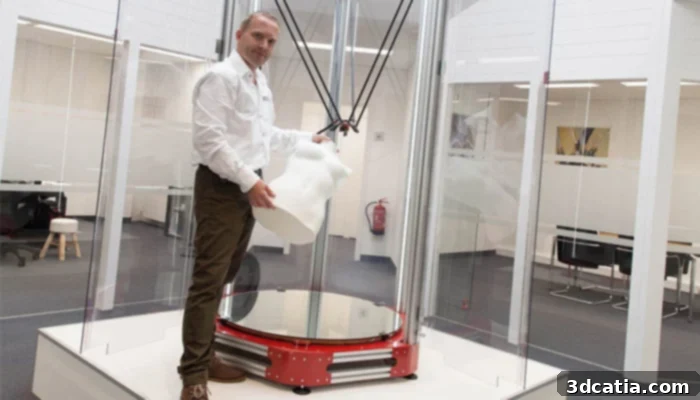
Credits: Tractus3D
While the core FFF technology remains largely consistent across most large format machines, manufacturing at XXL scales demands specific precautions and meticulous attention to detail. Pierre-John Bernard from Volvo Construction Equipment shared his valuable perspective: “When working with large format printing, a different compromise must be found between the sheer size of the print, the resultant printing time, and the required quality. It is critically important to exert a higher degree of control over the entire preparation phase, because even minor mistakes can quickly translate into days of wasted work and material.” Indeed, printing a 1 cubic meter piece can easily take several days. Should there be any defect in the digital file, or a printing error halfway through, the entire process might have to be restarted from scratch, incurring significant costs and delays. Pierre-John further emphasizes: “It is also absolutely essential to conduct thorough parameter validations for each filament used, covering aspects like thread tension, nozzle distance, material flow rates, layer thickness, and optimal temperature settings. Furthermore, the design and implementation of robust support structures are paramount to ensure the stability of the part on the build bed throughout the entire printing duration. In my professional opinion, the choice of the machine itself must be made with extreme care, as the underlying mechanical components must possess exceptional precision and reliability to handle the stresses and scale of large format printing.”
Transformative Applications of Large Format 3D Printing Across Industries
Large format 3D printing is rapidly extending its influence across a multitude of industrial sectors, serving a wide array of purposes from rapid prototyping and the production of specialized tools and jigs, to the direct manufacturing of end-use parts. These applications are incredibly diverse, encompassing everything from intricate lighting fixtures and robust table legs to complex car hoods and personalized architectural components. In essence, large format additive manufacturing is not fundamentally different from conventional 3D printing in terms of the spectrum of possible applications; rather, it extends the scale at which these applications can be realized. Much like its smaller-scale counterpart, large format 3D printing offers significant advantages over traditional manufacturing processes. These benefits include unparalleled design freedom, substantially shorter lead times for product development, enhanced opportunities for personalization, and often, significantly lower costs for developing new products and iterating designs.
For instance, Volvo Construction Equipment has strategically integrated large format 3D printing into its operations to accelerate the validation of new concepts and prototypes. Pierre-John explains the tangible benefits: “The primary objective was to minimize design iterations, thereby reducing delays in our development cycle and ultimately mitigating potential rework costs. Today, we successfully produce a variety of critical parts, including electric motor housings, specialized equipment flanges, intricate cabin interiors, and complex hoses. The possibilities are truly extensive, allowing us to innovate faster and more efficiently.”
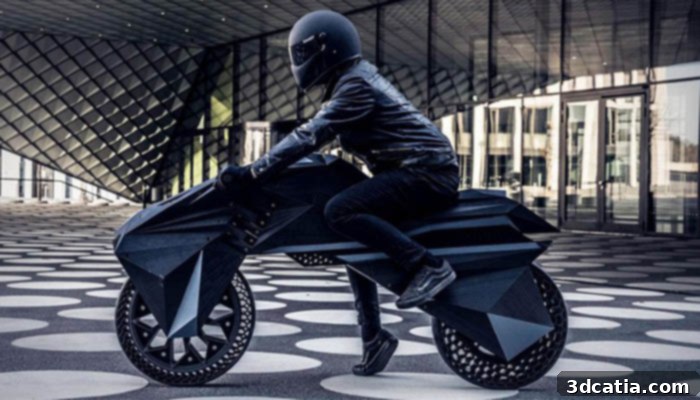
BigRep worked on the NERA prototype for example. A fully 3D printed electric motorcycle.
Companies like Massivit, a prominent leader in the large format visual communication sector, exemplify the innovative applications of this technology. Massivit creates oversized parts specifically for visual marketing campaigns, producing elaborate props, eye-catching billboards, and other large advertising elements. Their proprietary Gel Dispensing Printing (GDP) technology is unique in its ability to achieve exceptionally high printing speeds, making it ideal for rapid production of large, aesthetic pieces. Similarly, BigRep serves as a perfect illustration of the diverse range of projects that large format 3D printers can undertake. The company has collaborated on numerous groundbreaking initiatives, including the development of the NERA, a fully 3D printed electric motorcycle prototype that showcases extreme design freedom and functional integration. More recently, BigRep contributed to the AMAZEA underwater scooter, which is an impressive 75% 3D printed, demonstrating the technology’s capability in complex, high-performance product development.
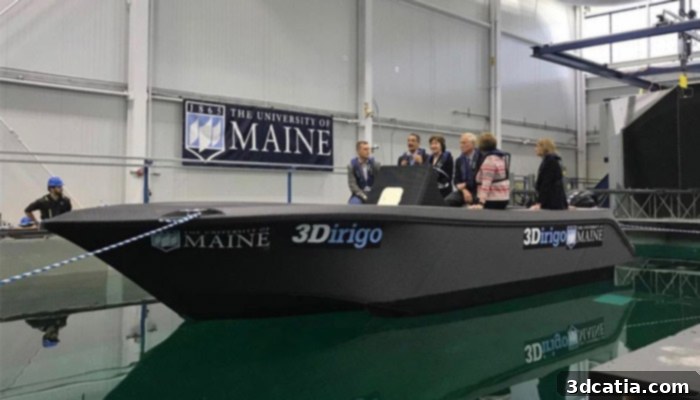
The 3Dirigo boat
Perhaps one of the most widely publicized applications of large format 3D printing comes from the University of Maine’s Advanced Structures and Composites Center: the 3Dirigo boat project. This remarkable vessel, measuring 25 feet in length, was meticulously designed by their industry partner Navatek, a renowned leader in advanced ship design. What makes the 3Dirigo truly extraordinary is that it was 3D printed entirely using ASCC’s immense 3D printer in an astonishingly short period of just 72 hours. Dr. Habib Dagher elaborates on the broader implications for the marine industry: “The UMaine Composites Center received substantial funding of $500,000 from the Maine Technology Institute. This funding was instrumental in forming a dedicated technology cluster aimed at assisting Maine’s esteemed boatbuilders. The cluster’s mission is to explore how large-scale 3D printing, particularly when utilizing economical, cellulose-filled plastics, can provide a significant competitive advantage to the industry. Current methods for direct composite tool manufacture in the marine sector typically involve a complex, multi-step construction technique. This process often includes steel framing, plywood sheathing, a precisely machined polystyrene substrate, all covered with epoxy fiberglass, and finally, an epoxy-based tooling paste for the ultimate machining and coating application.”
Dr. Dagher continues to highlight the efficiency gains: “The innovative application of large-scale 3D printing to manufacture bio-based, recyclable marine tooling offers a dramatically more efficient process for both manufacture and the subsequent final machining and coating application. This will lead to a considerable reduction in tooling creation lead times, which is a major bottleneck in traditional boatbuilding. The synergistic combination of advanced additive manufacturing technologies with cost-effective, bio-filled materials represents a potential game-changer for critical segments of the boatbuilding industry. By significantly reducing both production costs and lead times, this technology can foster greater innovation, improve market responsiveness, and enhance the overall sustainability of marine manufacturing. It truly exemplifies the transformative power of large format 3D printing when applied to specific, high-value industrial challenges.”
Do you have more questions or insights regarding the exciting field of large format 3D printing? We encourage you to share your thoughts in a comment below or engage with us on our Facebook and Twitter pages! Don’t forget to sign up for our free weekly Newsletter, ensuring you receive all the latest news, innovations, and expert analyses in the world of 3D printing delivered directly to your inbox!