
Revolutionizing Gut Health: The Innovative 3D Printed Pill for Advanced Microbiome Analysis
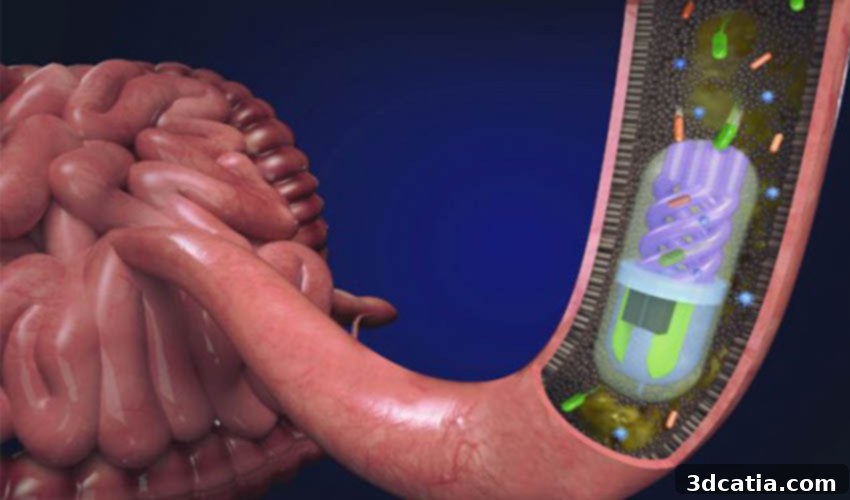
The intricate world of the human gut microbiome holds profound implications for overall health and disease. For years, scientists have sought non-invasive, accurate methods to sample and understand this complex ecosystem. A groundbreaking development from Tufts University is set to transform this field: a team of visionary researchers has successfully 3D printed a revolutionary ingestible pill designed to meticulously sample bacteria within the gastrointestinal (GI) tract. As this ingenious device traverses the digestive system, it collects a precise profile of the gut’s bacterial inhabitants, offering an unprecedented, non-invasive assessment tool. This pioneering innovation promises to deepen our understanding of conditions affecting the intestinal microbiome, potentially paving the way for novel diagnostic and therapeutic strategies.
Detailed in a seminal study published in the *Advanced Intelligent Systems* journal, the device is described as an ingestible, biocompatible, battery-less, and exquisitely 3D-printed micro-engineered pill. This combination of features makes it both safe for human use and remarkably sophisticated in its function. The human gut is a bustling metropolis, home to more than 1,000 distinct species of bacteria in a healthy individual. The vast majority of these microorganisms play a vital, beneficial role, actively aiding in digestion, nutrient absorption, and providing robust protection against disease-causing pathogens. However, when the delicate natural balance of these bacterial communities is disrupted – a condition known as dysbiosis – it can trigger a cascade of health complications, ranging from digestive disorders like Irritable Bowel Syndrome (IBS) and Inflammatory Bowel Disease (IBD) to broader systemic issues potentially linked to obesity, allergies, and even neurodegenerative conditions.
It is precisely this critical need to understand, monitor, and ultimately prevent such disturbances that has driven the Tufts researchers. Sameer Sonkusale, a distinguished professor of electrical and computer engineering at Tufts University’s School of Engineering and the corresponding author of this impactful study, eloquently articulates the mission: “We are learning quite a lot about the role of gut microbiome in health and disease. However, we know very little about its biogeography. The pill will improve our understanding of the role of spatial distribution in the microbiome profile to advance novel treatments and therapies for a number of diseases and conditions.” This statement underscores the importance of not just knowing *what* bacteria are present, but also *where* they are located within the vast expanse of the gut, a critical piece of information that conventional stool samples often fail to capture accurately. The pill’s ability to sample at various points along the GI tract offers an unprecedented view into this “biogeography.”

Tufts University Campus | Credits: Tufts University
Why Was This Pill 3D Printed? The Power of Additive Manufacturing in Medicine
The choice of 3D printing technology for manufacturing this innovative pill was not merely a matter of convenience; it was a fundamental requirement for achieving its intricate design and functionality. One of the paramount advantages of 3D printing, also known as additive manufacturing, is its unparalleled ability to create highly complex structures that would be exceedingly difficult, if not impossible, to produce using conventional manufacturing methods. This particular pill exemplifies this benefit perfectly. It was fabricated using a sophisticated 3D printer capable of integrating microscopic fluidic channels—microfluidic channels—within its structure. These channels are crucial because they allow the pill to precisely sample the diverse microbial populations at different, distinct stages of the gastrointestinal tract, from the acidic environment of the stomach to the varying pH levels of the small and large intestines.
Furthermore, the surface of the pill is ingeniously coated with a pH-sensitive material. This smart coating ensures that the pill remains inert, preventing any premature absorption of samples, until it reaches the specific pH environment of the small intestine. Upon encountering this environment, the coating precisely dissolves, activating the sampling mechanism. Inside the pill, a meticulously engineered membrane separates two distinct chambers. One chamber is equipped with helical channels specifically designed to efficiently take up and capture bacterial samples as the pill navigates the gut. The other chamber contains a calcium salt, playing a role in the overall functionality and safety of the device. Beyond its sampling capabilities, the pill also incorporates a small magnet and a fluorescent dye. These components are not for sampling but are vital for tracking the pill’s journey and location within the body using external imaging techniques, ensuring researchers can monitor its path and confirm successful operation. Giovanni Widmer, a co-author of the paper, highlights the user-centric design: “The design of this device makes it incredibly easy to use, posing little risk to the subject, yet providing so much information.” This emphasizes the balance between advanced technological capability and practical, patient-friendly application.
This innovative application of 3D printing technologies marks a significant leap forward in the medical field. It underscores the immense potential of additive manufacturing not just for creating physical objects, but for engineering sophisticated solutions that interact directly with biological systems. We have previously reported on other pioneering uses of 3D printed pills, such as those developed by Multiply Labs. Their approach focuses on creating personalized treatments, where 3D printed pills can be tailored to release active pharmaceutical ingredients at specific times throughout the day, optimizing drug efficacy and minimizing side effects for individual patients. These advancements highlight a rapidly growing segment within additive manufacturing that holds immense promise.
The ability to custom-design pills with precise internal geometries, controlled release mechanisms, and integrated sensing capabilities opens up a new frontier in personalized medicine and diagnostics. The segment of 3D printed pharmaceuticals is dynamic, with many more applications expected to become feasible and widespread in the coming years. From targeted drug delivery systems to on-demand pharmaceutical production, the possibilities are vast and transformative. The researchers behind the Tufts project are driven by the hope of better identifying and understanding the crucial roles played by different intestinal bacterial species in both maintaining health and contributing to disease pathogenesis. They view this groundbreaking pill as merely the beginning of a much larger journey, anticipating a future where such technologies enable more accurate diagnoses, more effective treatments, and a deeper comprehension of the complex interplay between our bodies and our microbial inhabitants. This truly signifies a new era for gastrointestinal health and personalized medicine.
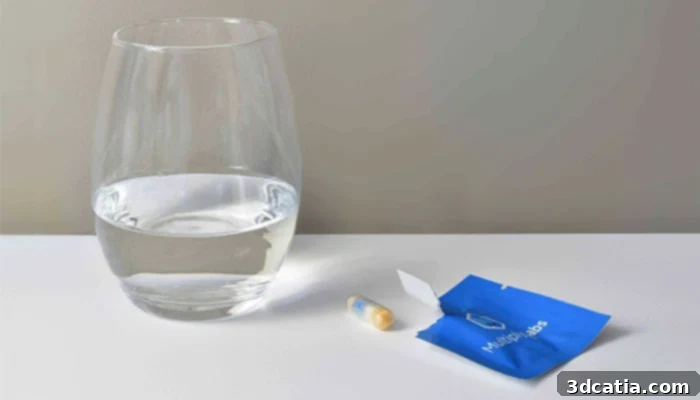
Multiply Labs’ 3D printed pill | Credits: Multiply Labs
For a more comprehensive dive into this exciting research, you can find additional information HERE.
*Cover Picture Credits: Nano Lab, Tufts University
What are your thoughts on this incredible new research and the potential it holds for transforming gut health diagnostics and treatments? Share your insights and comments below, or join the conversation on our Facebook and Twitter pages! Don’t miss out on the latest advancements and news in the world of 3D printing – remember to sign up for our free weekly Newsletter, delivered directly to your inbox!