
University of Minnesota Researchers Achieve Breakthrough: 3D Printing Flexible OLED Displays for the Future of Electronics
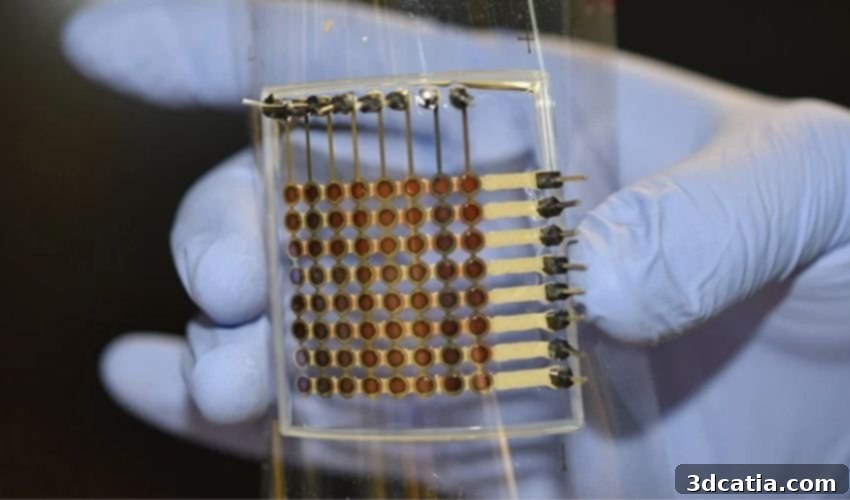
In a significant leap forward for display technology and additive manufacturing, a pioneering team of researchers at the University of Minnesota has successfully created the world’s first 3D printed, flexible organic light-emitting diode (OLED) displays. This groundbreaking achievement marks a critical step towards more versatile, durable, and potentially affordable electronic devices. Measuring 3.8 cm by 3.8 cm and featuring 64 active pixels, this prototype demonstrates the feasibility of manufacturing complex, high-performance displays using advanced 3D printing techniques.
The project garners particular interest due to its potential to revolutionize consumer electronics. Imagine smartphones that can truly fold without compromise, televisions that roll up like posters, or wearable devices seamlessly integrated into clothing. Current manufacturing methods for flexible displays often involve complex and expensive processes, typically requiring large, ultra-clean fabrication facilities. By leveraging two distinct additive manufacturing technologies and a meticulously designed custom printer, the Minnesota team has paved the way for a manufacturing paradigm that could make these futuristic visions a more affordable and accessible reality for a wide range of applications, from medical devices to smart textiles.
Understanding OLED Technology and Its Manufacturing Hurdles
Organic light-emitting diodes, or OLEDs, represent a significant evolution from traditional liquid crystal displays (LCDs). Unlike LCDs, which rely on inorganic crystalline semiconductors and a backlight to produce images, OLEDs utilize thin layers of organic compounds that emit light when an electric current passes through them. This fundamental difference grants OLEDs several compelling advantages that make them highly desirable for modern electronics:
- Superior Energy Efficiency: Without the need for a separate backlight, OLEDs consume less power, leading to longer battery life in portable devices and reduced energy consumption for larger screens, contributing to greener technology.
- Exceptional Contrast and True Blacks: Each pixel in an OLED display can be individually switched off, resulting in perfect blacks and an infinite contrast ratio, offering unparalleled visual depth, vibrancy, and detail, especially in dark scenes.
- Mechanical Flexibility: The organic materials inherently allow for thinner, lighter, and more flexible display structures. This characteristic is crucial for developing innovative form factors like rollable TVs, foldable phones, and curved displays for automotive dashboards.
- Wider Viewing Angles: OLED displays maintain color accuracy and brightness even when viewed from extreme angles, enhancing the user experience for multiple viewers or dynamic content.
- Enhanced Durability: Their inherent flexibility can also contribute to better resistance against physical impact and breakage compared to rigid display technologies, making devices more robust.
Despite these compelling benefits, the 3D printing of OLEDs has historically faced numerous formidable challenges. Traditional OLED fabrication typically occurs in ultra-clean, vacuum-sealed environments, demanding immense precision and significant capital investment. Adapting this to additive manufacturing presents unique obstacles. A primary difficulty lies in creating the active organic light-emitting layer. This layer requires near-perfect uniformity across its entire surface to ensure consistent light emission and prevent visual defects such as uneven brightness or dead pixels. Achieving such uniformity through 3D printing, where materials are deposited layer by layer, is significantly more complex than conventional vacuum deposition methods. Furthermore, the bonds formed between polymer and metal layers during 3D printing processes have often proven to be less stable, compromising the longevity and overall performance of the device. These issues have largely limited the widespread adoption of 3D printing for high-quality, functional OLEDs until now, highlighting the significance of the University of Minnesota team’s breakthrough.
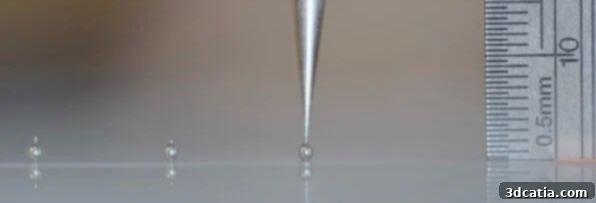
An extrusion method and a spray process were key to creating the flexible OLED display (photo credits: McAlpine Group, University of Minnesota)
The Innovative 3D Printing Process: Building OLEDs Layer by Layer
To overcome the previously insurmountable hurdles in 3D printing OLEDs, the University of Minnesota team developed a novel approach that synergistically combines two sophisticated additive manufacturing processes. This hybrid methodology allowed them to meticulously construct the six distinct layers necessary for a fully functional OLED display. Each layer plays a crucial role in the display’s operation, and the specific printing technique was carefully chosen and optimized for the precise deposition of its respective material.
Six Layers 3D Printed to Form the OLED Display
The fabrication process commenced with the utilization of an extrusion-based 3D printing machine. This highly precise method was employed to create several critical, robust components of the display structure. These included the conductive electrodes, which efficiently carry electrical current across the display; insulating layers, strategically placed to prevent short circuits and ensure proper electrical isolation; interconnects, vital for linking various parts of the display’s circuitry; and a durable encapsulation layer, designed to protect the delicate organic materials from environmental degradation caused by moisture and oxygen. Extrusion printing, often compared to decorating a cake or extruding toothpaste, involves forcing a viscous material through a nozzle to deposit it in precise, controlled patterns, thereby enabling the creation of well-defined structural elements with mechanical integrity.
Following the creation of these foundational layers, the same custom-built 3D printer seamlessly transitioned to a spray printing process for depositing the more sensitive organic and active layers. This dual-process integration within a single machine is a testament to the sophisticated custom engineering involved. The layers were successively printed from a variety of carefully selected materials, each chosen for its specific function within the complex OLED stack. For example, the very first layer was strategically deposited onto a flexible PET (polyethylene terephthalate) film, which serves as the pliable and transparent substrate upon which the entire display is built. This initial layer also incorporated silver nanoparticles, ensuring excellent electrical conductivity to the subsequent layers. Further into the stack, a critical silicone layer was applied as the fourth layer, effectively covering and protecting the underlying conductive and active materials while maintaining the overall flexibility of the device. Finally, the entire multi-layered device was meticulously encapsulated with a protective polymer cast within an extrusion-printed silicone mold, providing comprehensive environmental protection and structural integrity to the nascent flexible display, ensuring its long-term performance.
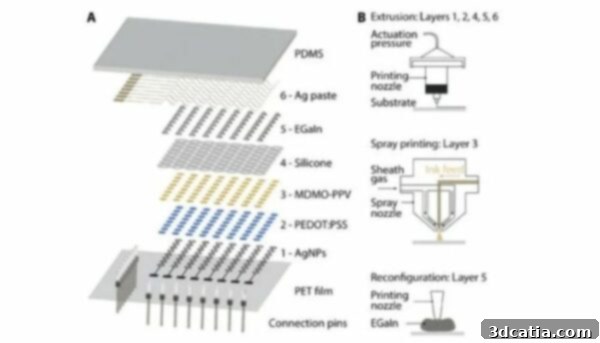
The flexible OLED screen is meticulously composed of 6 different layers, each applied with precision (photo credits: McAlpine Group, University of Minnesota)
Overcoming Challenges: The Breakthrough of Spray Printing for Uniformity
A critical innovation that proved indispensable for the success of this project was the implementation of the spray printing method specifically for the active organic layers. As the research team elaborated in their study, “Overall, the lack of uniformity in the active layers caused large variations in light emission across the active regions within the same batch of devices, signifying the need for alternatives to extrusion printing for the fabrication of large-scale display devices. Therefore, we exploited a spray printing method to deposit MDMO-PPV to improve the uniformity of the active layers.” This quote highlights the core problem with conventional additive manufacturing for OLEDs: achieving the necessary, consistent thickness and material distribution across the light-emitting organic layers. Without this critical uniformity, the display would inevitably suffer from uneven brightness, inconsistent color reproduction, and overall poor visual performance, making it commercially unviable.
The team’s ingenious solution involved integrating a specialized spray nozzle directly into their versatile 3D printing system. This nozzle functions by atomizing the ink – in this case, a precisely formulated solution containing the organic semiconductor MDMO-PPV – at its orifice. This atomization is achieved by generating a high relative speed between the nearly static ink and a stream of pressurized sheath gas. The result is the creation of incredibly fine microdroplets, typically with diameters ranging from a mere 30 to 50 micrometers. Crucially, these minute droplets rapidly evaporate almost immediately after impacting the printing substrate. This rapid evaporation plays a vital role in the process: it effectively suppresses mass transport in the lateral direction, meaning the deposited material does not excessively spread or clump unevenly after deposition. This unprecedented level of precise control over material placement and subsequent drying led to a dramatic and essential improvement in layer quality. “In the spray-printed active region, microdroplets were uniformly distributed across the target area and a substantial reduction in the thickness variation was observed,” the team proudly stated, underscoring the success of their novel method. The culmination of this innovative approach was a functional, flexible prototype measuring 3.8 centimeters on each side, boasting 64 pixels that consistently and uniformly display light, proving the viability of their advanced manufacturing technique.
The Custom Machine and a Glimpse into the Future of Display Manufacturing
The advanced manufacturing capabilities demonstrated by the University of Minnesota team are largely attributed to their meticulously custom-developed machine. This sophisticated printer is far from a standard off-the-shelf unit; it incorporates multiple specialized nozzles, each precisely designed for specific materials and printing processes (like extrusion and spray), which can be efficiently interchanged depending on the layer currently being deposited. These diverse nozzles are precisely mounted on a robotic gantry system, allowing for highly accurate, repeatable movements and seamless transitions between different printing operations across the printing substrate. While the precise development cost of this bespoke system is significant – estimated to be similar to that of a high-end electric vehicle like a Tesla Model S – its initial investment is seen as a crucial enabler for a technology with immense long-term potential and far-reaching implications.
Michael McAlpine, a senior lecturer in the Department of Mechanical Engineering at the University of Minnesota and a driving force behind this research, envisions a future where such advanced display manufacturing becomes far more accessible and democratized. He noted, “OLED displays are usually produced in big, expensive, ultra-clean fabrication facilities. This is something that we actually manufactured in the lab, and it is not hard to imagine that you could translate this to printing all kinds of displays ourselves at home or on the go within just a few years, on a small portable printer.” This powerful statement underscores the transformative potential of their work. Moving complex display manufacturing out of multi-billion-dollar cleanrooms and into more localized, flexible, and potentially even personal environments could drastically reduce production costs, accelerate innovation cycles, and enable unprecedented levels of customization. This vision extends beyond simple screens, suggesting a future where embedded displays are commonplace in everyday objects, personalized to individual needs, and manufactured on demand, fostering a new era of interactive and intelligent products.
The ability to 3D print flexible OLEDs could usher in a new era for numerous industries. In healthcare, it could mean the development of flexible diagnostic patches, smart bandages with integrated real-time displays for patient monitoring, or custom prosthetic interfaces. For the automotive sector, entire dashboards and interior surfaces could become dynamic, curved display surfaces, enhancing driver experience and safety. Fashion and textiles could incorporate intelligent fabrics with embedded, foldable screens for interactive clothing or smart accessories. Moreover, this research not only provides a robust proof of concept for 3D printed flexible OLEDs but also lays the foundational groundwork for scaling up production, improving resolution and pixel density, and developing a wider array of flexible electronic components, potentially including sensors and power sources. The implications for sustainable manufacturing are also profound, as on-demand printing could significantly reduce material waste associated with traditional mass production and long, complex supply chains, contributing to a more circular economy.
While we eagerly anticipate what the future holds for display technologies and their seamless integration into our daily lives, you can delve deeper into the specifics of this groundbreaking study by finding the full research paper HERE. What are your thoughts on utilizing advanced additive manufacturing techniques to produce flexible OLED displays? Share your insights, predictions, and potential applications in a comment below, or engage with us on our social media platforms: LinkedIn, Facebook, and Twitter! Don’t forget to sign up for our free weekly Newsletter here to receive the latest 3D printing news straight to your inbox! You can also explore all our fascinating videos and interviews on our dedicated YouTube channel.
*Cover Photo Credits: McAlpine Group, University of Minnesota