
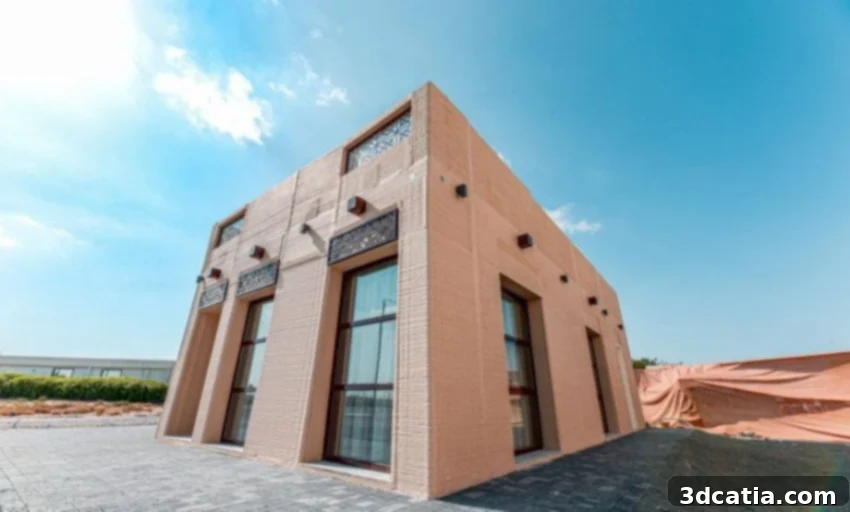
Revolutionizing Construction: The UAE’s First Emirati-Inspired 3D Printed Villa in Sharjah
The landscape of modern construction is undergoing a significant transformation, with 3D printing technology emerging as a pivotal force. In the heart of the United Arab Emirates, specifically within Sharjah’s vibrant Sharjah Research, Technology, and Innovation Park (SRTIP), a groundbreaking project has come to fruition. MEET (Middle Eastern Engineering Technologies) has successfully completed the construction of the MEET 3D Villa, marking a new era for architectural innovation in the region. This remarkable villa, a testament to rapid and sustainable construction, was printed in an astonishingly short span of just two weeks. This ambitious undertaking was made possible through the invaluable expertise and on-site support provided by the CyBe team, renowned developers, sellers, and users of state-of-the-art concrete 3D printers since their establishment in 2013. The collaboration brought together cutting-edge technology and regional vision, paving the way for future advancements.
This pioneering project is not merely a technical achievement; it represents a profound fusion of innovation and cultural identity. The MEET 3D Villa stands as the first 3D printed villa explicitly designed with inspiration drawn from rich Emirati heritage and architectural traditions. Its inception reflects a powerful collaboration across public, private, and academic sectors, highlighting a collective commitment to pushing the boundaries of what is possible in construction. Beyond its innovative structure, the villa is a beacon of sustainability, harnessing solar energy as its primary power source. This dedication to clean energy underscores a broader vision for a greener, more sustainable future, ensuring that progress benefits both current inhabitants and generations to come in the UAE and beyond.
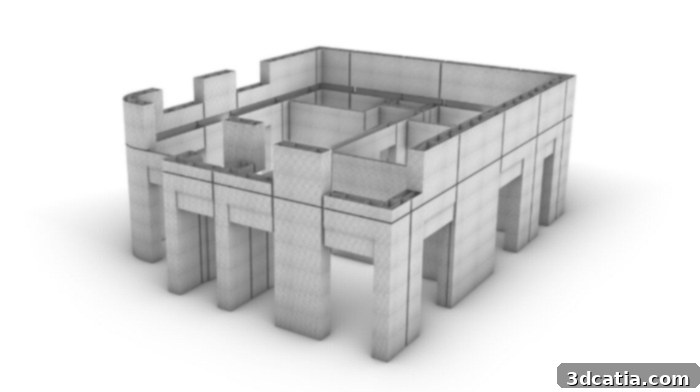
The walls of the villa were entirely 3D printed using concrete 3D printers, demonstrating the efficiency and precision of additive manufacturing in construction.
The Vision Behind the MEET 3D Villa: Blending Heritage with Innovation
The development of the MEET 3D Villa is deeply rooted in Sharjah’s strategic vision to become a global hub for innovation and sustainable development. The Sharjah Research, Technology, and Innovation Park (SRTIP) serves as an ideal ecosystem for such pioneering projects, fostering an environment where research meets practical application. The decision to infuse the villa’s design with Emirati heritage and architecture is particularly significant. It moves beyond merely demonstrating technological capability, aiming instead to create spaces that resonate with local culture and identity. This thoughtful integration ensures that advanced construction methods do not alienate traditional aesthetics but rather enhance them, offering a unique blend of past and future. Elements commonly found in traditional Emirati homes, such as privacy, spatial orientation, and the use of local materials (albeit simulated and improved by 3D printing), have been reinterpreted through this modern lens, creating a living space that feels both familiar and revolutionary.
The collaborative spirit driving this project exemplifies a forward-thinking approach to national development. Bringing together governmental entities, private enterprises like MEET and CyBe, and academic institutions such as the American University of Sharjah, creates a synergy that accelerates innovation. Each sector contributes its unique strengths: government provides strategic direction and regulatory support, private companies offer technological solutions and implementation expertise, and academia contributes research, development, and future talent. This multi-sectoral partnership ensures that the project benefits from diverse perspectives and resources, establishing a robust model for future large-scale projects aimed at modernizing infrastructure and promoting sustainable living within the UAE.
Unpacking the 3D Printing Process and its Advantages
When discussing a “3D printed house,” it’s crucial to understand that, primarily, the structural walls are produced using additive manufacturing techniques. In the case of the MEET 3D Villa, an impressive 100% of its walls were 3D printed in just over two weeks. This incredible speed is one of the most compelling advantages of concrete 3D printing. Traditional construction methods, involving formwork, pouring concrete, and curing, are significantly more time-consuming. CyBe’s advanced concrete 3D printers meticulously lay down successive layers of a specialized concrete mixture, building the walls precisely according to digital blueprints. This automated process minimizes human error, enhances structural integrity, and drastically reduces the overall construction timeline.
Beyond speed, the villa is designed to be an insulated and sustainable house. The materials and construction method employed allow for integrated insulation, improving thermal performance and reducing the need for excessive heating or cooling – a critical factor in the UAE’s climate. This inherent energy efficiency contributes directly to lower operational costs and a smaller carbon footprint throughout the villa’s lifespan. Furthermore, 3D printing generates significantly less waste compared to conventional construction, as materials are precisely deposited only where needed. This reduction in material waste aligns perfectly with sustainable building practices and contributes to a circular economy in construction. The incorporation of traditional Emirati architecture, coupled with these high-tech, eco-friendly features, makes the MEET 3D Villa a groundbreaking example of how modernity and heritage can coexist harmoniously to create sustainable, comfortable, and aesthetically pleasing living spaces. The villa was officially inaugurated on Tuesday, December 15th, marking its readiness for a new era of inhabitation.
Sustainability at its Core: The Power of Solar Energy
A cornerstone of the MEET 3D Villa’s design philosophy is its unwavering commitment to environmental sustainability. The house is powered entirely by the latest bifacial solar panels, representing a significant leap towards energy independence and clean energy utilization. Bifacial solar panels are advanced photovoltaic modules that can capture sunlight from both their front and rear sides, maximizing energy generation efficiency. This innovative technology allows the villa to harness more solar energy throughout the day, ensuring a consistent and robust supply of clean electricity. The integration of such cutting-edge solar solutions dramatically reduces the villa’s reliance on grid electricity, thereby lowering its carbon emissions and contributing to a healthier planet.
The UAE has consistently demonstrated its dedication to sustainable development and renewable energy initiatives. The MEET 3D Villa, with its self-sufficient solar power system, serves as a tangible example of this national commitment. It showcases how residential buildings can be designed and constructed to minimize environmental impact while maintaining high standards of comfort and modern living. By pioneering such energy-efficient designs, the project provides a blueprint for future sustainable urban developments within the region, encouraging broader adoption of renewable energy sources in construction. This focus on clean energy not only ensures a better future for present generations but also safeguards natural resources and environmental quality for future inhabitants of the United Arab Emirates.
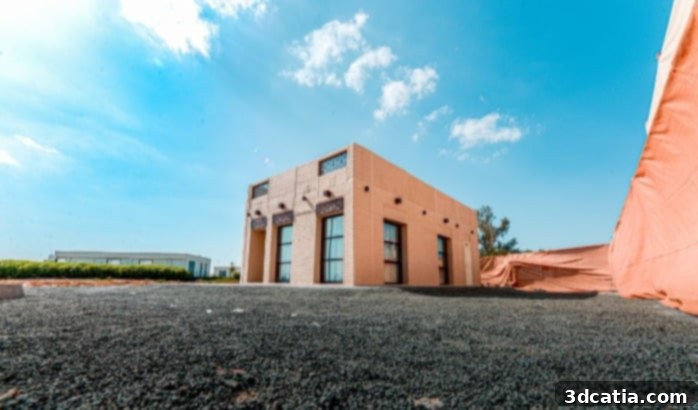
The fully realized 3D Printed Villa stands as a beacon of innovation in Sharjah, showcasing the potential of additive construction.
CyBe’s Pivotal Role: Technology and Education Partner
CyBe’s involvement in the MEET 3D Villa project extended far beyond simply supplying concrete 3D printers. As they articulated on their website, their mandate was to function as a comprehensive “technology and education partner.” This encompassed providing the advanced 3D printing technology required for construction, alongside extensive on-site training and support for the local teams. Such a hands-on approach is critical for the successful adoption and scaling of new technologies, ensuring that local engineers and construction professionals are equipped with the skills and knowledge to operate and innovate with 3D printing. This transfer of expertise is vital for building a sustainable future for additive manufacturing in the region.
Furthermore, CyBe engaged in crucial research activities at the American University of Sharjah, solidifying the academic pillar of the collaborative framework. This research component is essential for continuous improvement in 3D printing materials, processes, and applications, ensuring that Sharjah remains at the forefront of architectural and construction innovation. CyBe’s broader ambition, as stated, is “to make Sharjah a preferred destination for future architecture, as well as changing construction globally.” This bold vision highlights the transformative potential they see in this partnership. By actively participating in both the practical implementation and the intellectual development of 3D printing in construction, CyBe is helping to establish Sharjah as a leading light, not just regionally but internationally, for sustainable and advanced building practices. This commitment extends to developing localized solutions and fostering a robust ecosystem for future growth in additive construction.
The Global Acceleration of 3D Printed Construction
The completion of the MEET 3D Villa comes at a time when the global landscape of 3D printed house projects is experiencing unprecedented acceleration. Over the past few months, there has been a noticeable surge in the number and scale of such initiatives worldwide, signifying a growing confidence in additive manufacturing as a viable and advantageous construction method. What is particularly encouraging is that an increasing number of these projects are not just prototypes or showcases but are becoming fully habitable structures, integrating seamlessly into existing communities and demonstrating long-term viability.
A notable example of this global trend is the three-story residential building in Wallhausen, Germany, impressively 3D printed by COBOD. This project, among others, illustrates the scalability of 3D printing technology to multi-story structures and its potential for addressing housing needs more efficiently. Projects like the MEET 3D Villa in Sharjah contribute significantly to this global momentum. They serve as tangible proof-of-concept, demonstrating that 3D printing can adapt to diverse architectural styles, environmental conditions, and regulatory frameworks, while also meeting high standards of quality and sustainability. The increased adoption points towards a future where customized, cost-effective, and rapidly constructed buildings become commonplace, revolutionizing urban development and offering solutions for affordable housing and specialized infrastructure needs across the globe. You can learn more details about the construction process and features of the MEET 3D Villa by visiting the CyBe case study page.
The Future of Architecture and Sustainable Living in the UAE
The successful completion of the MEET 3D Villa is more than just a single project; it is a foundational step in shaping the future of architecture and sustainable living in the United Arab Emirates. By integrating advanced 3D printing technology with a deep respect for Emirati heritage and a steadfast commitment to clean energy, Sharjah is setting a powerful precedent. This villa demonstrates that it is entirely possible to create homes that are not only aesthetically pleasing and culturally resonant but also incredibly efficient, environmentally friendly, and rapidly deployable. Such innovations are critical for the UAE’s ambitious goals related to smart cities, economic diversification, and achieving net-zero emissions targets. The lessons learned from this project, from material development to operational efficiencies and the nuances of public-private-academic collaboration, will undoubtedly inform future construction policies and urban planning strategies across the Emirates.
The implications of projects like the MEET 3D Villa extend beyond residential construction. The capabilities demonstrated here can be applied to various infrastructure projects, commercial buildings, and even emergency housing solutions, showcasing the versatility of additive manufacturing. As the technology continues to evolve, we can anticipate even greater levels of automation, wider material choices, and even more complex architectural designs becoming feasible. The UAE, with its forward-thinking leadership and investment in innovation, is perfectly positioned to lead this charge, transforming its skylines and living environments to reflect a commitment to a progressive, sustainable, and technologically advanced future. The MEET 3D Villa stands as a proud symbol of this vision, inviting the world to witness how tradition and technology can collaboratively build a better tomorrow.
What do you think of this pioneering 3D printed villa and its implications for the future of construction? We invite you to share your thoughts and insights in a comment below or engage with us on our Facebook and Twitter pages. Don’t miss out on the latest advancements and news in the world of additive manufacturing! Sign up for our free weekly newsletter to receive all the crucial updates on 3D printing delivered straight to your inbox.