
Resin 3D Printer Manufacturers in the United States: A Comprehensive Guide
The world of additive manufacturing has been revolutionized by resin 3D printing, a technology that originated in the United States. Chuck Hull’s groundbreaking 1984 patent for stereolithography (SLA) laid the foundation for a dynamic industry that continues to expand and innovate. Since then, American companies have been at the forefront of resin 3D printing advancements, pioneering technologies like SLA, MSLA (Masked Stereolithography Apparatus), and DLP (Digital Light Processing). These technologies empower the creation of highly precise, high-quality parts suitable for a diverse range of applications, from intricate jewelry and detailed dentistry models to functional rapid prototypes and end-use parts.
The innovation in resin 3D printing is not confined to a single region but is instead distributed across the United States. This widespread development is reflected in a vibrant ecosystem of U.S.-based manufacturers, offering a comprehensive range of resin 3D printers. These manufacturers cater to various needs, providing everything from compact, user-friendly desktop machines ideal for hobbyists and small businesses to large-scale industrial SLA systems capable of handling demanding production environments. This article offers a snapshot of the American resin 3D printing landscape, showcasing key companies and highlighting where innovation is thriving across the nation. We’ll explore the different types of resin 3D printing technologies, the benefits of using resin printers, and some of the leading manufacturers in the United States.
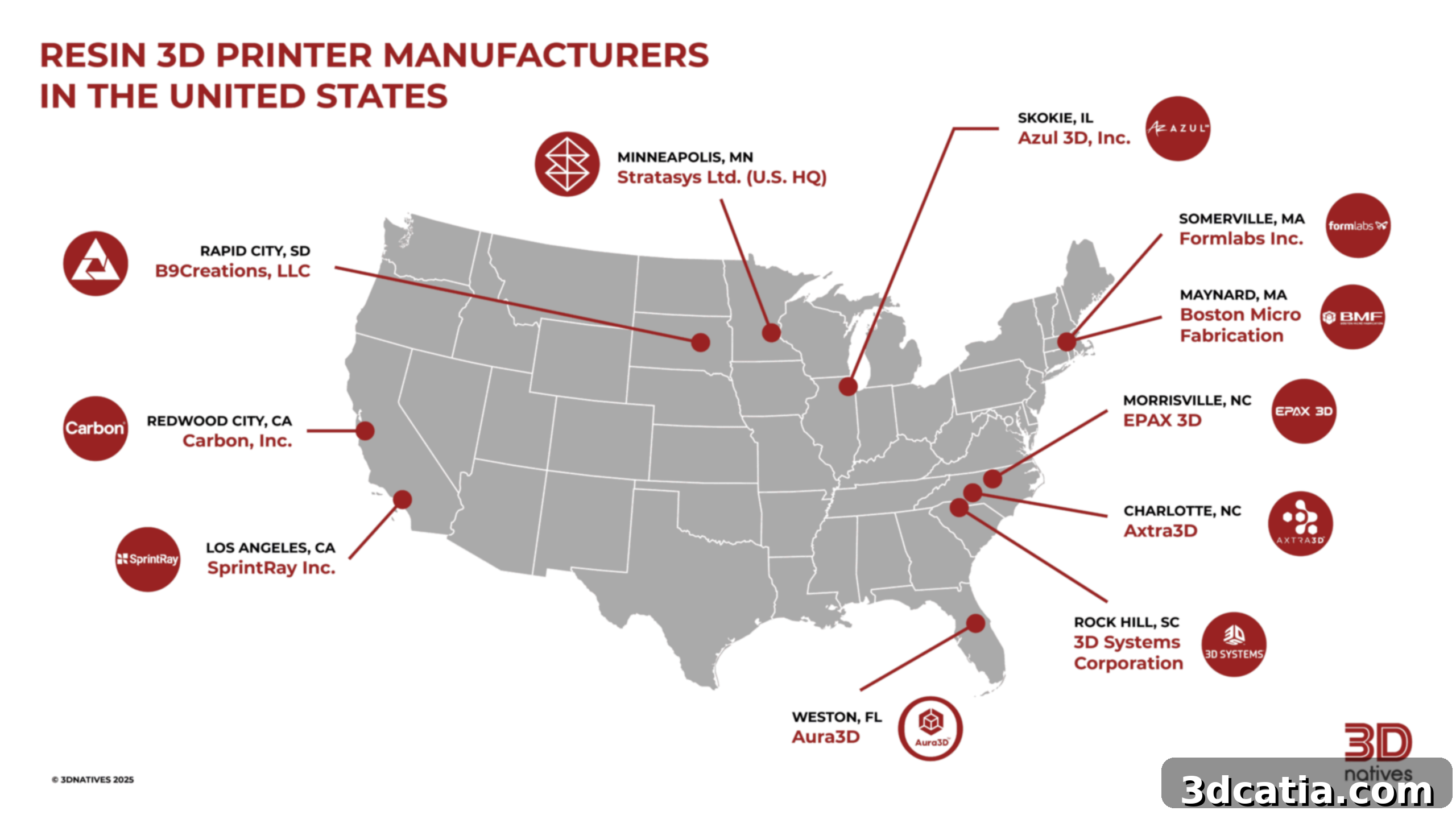
To view and download this map as a PDF, click HERE.
Interested in the companies that produce the specialized resins used in this process? You can find a comprehensive list of American resin manufacturers here. This resource will provide valuable insights into the materials that fuel the resin 3D printing revolution.
We encourage you to explore the landscape of American resin manufacturers and share your insights. Which companies are you familiar with? Are there any manufacturers we might have overlooked? Your feedback is valuable and helps us keep our resources up-to-date. Please feel free to share your thoughts and experiences in the comments section or on our LinkedIn or Facebook pages! Furthermore, stay informed about the latest developments in 3D printing by subscribing to our free weekly Newsletter, delivering the most relevant news directly to your inbox. You can also access a wealth of informative content on our YouTube channel, where you’ll find a diverse range of videos covering various aspects of 3D printing technology and applications.
Understanding Resin 3D Printing Technologies
Resin 3D printing encompasses several distinct technologies, each offering unique advantages and catering to specific applications. The primary technologies include Stereolithography (SLA), Masked Stereolithography Apparatus (MSLA), and Digital Light Processing (DLP). Let’s delve into each of these methods:
Stereolithography (SLA): As the original resin 3D printing technology, SLA utilizes a laser beam to selectively cure liquid resin layer by layer. The laser traces the outline of each layer, solidifying the resin and gradually building the object from the bottom up. SLA is known for producing highly accurate parts with smooth surface finishes, making it ideal for applications requiring precision and detail. However, SLA can be slower compared to other resin printing methods, especially for larger parts.
Masked Stereolithography Apparatus (MSLA): MSLA improves upon SLA by using an LCD screen to project an entire layer onto the resin at once. This dramatically speeds up the printing process, as the entire layer is cured simultaneously rather than being traced by a laser. MSLA printers are generally more affordable than SLA printers, making them a popular choice for hobbyists and small businesses. While MSLA can achieve excellent detail, the resolution is limited by the pixel size of the LCD screen.
Digital Light Processing (DLP): Similar to MSLA, DLP uses a projector to cure entire layers of resin at once. However, DLP projectors use digital micromirror devices (DMDs) to create the image, resulting in higher resolution and more precise control over the curing process. DLP printers are often used for applications requiring exceptional detail and accuracy, such as dental models and jewelry. DLP printers tend to be more expensive than MSLA printers but offer superior performance.
Benefits of Resin 3D Printing
Resin 3D printing offers several key advantages over other 3D printing technologies, making it a popular choice for various applications. These benefits include:
High Precision and Detail: Resin 3D printers are capable of producing parts with exceptional accuracy and fine detail, making them ideal for applications requiring intricate designs and precise dimensions. This is particularly important for industries like dentistry, jewelry, and microfluidics.
Smooth Surface Finish: Resin 3D printed parts typically have a smooth surface finish, reducing the need for post-processing. This is a significant advantage over technologies like Fused Deposition Modeling (FDM), which often requires extensive sanding and polishing to achieve a smooth surface.
Versatile Material Options: A wide range of resins are available, each with unique properties to suit different applications. These resins include flexible resins, tough resins, castable resins, and biocompatible resins, among others. This versatility allows engineers and designers to select the optimal material for their specific needs.
Relatively Fast Print Speeds (Especially MSLA/DLP): Compared to some other 3D printing technologies, resin 3D printing, particularly MSLA and DLP, can offer relatively fast print speeds, especially for parts with small footprints. This can significantly reduce production time and increase throughput.
Key American Resin 3D Printer Manufacturers
The United States is home to a number of leading resin 3D printer manufacturers, each contributing to the advancement of the technology. Here are a few notable companies:
3D Systems: A pioneer in the 3D printing industry, 3D Systems offers a range of SLA printers for various applications, from prototyping to production. They are known for their high-performance machines and extensive material portfolio.
Formlabs: Formlabs is a leading manufacturer of desktop SLA printers, popular for their ease of use, affordability, and high-quality output. They offer a variety of resins for different applications and have a strong presence in the dental and healthcare industries.
Carbon: Carbon is known for its innovative Digital Light Synthesis (DLS) technology, a type of DLP that enables the production of parts with exceptional mechanical properties and surface finish. Their printers are used in a variety of industries, including automotive, aerospace, and consumer goods.
Stratasys: While primarily known for FDM and PolyJet technologies, Stratasys also offers resin 3D printing solutions through its acquisition of Origin. Origin’s Programmable PhotoPolymerization (P3) technology allows for high-speed, high-resolution printing with a wide range of materials.
This is just a small sampling of the many American companies that are pushing the boundaries of resin 3D printing. The continued innovation and development in this field promise even more exciting advancements in the years to come.
Conclusion: The Future of Resin 3D Printing in the US
The resin 3D printing industry in the United States is thriving, driven by a combination of pioneering innovation, a diverse ecosystem of manufacturers, and the increasing demand for high-precision, high-quality parts. As the technology continues to evolve and new materials are developed, resin 3D printing is poised to play an even greater role in various industries, from healthcare and aerospace to consumer goods and beyond. The American companies highlighted in this article are at the forefront of this revolution, shaping the future of additive manufacturing and driving innovation on a global scale.