
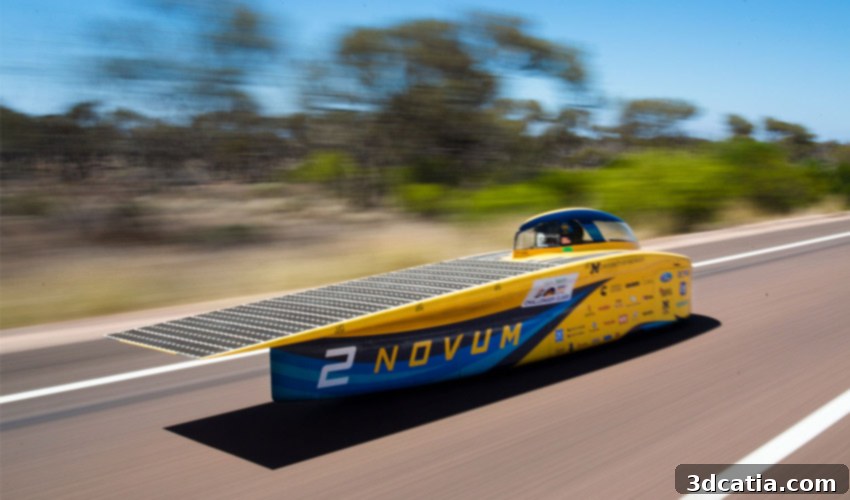
Uniformity Labs Revolutionizes Solar Racing with Advanced 3D Printed Aluminum Roll Cages
Uniformity Labs, a pioneering company at the forefront of advanced manufacturing, continues to push the boundaries of 3D printing technology, particularly in the realm of high-performance automotive components. Recently, the California-based innovator achieved a significant milestone by producing an ultra-low-porosity aluminum alloy (AlSi10Mg) automotive component: a sophisticated roll cage for a cutting-edge solar-powered race car. This critical safety and structural element was meticulously fabricated using state-of-the-art Selective Laser Melting (SLM) technology, showcasing the immense potential of metal additive manufacturing for demanding applications.
The project highlights the transformative impact of additive manufacturing (AM) within the automotive sector. AM is increasingly favored for its unparalleled ability to produce bespoke, high-performance parts that are not only lighter but also more cost-effective than those made with conventional methods. A key advantage lies in eliminating the need for expensive and time-consuming tooling or molds, drastically shortening manufacturing lead times and enabling rapid iteration of designs. In this specific endeavor, Uniformity Labs harnessed the power of metal additive manufacturing, leveraging their proprietary AlSi10Mg aluminum alloy, renowned for its superior material properties, to create a part that excels in both strength and safety.
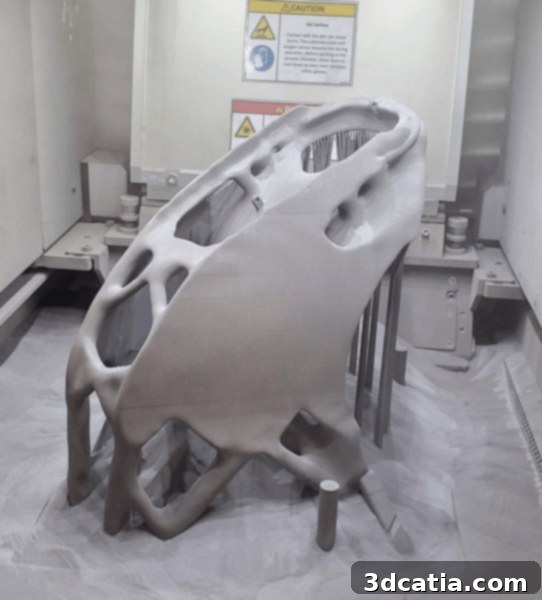
The intricately designed 3D printed roll cage for the solar-powered race car (photo credits: Uniformity Labs)
Precision Engineering: The 3D Printed Roll Cage Design and Production
The heart of this innovative project lies in the creation of a robust roll cage, an indispensable safety component designed to provide vital protection for the vehicle’s occupants in the event of a rollover or impact. Fabricated on an advanced SLM Dual Laser machine, the roll cage was meticulously constructed from Uniformity Labs’ specialized aluminum alloy. The process involved depositing the metal powder in incredibly thin layers, precisely 30 microns thick, ensuring not only exceptional structural integrity but also an incredibly smooth surface finish. This level of precision is paramount in high-stress applications where every detail can influence performance and safety.
Adam Hopkins, founder and CEO of Uniformity Labs, underscored the impact of their technology on this project: “Our ultra-low porosity AlSi10Mg and print processes allowed the car development team to create a better part quickly, cheaply, and optimized for the necessary weight and safety parameters. It’s easy to see how the processes used, and benefits afforded to the roll-cage production can apply to the creation of complex parts for use in mainstream industries such as aviation, auto, and consumer electronics. That’s what our technology is all about.” Hopkins’ statement highlights the dual benefits of speed and performance, coupled with the immense scalability and versatility of their additive manufacturing solutions across diverse industrial sectors.
Unlocking Performance with Topological Optimization
A crucial element in the design process was the implementation of advanced topological optimization software. This cutting-edge computational tool played a pivotal role in intelligently distributing material within the roll cage structure, directly correlating with the forces and stresses it would encounter during operation. By simulating various load conditions, the software identified the most efficient geometries, allowing for material to be precisely placed where it adds the most structural value, and removed from areas where it contributes minimally to strength. This iterative optimization process resulted in a design that achieves superior strength-to-weight ratios, a critical advantage for competitive solar racing where every gram counts.
The initial design brief for the roll cage had considered traditional manufacturing methods, specifically injection molding with a carbon fiber composite material, to meet the stringent strength requirements. However, Uniformity Labs’ innovative approach, leveraging metal additive manufacturing, not only matched but in many aspects, surpassed these expectations. By choosing 3D printing with their proprietary aluminum alloy, the company was able to significantly reduce both manufacturing costs and production lead times. Crucially, this was achieved without any compromise on the required level of strength and safety, demonstrating the competitive edge of advanced additive techniques over conventional methods for high-performance applications.
The Bridgestone World Solar Challenge: A Proving Ground for Innovation
This advanced 3D printed component is destined for the challenging environment of the Bridgestone World Solar Challenge, an iconic international car race held in the rugged Australian outback. This grueling competition pits solar-powered vehicles against each other in a monumental journey spanning 3,000 kilometers from Darwin to Adelaide. The race is a true test of engineering, endurance, and efficiency, requiring vehicles to perform flawlessly under extreme conditions, relying solely on solar energy. For a component as vital as a roll cage, uncompromising reliability and structural integrity are non-negotiable, making Uniformity Labs’ contribution a testament to the robustness of their additive manufacturing processes.
The success of Uniformity Labs’ ultra-low porosity AlSi10Mg aluminum alloy is largely attributed to its exceptional material properties. Traditional metal 3D printing often struggles with porosity, which can introduce weaknesses and reduce mechanical performance. Uniformity Labs has overcome this challenge through proprietary powder formulations and optimized printing parameters, resulting in parts with densities approaching 100%. This high density directly translates into superior strength, fatigue resistance, and overall durability, making it an ideal material for critical automotive and aerospace applications where structural integrity is paramount. For the solar race car, this means a lighter, stronger, and more dependable safety structure, directly contributing to the vehicle’s competitive edge and the safety of its pilot.
Broader Implications for Industrial Applications
The application of this advanced 3D printing technology extends far beyond solar racing. As Adam Hopkins highlighted, the lessons learned and the capabilities demonstrated in producing this complex roll cage have profound implications for a multitude of mainstream industries. In aviation, the ability to create lightweight, high-strength components with optimized geometries can lead to significant fuel efficiency gains and enhanced performance. The broader automotive industry can benefit from rapid prototyping of custom parts, short-run production of specialized components, and the development of next-generation vehicles that are both safer and more efficient. Even consumer electronics can leverage precise metal 3D printing for intricate housings, heat sinks, and internal components, enabling new levels of miniaturization and functionality.
Uniformity Labs’ achievement underscores a broader trend in manufacturing: the shift towards more sustainable, efficient, and customizable production methods. By reducing material waste, streamlining supply chains, and enabling localized production, metal additive manufacturing offers a pathway to a more resilient and environmentally conscious industrial future. This specific project serves as a compelling case study, demonstrating that with the right materials and processes, 3D printing can not only meet but exceed the demands of some of the most challenging engineering problems.
This pioneering work by Uniformity Labs not only pushes the boundaries of what’s possible with additive manufacturing but also inspires future innovations in high-performance engineering. It showcases how a combination of advanced materials, intelligent design, and sophisticated printing processes can yield components that are superior in performance, efficiency, and cost-effectiveness. As solar-powered vehicles continue to evolve and compete on the global stage, technologies like those developed by Uniformity Labs will be instrumental in driving the next generation of sustainable mobility.
You can find more detailed information about this groundbreaking project and the innovative materials used on Uniformity Labs’ official news page HERE.
What are your thoughts on this incredible 3D printed roll cage and its potential impact on automotive engineering? We invite you to share your insights and comments below, or connect with us on our Facebook and Twitter pages. Don’t forget to sign up for our free weekly newsletter, ensuring you stay up-to-date with all the latest advancements and news in the dynamic world of 3D printing, delivered directly to your inbox!