
Revolutionizing Military Construction: The US Army’s 3D Printed Barracks and the Future of Expeditionary Structures
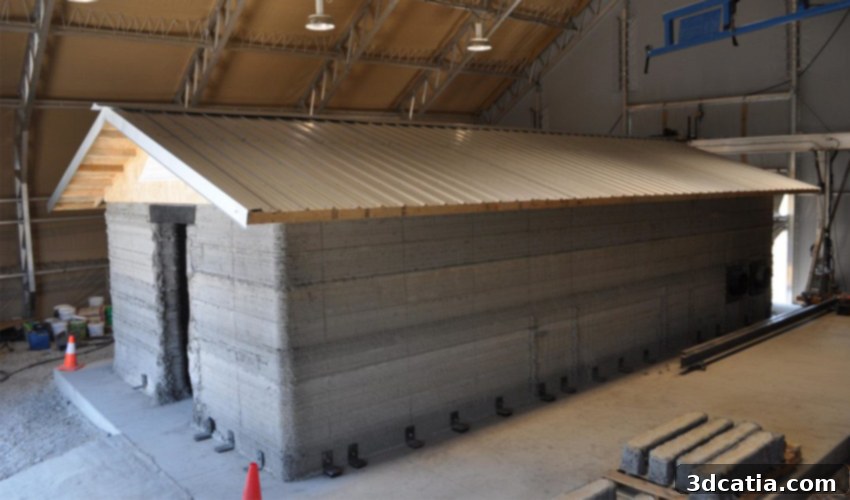
In a significant stride towards modernizing military infrastructure and streamlining on-field construction, the U.S. Army’s Construction Engineering Research Laboratory (CERL), based in Champaign, Illinois, has achieved a remarkable milestone: the successful completion of a 512-square-foot, 3D printed concrete barracks. This groundbreaking project was realized through CERL’s proprietary in-house 3D printing technology, a system meticulously developed and refined through a strategic partnership with the National Aeronautics and Space Administration (NASA). This achievement underscores the growing synergy between advanced additive manufacturing techniques and the critical demands of military operations, promising a future where vital structures can be erected with unprecedented speed and efficiency.
This innovative undertaking is a cornerstone of the US Army’s ambitious three-year initiative known as the “Automated Construction of Expeditionary Structures” (ACES) program. The primary objective of ACES is to develop and deploy capabilities for rapidly constructing semi-permanent buildings and other essential infrastructure components using concrete 3D printing. A key aspect of this program involves utilizing a composite concrete mix formulated from locally available materials, significantly reducing the logistical footprint and reliance on complex supply chains. The successful construction of this new barracks serves as a tangible proof-of-concept for the ACES program’s potential to transform military construction. This initiative aligns with a broader trend across the U.S. military, which has been increasingly integrating additive manufacturing technologies into its operations, including the deployment of 3D printers at the front lines to enable on-demand parts fabrication and repairs.
Concrete 3D printing saves cost and time Photo// Mike Jazdyk
Driving Efficiency and Agility with the ACES Program
The core philosophy behind the ACES program is to seamlessly integrate additive manufacturing technology directly into field operations, thereby delivering substantial improvements in both cost-effectiveness and construction timelines. Dr. Michael Case, the CERL ACES Program Manager, eloquently articulated the vision, stating, “ACES provides a capability to print custom designed expeditionary structures on-demand, in the field, using locally available materials. ACES will allow the Army to print buildings and other required infrastructure, such as barriers, culverts, and obstacles on location.” This capability represents a paradigm shift from traditional construction methods, which often involve extensive planning, complex logistics for material transport, and a significant labor force.
The ability to produce structures on-demand offers an unparalleled level of operational flexibility for military forces. Instead of relying on pre-fabricated units shipped from afar or time-consuming conventional builds, commanders can request and receive bespoke structures tailored to immediate mission requirements. This includes not only barracks for housing personnel but also critical support infrastructure like protective barriers for enhanced security, culverts for managing water flow, and various obstacles for tactical defense or training purposes. The implications for rapid deployment, disaster relief operations, and humanitarian aid missions are profound, allowing for quicker establishment of essential facilities in remote or challenging environments.
Quantifiable Benefits: Workforce Reduction and Logistics Optimization
Beyond speed and customization, the ACES project introduces several other compelling advantages that promise to significantly enhance military logistics and operational safety. One of the most striking benefits is the projected reduction in the required workforce by an impressive 62% when compared to more traditional construction methodologies. This substantial decrease in personnel translates directly into fewer troops exposed to potentially hazardous environments during construction, thereby improving overall force protection. Moreover, a smaller construction crew demands less logistical support in terms of housing, feeding, and transporting personnel, freeing up valuable resources for other critical military tasks.
Another pivotal advantage is the drastic reduction in the volume of building materials that need to be shipped to construction sites. Thanks to the ACES program’s focus on utilizing locally supplied materials and its efficient additive manufacturing process, the amount of material transport can be cut in half. This optimization of logistics has cascading benefits: it reduces fuel consumption, lowers transportation costs, minimizes the vulnerability of supply lines, and accelerates the entire construction process. For military operations in remote or contested territories, the ability to source and utilize local aggregates for concrete mixes drastically improves self-sufficiency and operational autonomy. This shift not only makes construction more cost-effective but also more resilient and environmentally sustainable by reducing carbon footprint associated with long-haul transportation.
The barracks was created using concrete 3D printing Photo// Mike Jazdyk
The Power of Collaboration: CERL and NASA’s Partnership
The success of the ACES technology is deeply rooted in the close collaboration between CERL and NASA. This partnership has been instrumental in refining and advancing the concrete 3D printing system. NASA’s profound knowledge and pioneering efforts in additive manufacturing, particularly for space exploration, have provided invaluable insights and expertise. The challenges of building structures in extraterrestrial environments, where resources are scarce and logistics are paramount, share significant parallels with the demands of military construction in austere or remote locations on Earth. Both require systems that are robust, efficient, capable of utilizing local materials, and minimally reliant on extensive human intervention.
Over the course of their synergistic partnership, CERL and NASA have focused intently on making the concrete 3D printing system more mobile and adaptable for field deployment. This has involved overcoming significant engineering hurdles related to printer size, weight, power requirements, and the ability to operate reliably in diverse environmental conditions, from arid deserts to humid jungles. The goal is to develop a system that can be easily transported to any location, set up quickly, and begin printing structures with minimal preparation. This continuous development cycle is evidenced by the upcoming unveiling of a developed and extensively tested third version of the system next month, signaling a sustained commitment to innovation and practical application.
Future Implications and Broader Impact
The successful deployment of 3D printed barracks by the US Army represents more than just a technological achievement; it signifies a strategic shift in how military forces approach infrastructure development. This innovation is set to revolutionize not only how permanent and semi-permanent structures are built but also how rapid response capabilities are conceptualized. Imagine humanitarian aid missions where essential shelters, medical facilities, or even temporary bridges can be erected in a matter of days following a natural disaster, without the need for vast quantities of pre-shipped materials. This technology offers an unprecedented level of responsiveness and adaptability in crisis situations.
Looking ahead, the ACES program has the potential to expand beyond barracks, encompassing a wide array of military and civil engineering applications. Field hospitals, command and control centers, defensive fortifications, and even complex repair facilities could all benefit from the speed, efficiency, and customized design capabilities offered by concrete 3D printing. However, the path forward will involve addressing ongoing challenges such as ensuring material consistency across varied local sources, developing printers that can withstand extreme environmental fluctuations, and training personnel to operate and maintain these advanced systems effectively. Despite these challenges, the long-term strategic advantages for the US Army are clear: enhanced operational flexibility, reduced logistical burdens, improved force protection, and a significantly faster response time to global demands.
The adoption of additive manufacturing in military construction is a testament to the ongoing drive for innovation within defense sectors worldwide. By leveraging technologies initially explored for space colonization and adapting them for terrestrial military use, the US Army is not only improving its own capabilities but also setting new benchmarks for efficiency and sustainability in construction. The foundational work laid by CERL and NASA promises a future where robust, custom-designed structures can materialize on demand, wherever and whenever they are most needed, fundamentally reshaping the landscape of expeditionary engineering.
Find out more on this project here
What do you think the future holds for the Army and this transformative project? We invite you to share your thoughts and perspectives in a comment below or join the discussion on our Facebook or Twitter page! Don’t forget to sign up for our free weekly Newsletter, with all the latest news in 3D printing delivered straight to your inbox, ensuring you stay at the forefront of this rapidly evolving industry!