
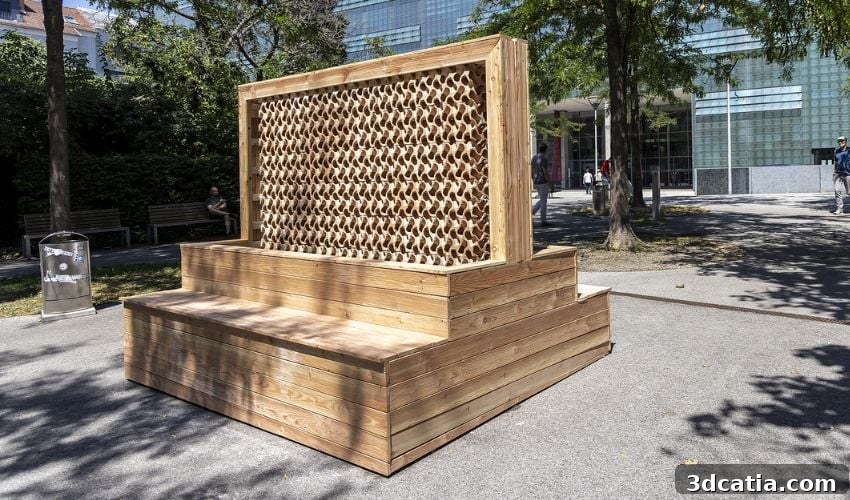
Europe is experiencing its fourth major heatwave of the 2026 season, with temperatures exceeding 40°C across the Iberian Peninsula, France, Italy and Austria. Urban areas are especially affected: the urban heat island effect can raise local temperatures by 1.7 to 4°C or more compared with surrounding rural locations. In response to these conditions, the Institute of Architecture and Media at TU Graz is exploring a low-tech, power-free cooling approach based on evaporative principles implemented using 3D-printed, highly porous ceramic cubes. This project is another example of how 3D printing can support sustainable building technologies.
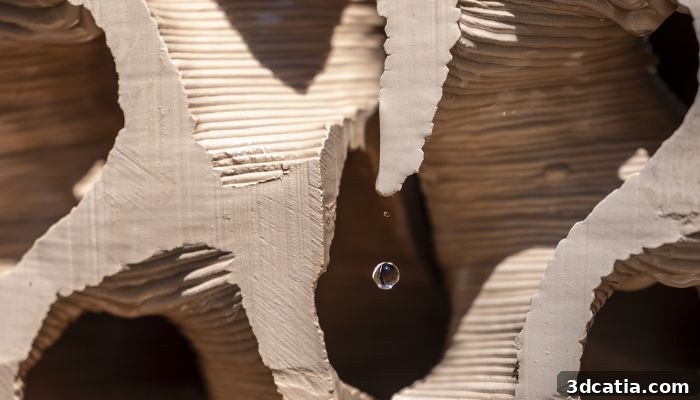
An up-close look at the 3D printed cubes.
What Is Evaporative Cooling?
Evaporative cooling occurs when water evaporates and absorbs heat from its surroundings, producing a cooling effect. Milena Stavric from TU Graz points out that evaporative cooling is an ancient, well-established principle, used historically in clay jugs and traditional wind towers. The innovation from this team lies in combining that established physical process with contemporary fabrication: 3D printing enables the creation of complex, porous, and functionally optimised geometries from clay mixtures. Those structures store water efficiently and present a large evaporation surface relative to their size.
Each cube measures roughly 23 centimetres per side. They are printed from a ceramic clay blend and fired at a lower temperature to preserve a highly porous consistency. Capillary forces draw water into the ceramic pores and distribute it throughout the structure, creating an extensive surface area for continuous evaporation. As water evaporates from that surface, it draws heat out of the adjacent air, lowering local temperatures without electricity.
3D Printed Cooling Walls: Made with Fungus
To enhance cooling performance, researchers at the institute’s Shape Lab developed a bio-inspired variant. They mix fungal culture and sawdust into the clay as an organic nutrient medium. Mycelium—the thread-like network of fungal filaments—grows into the material before printing and firing. During firing the organic components burn away, leaving a hierarchical network of micro- and macro-pores that improves water uptake and distribution through the cube.
In parallel, TU Graz is testing locally available waste materials as alternative feedstocks. For example, dredged sediment from Lake Neusiedl, which is produced during routine management of the shallow lake, is being evaluated as a 3D-printable, resource-efficient material. Using such residual materials can reduce waste and support circular construction practices while supplying a printable clay-like medium suitable for creating porous cooling elements.
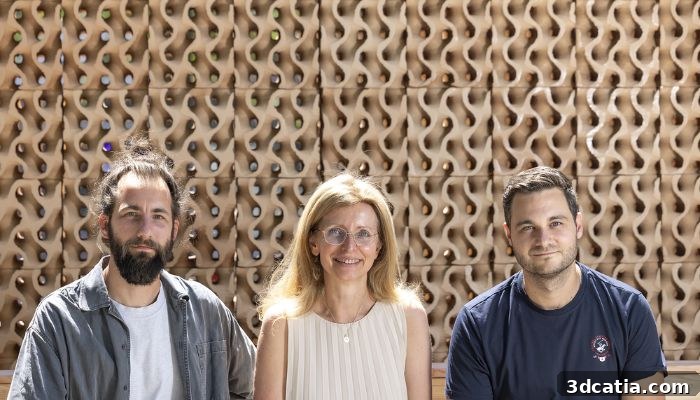
From left to right: Julian Jauk, Milena Stavric and Kristijan Ristoski from the Institute of Architecture and Media at Graz University of Technology.
Tested with a Demonstration Wall
The team trialled the cooling effect in a hot attic space at TU Graz. A single water-filled cube produced a measured temperature drop of nearly seven degrees Celsius in its immediate vicinity, a result that was clearly perceptible throughout the room, according to graduate researcher Kristijan Ristoski. Building on that result, the group constructed a freestanding demonstration wall measuring two by two metres. This prototype is installed at TU Graz’s Campus Neue Technik in Stremayrgasse, Graz, and a related exhibit is on display at the city’s Museum of Perception.
The research is collaborative, involving TU Graz’s Institute of Building Physics, Services and Construction, and has received funding from Austria Wirtschaftsservice GmbH (aws). The team states they are open to dialogue with planners and companies interested in evaluating and implementing the technology in built environments. Their aim is to offer a low-energy cooling alternative that can be integrated into homes, offices, schools and public spaces—particularly in urban locations where tree cover and shading are insufficient to mitigate heat.
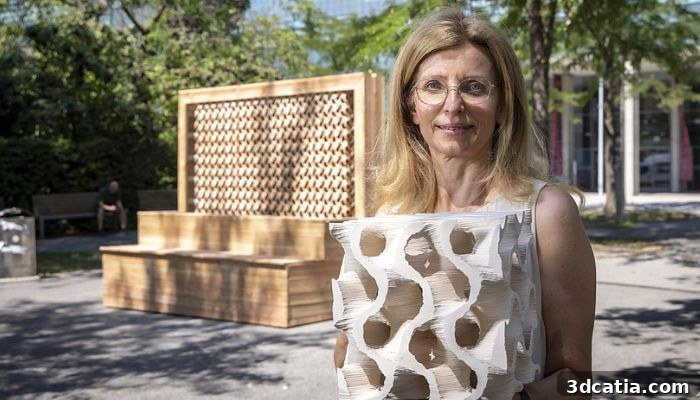
Milena Stavric from the Institute of Architecture and Media at TU Graz with a cooling cube.
By relying on natural cooling principles rather than energy-intensive air-conditioning, the team hopes these porous ceramic elements can help reduce heat stress in built environments. The cubes are presented as a scalable solution: as single units for spot cooling or as integrated arrays forming walls and façade elements to moderate indoor temperatures passively.
*Photo credits: Lunghammer – TU Graz