
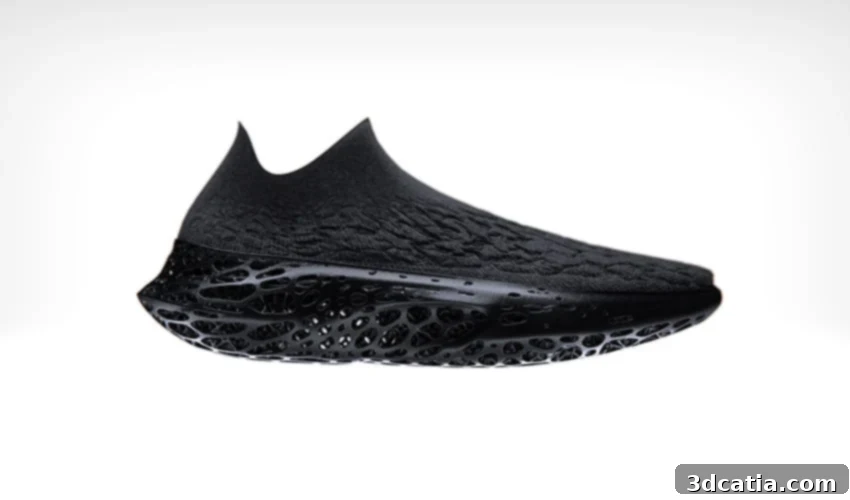
Decathlon’s Revolutionary 3D Printed Shoes: Pushing Sustainable Footwear Innovation with HP and Lonati
The world of sports footwear is undergoing a significant transformation, driven by advancements in additive manufacturing. Leading this charge is Decathlon, a global sporting goods retailer, which has unveiled a groundbreaking sports shoe developed through cutting-edge 3D printing technology. This ambitious project is the result of a powerful collaboration with technology giant HP and textile machinery expert Lonati Group. Together, they are redefining what’s possible in shoe manufacturing, combining HP’s Multi Jet Fusion (MJF) technology with Lonati’s advanced knitting machinery. The outcome is not just a new pair of shoes, but a revolutionary step towards environmentally friendly and high-performance footwear production.
Additive manufacturing, commonly known as 3D printing, has rapidly gained immense traction across various industries, and its impact on the sports sector, particularly in shoe manufacturing, has been nothing short of transformative. This innovative approach allows for the creation of complex geometries and custom designs previously impossible with traditional manufacturing methods. Over the past few years, we’ve witnessed numerous remarkable projects that underscore the potential of this technology. Examples include the fully 3D-printed ELASTIUM-1, which showcased the possibilities of integrated design and function. Adidas, a pioneer in this space, has also launched several successful models like the acclaimed 4DFWD and 4D Fusio, both featuring intricate 3D-printed midsoles designed for optimized performance and energy return. Furthermore, specialized shoe manufacturers like Zellerfeld have gone a step further by launching dedicated platforms for their entirely 3D-printed shoe collections, highlighting a growing consumer demand for personalized and innovative footwear.
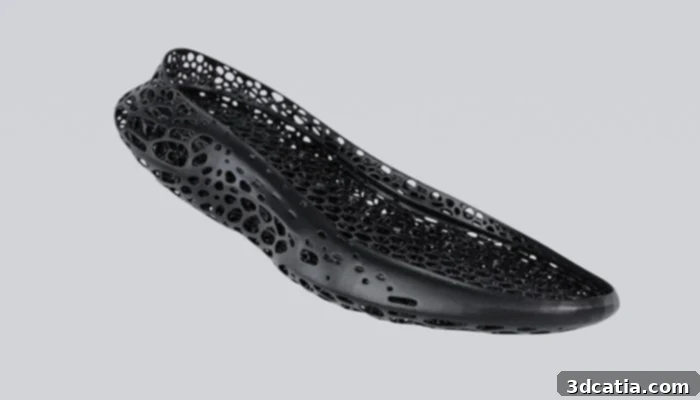
The shoes’ soles are made using HP 3D printing technology (Photo credits: HP)
The Power of Collaboration: Decathlon, HP, and Lonati Group
This innovative project represents a synergy of expertise from three distinct but complementary leaders. Decathlon, with its vast experience in sports product development and understanding of athlete needs, brings the vision for high-performance and accessible sports footwear. HP, a global technology powerhouse, contributes its advanced 3D printing capabilities, particularly the Multi Jet Fusion technology, which is ideal for producing durable, functional parts at scale. Lonati Group, renowned for its state-of-the-art knitting machinery, provides the textile innovation necessary for crafting the shoe’s upper. This unique blend of competencies has allowed the partners to tackle complex challenges in shoe design, material science, and manufacturing processes, ultimately delivering a product that sets new benchmarks in the industry.
Unpacking HP’s Multi Jet Fusion Technology in Footwear
At the heart of Decathlon’s new shoe lies HP’s Multi Jet Fusion technology. Unlike traditional manufacturing methods that involve molds and extensive tooling, MJF builds parts layer by layer, offering unparalleled design freedom. The process involves depositing a fusing agent and a detailing agent onto a thin layer of powdered material, which is then fused by infrared energy. This enables the creation of highly complex geometries and lattice structures that are lightweight yet incredibly strong. For footwear, this means designing midsoles and outsoles with optimized cushioning zones, energy return properties, and customized support structures that can be tailored to individual biomechanics or specific athletic requirements. The ability to produce functional parts with fine detail and mechanical integrity makes MJF a game-changer for high-performance sports equipment.
Specifically, the newly unveiled Decathlon shoe leverages HP’s industrial-grade 3D printer, the Jet Fusion 5200 series, to create the intricate midsole and outsole components. The Jet Fusion 5200 is celebrated for its ability to deliver production-grade parts with superior consistency, accuracy, and speed, making it suitable for scalable manufacturing. Its advanced algorithms and integrated process controls ensure repeatable mechanical properties, which is crucial for safety-critical components like shoe soles that endure significant stress during athletic activity. This industrial capacity of the HP Jet Fusion 5200 enables Decathlon to move beyond prototyping and towards the mass customization and production of these innovative footwear elements.
Material Excellence: Ultrasint TPU01 for Optimal Performance
The choice of material is paramount in performance footwear, and for the midsole and outsole of the Decathlon shoe, the partners selected Ultrasint TPU01. This versatile thermoplastic polyurethane (TPU) powder is supplied by BASF, a world leader in chemical products. TPU is widely recognized for its excellent elasticity, abrasion resistance, and high energy return, making it an ideal candidate for athletic applications. Ultrasint TPU01 specifically offers an optimal balance of flexibility and resilience. These properties are crucial for sports shoes, providing the necessary shock absorption to protect joints during impact while also offering excellent rebound to propel athletes forward. The material’s ability to withstand repeated compression and quickly return to its original shape ensures consistent performance throughout the shoe’s lifespan. Furthermore, the inherent durability of TPU contributes to the longevity of the shoe, aligning with sustainable design principles by extending product utility.
Lonati’s Contribution: A Lightweight and Comfortable Upper
While HP’s technology focuses on the structural and performance-critical sole, Lonati Group’s involvement is centered on creating the shoe’s upper. Utilizing their advanced XT-MACHINE and Double Cylinder E1530XS knitting machines, Lonati produces a sophisticated fabric “sock.” This knitting expertise allows for the creation of seamless, lightweight, and breathable uppers that conform precisely to the foot. The fabric sock not only enhances comfort by minimizing points of friction and irritation but also contributes significantly to the shoe’s overall lightweight profile. The integration of a flexible, custom-knitted upper with a robust, 3D-printed sole creates a holistic design that prioritizes both athletic performance and wearer comfort, showcasing a truly collaborative approach to modern footwear engineering.
Performance Redefined: Lightweight and Shock-Resistant Design
The combined innovations in design, material, and manufacturing technology culminate in a shoe that is both exceptionally lightweight and highly shock-resistant – two critical attributes for any serious athletic footwear. The intricate lattice structures enabled by HP’s Multi Jet Fusion technology allow engineers to strategically remove material where it’s not needed, drastically reducing the overall weight without compromising structural integrity. This lightweight construction minimizes fatigue for the wearer, allowing for longer, more efficient runs and activities.
Simultaneously, the inherent properties of Ultrasint TPU01, combined with the optimized geometries of the 3D-printed midsole, provide superior shock absorption. The material and design work in harmony to dissipate impact forces more effectively than traditional foam midsoles. This not only protects the athlete’s feet, knees, and joints from the repetitive stresses of running and jumping but also translates into enhanced comfort and reduced risk of injury. The ability to precisely control the density and flexibility of different zones within the midsole allows for a level of performance tuning previously unimaginable, truly customizing the feel and response of the shoe to the demands of various sports and individual preferences.
A Major Stride Towards Sustainable Shoe Production
Perhaps the most compelling aspect of this new Decathlon shoe is its profound commitment to environmental sustainability. Traditional shoe manufacturing processes are notoriously complex, often involving numerous materials bonded together with strong adhesives, which severely hinders repair or recycling efforts at the product’s end-of-life. These conventional methods generate considerable waste and make circularity a significant challenge.
However, additive manufacturing intrinsically addresses many of these environmental challenges. The Decathlon shoe exemplifies this by employing a smart, glueless assembly method. This design choice is revolutionary because it allows for easy disassembly, making the shoe highly repairable when damaged. Instead of discarding an entire pair due to a worn-out sole or a torn upper, individual components can be replaced, significantly extending the product’s lifespan and reducing waste.
Furthermore, the strategic use of a single material – Ultrasint TPU01 – for the entire midsole and outsole vastly improves the shoe’s recyclability. With traditional multi-material constructions, separating different plastics, rubbers, and foams for recycling is often economically unfeasible. By consolidating to a single, high-performance thermoplastic, the end-of-life recycling process becomes much more straightforward and cost-effective. This enables a true closed-loop system where worn-out soles can be efficiently recovered, reprocessed, and transformed back into raw material for new shoes, minimizing reliance on virgin resources and drastically reducing landfill contributions.
Don Albert, Footwear Industry Manager at HP Personalization and 3D Printing, eloquently summarizes this paradigm shift: “HP Multi Jet Fusion Technology ushers in a new era of sustainable and innovative manufacturing. We are proud to partner with Decathlon to showcase the immense potential of 3D printing and contribute to the development of more environmentally friendly manufacturing. The Lonati group’s expertise in textile manufacturing is fully in line with our values of respect for the environment. This collaboration is a real source of inspiration.” Albert’s statement highlights HP’s broader vision to drive sustainable practices through technological innovation, recognizing that advanced manufacturing can play a critical role in addressing global environmental concerns.
The Future of Footwear: Customization, Agility, and Responsibility
Decathlon’s new 3D printed shoe is more than just a product; it’s a testament to the future direction of the entire footwear industry. The capabilities of 3D printing extend beyond mere sustainability to offer unprecedented levels of customization and manufacturing agility. Imagine shoes perfectly tailored to an individual’s foot shape, gait analysis, and performance requirements, produced on-demand rather than through a rigid mass production line. This shift could lead to a significant reduction in overproduction and unsold inventory, further enhancing environmental benefits.
Moreover, the integration of 3D printing into the supply chain allows for greater localization of manufacturing. Instead of relying on distant factories, components or even entire shoes could be printed closer to consumer markets, drastically reducing shipping costs, lead times, and carbon emissions associated with global logistics. This agility enables brands to respond much faster to market trends and consumer demands, delivering innovative products with greater efficiency.
The pioneering efforts of Decathlon, HP, and Lonati Group represent a significant leap forward in creating a footwear industry that is not only high-performing but also deeply responsible. By embracing additive manufacturing, they are setting a new standard for eco-conscious design, material utilization, and end-of-life solutions. This collaborative innovation truly embodies the potential for technology to drive both peak athletic performance and profound environmental stewardship.
What do you think of this new 3D printed shoe by Decathlon and the broader implications for sustainable manufacturing? We’d love to hear your thoughts! Let us know in a comment below or on ourLinkedIn,Facebook, andTwitter pages! Don’t forget to sign up for our free weeklyNewsletter here to get the latest 3D printing news straight to your inbox! You can also find all our videos on ourYouTube channel.
*Cover credit photo: HP