
Exploring the Cutting Edge: Top 5 Innovative 3D Printing Applications in Action
Welcome to our weekly exploration of groundbreaking advancements in additive manufacturing! This week, we’re diving into five captivating videos that offer a wealth of 3D printing inspiration, showcasing how diverse industries are leveraging this transformative technology. From revolutionizing sound design and enhancing Formula One performance to democratizing manufacturing processes and enabling large-scale production, these examples underscore the immense potential of 3D printing. We’ll begin by discovering how Novel Acoustics pushes the boundaries of optimal sound design using Stratasys’ 3D printing solutions. Next, we’ll shift gears to the high-octane world of Formula One, where the Visa Cash App RB team employs additive manufacturing to drastically improve their brake ducts. Following this, learn how you can create your own functional injection molds using accessible FDM or SLA 3D printing technologies. Our fourth highlight demonstrates the efficiency of consolidating multiple parts into single, complex structures through advanced manufacturing techniques. Finally, prepare to be amazed by the sheer scale of a massive storage container, rapidly produced on a large-format 3D printer from CEAD. Each of these unique applications not only provides valuable insights but could also spark the imagination for your next ambitious project. Join us as we uncover what you’ll discover!
Top 1: Revolutionizing Audio: 3D Printing a Concept Loudspeaker for Optimal Sound Design
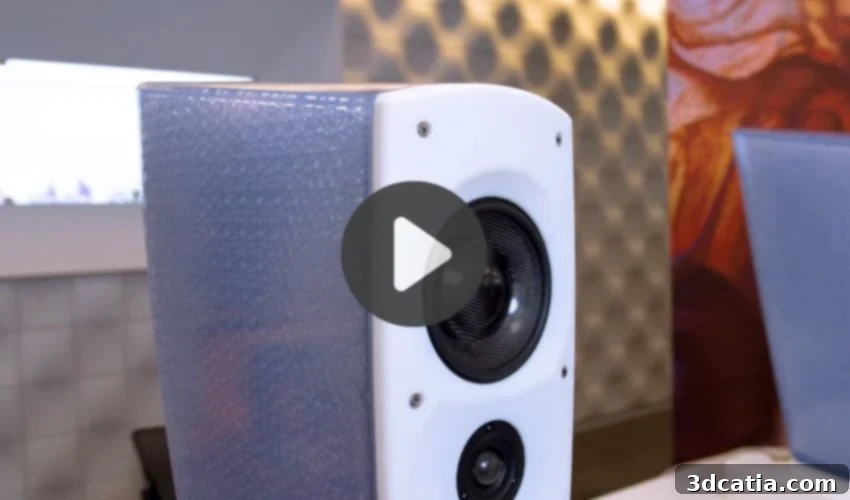
Have you ever wondered about the intricate science and art behind manipulating sound for perfect acoustics? In this insightful video, Boaz Dekel, Co-founder of Novel Acoustics, sheds light on how his company harnesses the power of 3D printing to achieve unprecedented benefits in acoustic engineering. He showcases a meticulously designed concept speaker, a brilliant demonstration of how additive manufacturing technology can perfectly integrate with the demanding requirements of acoustic design. Traditional manufacturing methods often impose significant limitations on geometric complexity, which is a major hurdle in optimizing sound paths, internal structures, and resonance chambers within a loudspeaker. However, 3D printing liberates designers from these constraints, allowing for the creation of organic, intricate shapes and internal lattices that are otherwise impossible to produce. Dekel elaborates on the iterative design process, highlighting how rapid prototyping with 3D printing enabled quick testing and refinement of various acoustic principles. This agility is crucial in acoustic development, where subtle changes in geometry or material density can have profound effects on sound quality. By leveraging 3D printing, Novel Acoustics can experiment with novel internal geometries that precisely guide sound waves, minimize unwanted reflections, and enhance overall audio fidelity. This capability not only accelerates product development but also opens up new avenues for personalized audio experiences and highly specialized sound systems. Discover how he developed this groundbreaking design, the manifold ways 3D printing benefited the project, and further fascinating details below. This demonstration truly exemplifies how additive manufacturing is not just about making parts, but about creating new possibilities in engineering and design.
Top 2: High-Performance Engineering: How Formula 1 Optimizes Brake Ducts with Advanced 3D Printing
It’s no secret that the demanding world of Formula 1 racing is a relentless proving ground for cutting-edge technology, and additive manufacturing has long been an indispensable tool in its arsenal. In this thrilling video, we get an exclusive look into how the Visa Cash App RB Formula One Team (VCARB) has profoundly transformed their brake duct manufacturing processes. By adopting Roboze’s state-of-the-art additive manufacturing technology, utilizing the high-performance material Carbon PEEK, VCARB has achieved remarkable breakthroughs in efficiency and performance. Brake ducts in Formula 1 are incredibly critical components, responsible for managing the extreme heat generated during braking and ensuring aerodynamic efficiency. Traditionally, producing these complex parts involved labor-intensive, multi-step processes with significant lead times and material waste. However, with Roboze’s precise FFF (Fused Filament Fabrication) technology and the exceptional properties of Carbon PEEK, VCARB has managed to overcome these challenges. Carbon PEEK is a carbon fiber reinforced PEEK polymer known for its extraordinary strength-to-weight ratio, high-temperature resistance, chemical inertness, and superior mechanical properties—all essential attributes for F1 components operating under immense stress. This innovation has led to astounding results: a staggering 68% reduction in production costs, a rapid 66% acceleration in manufacturing speed, and an incredible 86% decrease in the number of technical drawings required. These figures translate directly into a streamlined design-to-production workflow, enabling faster iterations, greater design freedom for aerodynamic optimization, and ultimately, a more competitive race car. Roboze’s expertise has empowered VCARB to produce lightweight, high-performance brake ducts that not only enhance the car’s braking efficiency and cooling capabilities but also demonstrate how 3D printing is fundamentally revolutionizing high-stakes motorsport. This partnership exemplifies the critical role additive manufacturing plays in pushing the boundaries of automotive performance and innovation, influencing not only F1 but also broader industries requiring precision, speed, and advanced materials.
Top 3: Empowering Makers: How to 3D Print Your Own Injection Molds, Even with Recycled Plastic
Are you captivated by the idea of creating custom parts through injection molding for a small-batch project or personal prototypes, but deterred by the prohibitive overhead costs associated with traditional tooling? Look no further than the innovative solution of 3D printing your own injection molds using either FDM (Fused Deposition Modeling) or SLA (Stereolithography) technology! This incredibly informative video from Sustainable Design Studio provides a comprehensive guide, walking you through the entire process of designing and creating your custom injection molds. What makes this approach even more compelling is its emphasis on sustainability: the video demonstrates how to use recycled plastic as your molding material, contributing to a more circular economy and reducing waste. The video meticulously introduces the core differences between FDM and SLA technologies in the context of mold creation. FDM printers, known for their affordability and material versatility, are excellent for producing robust molds with good heat resistance using filaments like ABS or PETG. While FDM molds might require some post-processing to achieve smoother surfaces, they are ideal for simpler geometries and larger molds where precision isn’t absolutely critical. SLA technology, on the other hand, excels in producing highly detailed, smooth, and dimensionally accurate molds, thanks to its resin-based process. This precision is often crucial for achieving clean part ejection and intricate features in the final molded product. The tutorial also expertly explains how to select and input the optimal settings for creating a durable and effective mold, carefully tailored to the specific 3D printing technology you choose and the type of plastic you intend to inject. This democratized approach to manufacturing opens up a world of possibilities for designers, small businesses, and hobbyists alike, allowing them to rapidly prototype and produce custom plastic components without massive capital investment. Imagine the potential: what unique product, custom part, or innovative design would you like to bring to life by creating your own injection mold?
Top 4: Engineering Efficiency: Streamlining Designs and Manufacturing through 3D Printed Part Consolidation
In complex mechanical assemblies, the number of individual components can significantly impact manufacturing cost, assembly time, potential points of failure, and overall weight. By strategically consolidating multiple discrete parts into a single, intricately designed 3D printed component, engineers can achieve remarkable gains in efficiency and performance. This revolutionary approach not only drastically reduces the amount of parts requiring individual assembly but also simplifies the entire manufacturing procedure, leading to substantial cost savings. Furthermore, part consolidation often results in a significant reduction in overall weight, a critical factor in industries like aerospace, automotive, and robotics where every gram counts. This compelling video from Desktop Metal provides a clear demonstration of how their innovative Studio System empowers designers to safely and easily 3D print metal parts. The system is perfectly suited for generating functional prototypes and running low-volume production of these highly optimized, consolidated assemblies. The inherent design freedom offered by additive manufacturing allows engineers to create complex internal geometries, integrated functionalities like internal fluid channels or heat sinks, and optimized lattice structures that are simply impossible to achieve with traditional subtractive or formative manufacturing methods. This capability transforms designs, allowing for a holistic approach where multiple functions are elegantly integrated into one robust piece. For example, an assembly that previously required a dozen bolted or welded components can now be designed as a single, stronger, and lighter part. This technique not only simplifies supply chains by reducing the number of different components to source and manage but also unlocks entirely new possibilities for design optimization, leading to superior performance, enhanced reliability, and breakthrough innovation across a multitude of industries. The potential for cost reduction through fewer materials, less labor, and reduced inventory, coupled with performance enhancements, makes part consolidation a truly transformative aspect of modern additive manufacturing.
Top 5: Grand Scale Innovation: Printing an Industrial Storage Bin on a Large-Format 3D Printer
While many associate 3D printing with small, intricate components or prototypes, the realm of large-format additive manufacturing is rapidly expanding, bringing industrial-scale production capabilities to the forefront. CEAD, a company renowned for its pioneering large-format 3D printers, vividly demonstrates these capabilities in this remarkable video. The footage showcases the extraordinary prowess of the CEAD Flexcube, a machine capable of producing truly massive objects with impressive speed and precision. In this particular demonstration, they tackle the creation of a colossal storage bin, designed with a unique and complex shape specifically intended for housing thermoplastic material used in the 3D printing of boats. This application highlights the industrial relevance of large-format additive manufacturing, moving beyond mere prototyping to the production of functional, end-use components and specialized tooling. The ability to print such a large, custom-shaped container efficiently is a testament to the Flexcube’s advanced extrusion technology and robust build volume. The video also casually mentions another impressive feat: the same printer was used to 3D print functional scooters at the prestigious Formnext exhibition, further underscoring its versatility and capacity for diverse, large-scale projects. Watching the massive bin materialise layer by layer, printed entirely in just one night, is a compelling visual testament to the speed and efficiency that large-format 3D printing brings to industrial manufacturing. This technology is not just about making things bigger; it’s about enabling the rapid production of custom, large-scale parts that were previously either cost-prohibitive, time-consuming, or entirely impossible with traditional methods. From bespoke industrial tooling and automotive components to large artistic installations and even architectural elements, large-format 3D printers like the CEAD Flexcube are opening up new horizons for manufacturing, allowing businesses to innovate on a grander scale with unprecedented agility and design freedom. This video truly encapsulates the exciting future of large-scale additive manufacturing.
These incredible examples illustrate just a fraction of the transformative potential of 3D printing across various sectors. The integration of additive manufacturing into acoustic engineering, for instance, represents a paradigm shift, allowing for unparalleled control over sound manipulation and bespoke audio solutions. Similarly, the advancements in motorsport, industrial tooling, and large-scale production demonstrate how 3D printing is not just a technology of the future, but a vital force shaping today’s innovation landscape. Which of these five remarkable videos sparked your imagination the most? How do you envision the further integration of 3D printing and acoustic engineering, or other specialized fields? We’d love to hear your thoughts and predictions! Share your insights and favorite video of the week by leaving a comment below, or engage with our vibrant community on our LinkedIn, Facebook, and Twitter pages! For those eager to stay at the forefront of additive manufacturing news, don’t miss out on signing up for our free weekly Newsletter here, delivering the very latest 3D printing innovations directly to your inbox. You can also explore our extensive library of compelling videos on our dedicated YouTube channel. Stay curious, stay inspired, and keep exploring the incredible world of 3D printing!
*Cover Image Credit: Screenshot from Stratasys video