
The Orca: A New Wave in Footwear Manufacturing Through Hybrid 3D Printing
The footwear industry has witnessed a significant transformation with the advent of 3D printing technology. For years, 3D printed shoes have been circulating in the market, pushing the boundaries of design, performance, and manufacturing. From avant-garde high fashion pieces showcased by designers like Dior to high-performance running sneakers from giants such as Adidas and ASICS, brands globally have embraced additive manufacturing to create innovative products that were once mere concepts. This technological shift is not just about aesthetics; it’s about reimagining the entire production lifecycle, offering unparalleled customization, efficiency, and sustainability.
Joining this pioneering movement is LaLaLand Production and Design, a prominent California-based shoe manufacturer renowned for its extensive expertise in footwear creation. In a strategic move to integrate cutting-edge technology with traditional craftsmanship, LaLaLand partnered with Elastium, an innovative Los Angeles-based 3D printing startup. This collaborative effort has culminated in the release of their first groundbreaking 3D printed shoe: The Orca. This partnership signifies a crucial step towards a future where advanced manufacturing techniques complement established processes, creating products that are both revolutionary and commercially viable.
Introducing The Orca: Design Inspired by Nature, Engineered for Performance
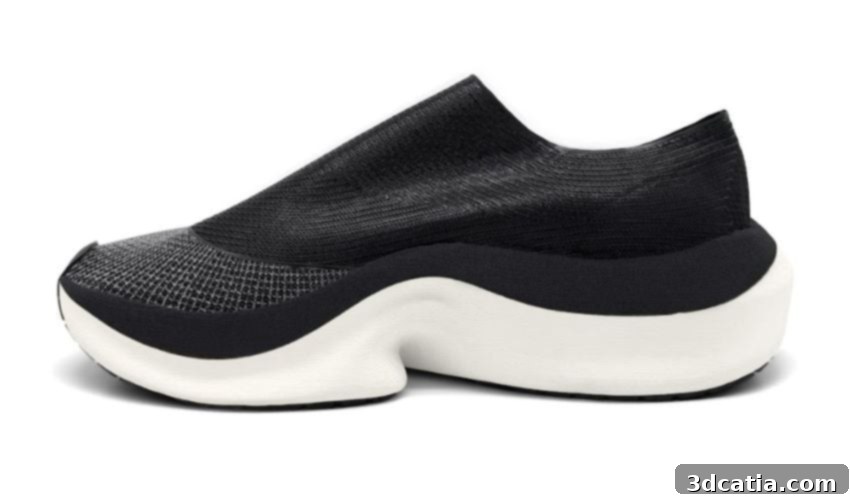
The Orca shoe is a testament to thoughtful design and advanced engineering, drawing clear inspiration from its namesake, the majestic killer whale. Its aesthetic instantly evokes the creature’s powerful yet elegant form, featuring smooth, pristine white soles that transition seamlessly into a sleek black upper. This striking monochrome palette not only provides a sophisticated look but also subtly hints at the Orca’s distinctive coloration in nature. A particularly clever design element is the sole’s gentle curve midway through the shoe, subtly suggesting the graceful arc of a fin, adding a layer of thematic depth to the footwear.
However, the true marvel of The Orca lies beyond its compelling appearance. Its innovation is deeply embedded in its construction, where core components – the midsole, outsole, and upper – are precisely 3D printed using Elastium’s proprietary pellet-based technology, known as FIDEM. This advanced additive manufacturing process is central to the shoe’s unique characteristics. FIDEM stands out because it provides efficient shortcuts for the transition between 3D printing and traditional molding techniques. This hybrid approach is a specialty of LaLaLand, allowing them to leverage the precision and complexity possible with 3D printing while integrating it smoothly with the proven methodologies of conventional shoe manufacturing.
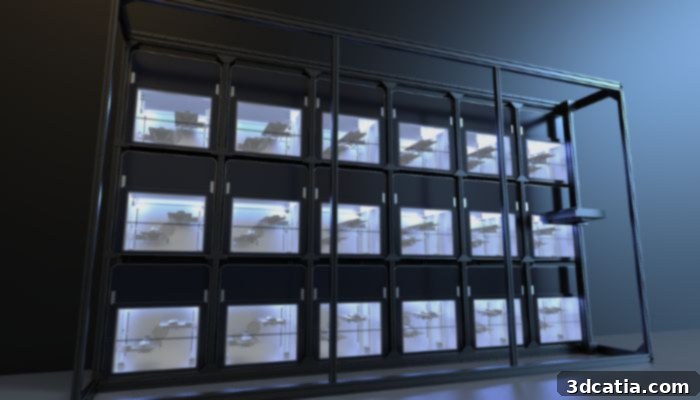
The 3D printing chambers where Elastium prints their shoes
Revolutionary Materials: The Power of TPU in Footwear
At the heart of The Orca’s superior performance and comfort is its strategic use of thermoplastic polyurethane (TPU). This versatile material was employed in various forms to complete the shoe, meticulously chosen for its distinct properties that cater to different parts of the footwear. For instance, TPU was utilized as a high-performance foam for the sole, providing exceptional cushioning and support. Concurrently, a more elastic form of TPU was engineered for the shoe’s upper, ensuring flexibility, breathability, and a snug fit that adapts to the wearer’s foot.
One of the most impressive attributes of Elastium’s proprietary TPU foam is its remarkable energy return, exceeding 75%. Energy return refers to the amount of bounce or rebound provided by the shoe’s cushioning after the foot lands on the ground. A higher energy return translates to a more responsive feel, reducing fatigue and enhancing athletic performance. This characteristic significantly outperforms ethylene vinyl acetate (EVA), which is a long-standing standard material in the footwear industry for its cushioning properties. While EVA has served well, TPU’s advanced formulation offers a dynamic responsiveness that elevates the wearer’s experience, making each step more efficient and comfortable.
Beyond its impressive energy return, TPU boasts high flexibility and exceptional resistance to abrasion, oils, greases, and many chemicals. These inherent properties make it an ideal material for creating shoes that must endure rigorous use while remaining flexible and durable. The material’s capacity to withstand wear and tear ensures a longer lifespan for the footwear, contributing to sustainability by reducing the frequency of replacements. The combination of cushioning, flexibility, and durability positions TPU as a superior choice for modern athletic and performance footwear.
The assembly of The Orca exemplifies the true spirit of hybrid manufacturing. While significant components are produced through 3D printing, the team ingeniously integrated traditional techniques like stitching to bring the various parts together. This blend of new and old methods ensures that the shoe benefits from the precision and customizability of 3D printing, alongside the proven strength and aesthetic finish of conventional craftsmanship. This hybrid approach is not just a compromise; it’s an optimization, ensuring the best qualities of both worlds are leveraged to create a superior product.
Redefining Footwear Production: Speed, Scalability, and Sustainability
The collaboration between LaLaLand and Elastium is a direct response to the urgent demand for faster, more scalable, and environmentally sustainable footwear production methods. Traditional manufacturing often involves complex global supply chains, extensive lead times, and significant upfront investments. These challenges have long plagued the industry, leading to issues such as logistical overhead, heavy initial capital outlays, sluggish response times to market trends, and the problematic accumulation of unsold inventory.
In contrast, LaLaLand and Elastium’s innovative production model dramatically streamlines the process, allowing for a concept-to-market timeline of mere weeks. This rapid turnaround is a game-changer, enabling brands to quickly adapt to consumer preferences and market shifts. Furthermore, the model significantly reduces initial investment costs by up to 80%, making it far more accessible for both established brands looking to innovate and emerging designers entering the market. This financial efficiency, coupled with speed, creates a highly agile and responsive manufacturing ecosystem.
Addressing Global Supply Chain Challenges
The issues inherent in traditional manufacturing are often exacerbated by the volatile geopolitical climate, which can disrupt international trade, impose tariffs, and increase transportation costs. These external factors make outsourcing stock not only costly but also time-consuming and unpredictable. The dependence on distant factories and intricate logistics networks creates vulnerabilities that modern businesses are eager to overcome.
Consequently, there is an intensified need for localized and sustainable manufacturing. Localizing production reduces reliance on lengthy global supply chains, minimizes transportation emissions, and allows for quicker reactions to regional market demands. LaLaLand and Elastium are actively working to meet this escalating demand by establishing manufacturing capabilities that are both local and highly efficient. Their goal is not just to produce shoes but to transform how shoes are made, consumed, and sustained within communities. Moreover, they are committed to localizing their production without sacrificing scalability or limiting the diverse range of products they can produce, ensuring broad market applicability.
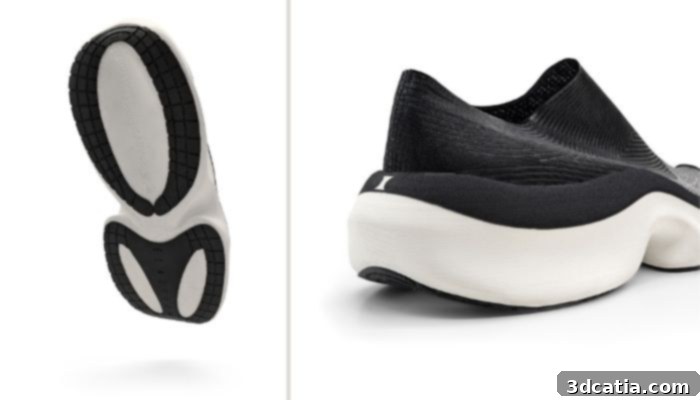
Close-ups of the bottom of the shoe (left) and side of the shoe (right)
The Visionary Approach: Empowering Traditional Manufacturing with 3D Printing
Robert Karklinsh, the innovative founder of Elastium, articulates a deeply consumer-focused vision that underpins the company’s strategy. He offers a compelling rationale for why his startup chose to empower and integrate with traditional manufacturing rather than attempt to entirely supplant it. Karklinsh explains, “For years, there has been a belief that 3D printing and other advanced technologies would revolutionize footwear by replacing traditional manufacturing. For me as an engineer and designer, the idea of 3D-printed shoes grown like potatoes in 3D printer farms is fascinating. But the market doesn’t move on what engineers or designers think—it moves on what consumers demand. And consumers demand far beyond fully 3D printed ‘potato shoes,’ which are seen just as another trend rather than a revolution.”
This perspective is crucial. Karklinsh acknowledges the allure of fully automated, entirely 3D printed footwear production but grounds his approach in market realities. He believes that consumers are looking for more than just technological novelty; they seek compelling products that offer genuine value, comfort, style, and performance. A shoe that is merely 3D printed, without meeting these fundamental consumer expectations, is likely to be perceived as a fleeting trend rather than a sustainable innovation that reshapes the industry.
To transcend the status of a mere trend and firmly establish 3D printing in footwear—alongside localized production—as a standard industry practice, Karklinsh emphasizes that consumer demands must remain at the absolute center of product development. He firmly believes that the true revolution lies in a synergistic approach. “The actual revolution towards localized production can be only achieved by putting the consumer in the center of it and integrating all kinds of technologies and craftsmanship into breakthrough products that fascinate consumers rather than designers,” Karklinsh asserts. This philosophy advocates for a holistic manufacturing model where advanced technologies like 3D printing are seamlessly blended with proven traditional techniques and human craftsmanship. The ultimate goal is to create products that not only leverage technological advancements but also resonate deeply with what consumers truly desire: superior quality, innovative design, and practical utility. This integrated strategy promises not just better shoes, but a more sustainable and responsive future for the entire footwear industry.
The No-MMOQ Hybrid Production Model: Flexibility and Scalability
A cornerstone of LaLaLand and Elastium’s innovative partnership is their development of a groundbreaking No-Minimum-and-Maximum-Order-Quantity (No-MMOQ) Hybrid production model. This revolutionary model offers unprecedented flexibility to brands, allowing them to launch new designs with as few as a single pair. This capability significantly reduces the financial risk associated with introducing new products, making innovation more accessible for both established brands and independent designers.
Furthermore, the No-MMOQ model ensures that if a design proves successful, it can be seamlessly scaled up to mass production without significant hurdles. This dynamic approach perfectly addresses the unpredictable nature of fashion and consumer trends. The hybrid model itself is a masterclass in efficiency, combining the rapid prototyping, design complexity, and material optimization capabilities of 3D printing with the robustness, cost-effectiveness, and finishing quality of traditional manufacturing. This synergy provides unparalleled flexibility and scalability without compromising on the high standards of quality or increasing production costs.
The implications of the No-MMOQ Hybrid production model are far-reaching. It fosters an environment where customization is not just a niche offering but an integrated part of the production process. Brands can offer bespoke options, cater to niche markets, and test new concepts with minimal investment. This agility not only accelerates product development cycles but also significantly reduces waste from overproduction, aligning perfectly with sustainable manufacturing principles. By offering a responsive, scalable, and cost-efficient solution, LaLaLand and Elastium are setting a new benchmark for how footwear is designed, produced, and brought to market, promising a more sustainable and consumer-centric future for the industry.
To learn more about The Orca shoe and Elastium’s pioneering approach to footwear manufacturing, you can visit their website here.
The introduction of The Orca by LaLaLand and Elastium represents a pivotal moment, showcasing how strategic integration of additive manufacturing and traditional techniques can drive true innovation. This isn’t just about creating a new shoe; it’s about forging a path towards a more agile, sustainable, and consumer-focused future for the entire footwear industry. It challenges existing paradigms and offers a scalable solution to many of the long-standing issues in global manufacturing, proving that cutting-edge technology and time-honored craftsmanship can indeed create something extraordinary when combined thoughtfully.
Would you wear The Orca shoe and embrace this blend of innovation and sustainability? Let us know in a comment below or on our LinkedIn, Facebook, and Twitter pages! Don’t forget to sign up for our free weekly newsletter here for the latest 3D printing news straight to your inbox! You can also find all our videos on our YouTube channel.
*All Photo Credits: Elastium