
Unveiling the Future: This Week’s Top 5 Revolutionary 3D Printing Innovations
Welcome to an illuminating journey through the latest advancements in additive manufacturing, where we explore how 3D printing is continuously pushing the boundaries of innovation across diverse sectors. This week, our compilation of top 3D printing videos showcases groundbreaking projects that are transforming everything from accessible astronomy and sustainable energy to micro-scale engineering and life-saving medical procedures. From meticulously crafted telescopes enabling widespread stargazing to intricate organ models revolutionizing surgical preparation, these stories highlight the remarkable versatility and profound impact of 3D printing technology. Join us as we delve into these compelling demonstrations of creativity, precision, and forward-thinking design, revealing how digital fabrication is shaping a more efficient, accessible, and sustainable future.
Top 1: Ten Telescopes – Revolutionizing Stargazing with Affordable 3D Printed Optics
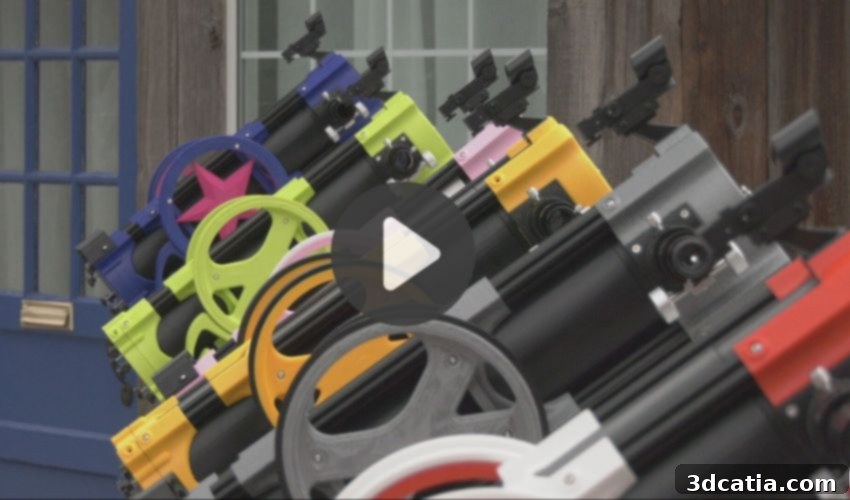
Our first spotlight shines brightly on a truly inspiring initiative spearheaded by Ten Telescopes, an organization dedicated to making the wonders of the cosmos accessible to everyone in Ontario, Canada. Founded by Brian Michel, this visionary project addresses a significant barrier to entry in astronomy: the often-prohibitive cost of conventional telescopes. Traditional optical instruments, while powerful, can be financially out of reach for many enthusiasts, limiting public engagement with stargazing and astronomical education.
Ten Telescopes leverages the transformative power of 3D printing to mitigate these financial hurdles. By designing and producing ten intricately crafted, functional telescopes using additive manufacturing, the initiative provides free access to these instruments, fostering a vibrant community of amateur astronomers. What makes this project particularly innovative is its commitment to open-source principles. All design files are freely available on their website, empowering individuals globally to download, 3D print, and assemble their own high-quality telescopes from the comfort of their homes. This not only democratizes access to advanced optical technology but also promotes STEM education and hands-on learning, inspiring a new generation of scientists and stargazers. The precision and customization offered by 3D printing allow for complex optical components and structural elements to be produced efficiently and affordably, proving that high-quality astronomical observation doesn’t require a hefty investment. This community-driven model exemplifies how digital fabrication can foster shared knowledge and collective scientific exploration, breaking down traditional barriers to participation in scientific hobbies.
Top 2: TU Berlin Students Harness 3D Printing for Enhanced Rotor Blade Efficiency and Sustainability
Our exploration continues at the fascinating intersection of 3D printing technology and renewable energy, where students from TU Berlin are making significant strides in optimizing rotor blade design. Jörg Abler and Laurin Assfalg are at the forefront of this research, demonstrating the unparalleled adaptability of additive manufacturing in their quest to maximize the efficiency of wind turbine rotor blades. The challenge lies in designing blades that can capture the maximum amount of wind energy, a task often constrained by the limitations of traditional manufacturing methods which struggle with highly complex geometries and rapid iterative design processes.
Through their innovative studies, these students have undertaken a comprehensive redesign of rotor blades, leveraging 3D printing to achieve intricate forms that would be impossible or prohibitively expensive to produce using conventional techniques. Additive manufacturing allows for the creation of organic shapes, internal lattice structures, and optimized aerodynamic profiles that significantly enhance performance. The ability to rapidly prototype and test various designs is crucial in this field, and 3D printing excels in facilitating quick iterations, leading to more efficient and sustainable solutions. The team utilized a 1-meter scaled prototype to showcase the real-world applicability of their research, conducting rigorous testing in a laboratory environment. This hands-on approach not only validates the theoretical advantages of 3D printed components but also accelerates the development cycle for advanced energy technologies. Their work underscores the pivotal role 3D printing plays in advancing sustainability goals, offering a pathway to more efficient renewable energy systems and demonstrating the potential for additive manufacturing to drive progress in environmental engineering and resource optimization.
Top 3: My N Mi Presents: A Detailed Look at the World’s Smallest 3D Printer
Next, we are captivated by a remarkable feat of engineering as My N Mi introduces us to the world’s smallest 3D printer, a testament to the incredible precision and miniaturization capabilities within additive manufacturing. This groundbreaking device, which garnered attention last year, continues to astound with its ability to fabricate objects at an almost imperceptible scale. The video offers an incredibly close look at the minuscule components that constitute this innovative printer, some of which are no larger than a single grain of sand. This extreme level of miniaturization highlights the extraordinary advancements in micro-fabrication technologies.
The construction and operation of such a miniature printer demand unparalleled precision and control. Every component, from the print head to the movement mechanisms, must be designed and manufactured with exquisite accuracy to achieve reliable and consistent results at the sub-millimeter scale. This technological marvel opens up vast possibilities for various applications that require ultra-fine details and tiny structures. Imagine the potential for micro-robotics, where complex tiny machines can be printed for medical procedures or industrial inspections. Consider advancements in electronics, where intricate circuits could be integrated into smaller form factors, or in biomedical engineering, enabling the creation of advanced micro-implants and drug delivery systems. The development of the world’s smallest 3D printer not only pushes the boundaries of engineering but also signifies a leap forward in our ability to manipulate matter at scales previously thought impossible for additive manufacturing, promising revolutionary developments in fields requiring extreme precision and compact designs.
Top 4: Acoustic Fields Explores 3D Printed Rooms for Optimal Sound and Lunar Living
Our journey into the versatility of 3D printing takes us next to the realm of architectural acoustics and even space exploration, as Dennis Foley from Acoustic Fields presents a revolutionary concept: constructing 3D printed rooms designed for perfect acoustics. Foley introduces the ingenious application of on-site concrete layering technology, a method that allows for the rapid and precise construction of complex structures directly where they are needed. This approach offers unprecedented customization in room design, enabling the creation of unique geometries and material densities specifically engineered to mitigate low-frequency noise issues, a common challenge in modern architecture and audio environments. Traditional acoustic treatments often involve bulky and aesthetically disruptive solutions, but 3D printing offers the ability to integrate sound-absorbing or diffusing structures directly into the walls, floors, and ceilings of a room, creating optimal sonic environments that are both functional and visually appealing.
Beyond terrestrial applications, Foley casts an ambitious gaze towards the stars, envisioning the expansion of this groundbreaking technology to the moon. He proposes constructing lunar structures using locally sourced lunar dust – a practice known as in-situ resource utilization (ISRU). This futuristic application of 3D concrete printing addresses the enormous logistical and financial challenges of transporting building materials from Earth to space. By utilizing extraterrestrial regolith, future lunar habitats, scientific outposts, and even industrial facilities could be fabricated autonomously or semi-autonomously, providing sustainable infrastructure for long-duration space missions. This concept not only showcases the adaptability of 3D printing in extreme environments but also highlights its potential to significantly reduce the cost and complexity of human expansion into space. The ability to create structurally sound, acoustically optimized, and radiation-shielding habitats from lunar materials would be a monumental step towards sustainable off-world living, demonstrating 3D printing’s critical role in future space exploration and colonization efforts.
Top 5: 3D Printing’s Transformative Role in Precision Surgical Planning for Kidney Procedures
We conclude our compilation with a deeply impactful application of 3D printing within the medical field, specifically focusing on its transformative role in kidney surgery and surgical planning. The creation of life-size, patient-specific 3D models of organs has become an invaluable tool, empowering surgeons with unprecedented preparation and insight before performing complex procedures. Traditionally, surgeons rely on 2D imaging like MRI and CT scans, which provide crucial information but can sometimes lack the tactile and three-dimensional understanding necessary for the most intricate operations.
Through advanced 3D printing technology, highly detailed models of a patient’s specific kidneys, complete with tumors, vascular structures, and surrounding tissues, can be precisely replicated. These physical models serve as a comprehensive roadmap, allowing doctors to hold, examine, and even practice on an exact replica of the patient’s anatomy. This hands-on preparation enables surgeons to better assess the exact size, location, and relationship of tumors to vital structures, facilitating a more precise and individualized intervention strategy for tumor removal. They can plan incision points, determine the optimal surgical approach, and anticipate potential complications with a level of detail previously unattainable. This practice not only enhances surgical precision and reduces operative time but also significantly improves patient outcomes by minimizing risks and maximizing the likelihood of complete tumor resection while preserving healthy tissue. Beyond kidney procedures, this technology is revolutionizing training for medical students and residents, providing realistic, tactile teaching aids that bridge the gap between theoretical knowledge and practical application. The integration of 3D printing into healthcare underscores its profound potential to personalize medicine, improve surgical safety, and advance patient care across numerous specialties, from orthopedics and cardiology to neurosurgery and beyond.
This week’s showcase truly underscores the incredible breadth and depth of innovation driven by 3D printing technology. From democratizing access to astronomy and enhancing sustainable energy solutions to pushing the boundaries of miniaturization, designing optimal acoustic environments, and revolutionizing patient-specific surgical planning, additive manufacturing continues to prove its invaluable role in shaping our future. Which of these groundbreaking videos resonated with you the most this week? Are you inspired by the prospect of affordable 3D printed telescopes, or perhaps fascinated by the potential for lunar habitats? Share your thoughts and let us know in a comment below! Connect with us on our LinkedIn, Facebook, and Twitter pages to join the conversation. Don’t miss out on the latest developments in the additive manufacturing world – sign up for our free weekly Newsletter here to receive top 3D printing news directly in your inbox! You can also explore all our compelling videos and further insights on our dedicated YouTube channel.
*Cover Photo Credits: CTV Your Morning