
Weekly 3D Printing Innovations: Top Videos Reshaping Additive Manufacturing
As another week draws to a close, we’re thrilled to present our hand-picked selection of the top five videos in the dynamic world of additive manufacturing. This week’s roundup is packed with inspiring advancements and groundbreaking applications that truly highlight the transformative power of 3D printing. Prepare to delve into a diverse array of colorful highlights, starting with a fascinating look at how additive manufacturing is poised to revolutionize nutrient intake through innovative fruit and vegetable creations. We’ll then revisit the awe-inspiring Terran-1 launch, a testament to 3D printing’s impact on space exploration, providing deeper insights into the intricate process and details behind its semi-successful journey earlier this year. Beyond these, you can look forward to an essential, comprehensive guide on the versatile role of polymers in 3D printing, crucial for understanding material science in AM. And for a touch of futuristic robotics, we’ll showcase a revolutionary new 3D printed gripper that operates entirely without electronics, pushing the boundaries of autonomous systems. If your interest in 3D printing videos runs deep, our YouTube channel is your ultimate destination. We consistently update it with exclusive interviews, in-depth reviews, and a wealth of engaging content designed specifically for enthusiasts like you. Don’t miss out on the opportunity to explore, learn, and stay at the forefront of the latest trends shaping the future of 3D printing. Happy Sunday, and enjoy the show!
Top 1: Innovative 3D Printer Produces Nutrient-Packed Meals
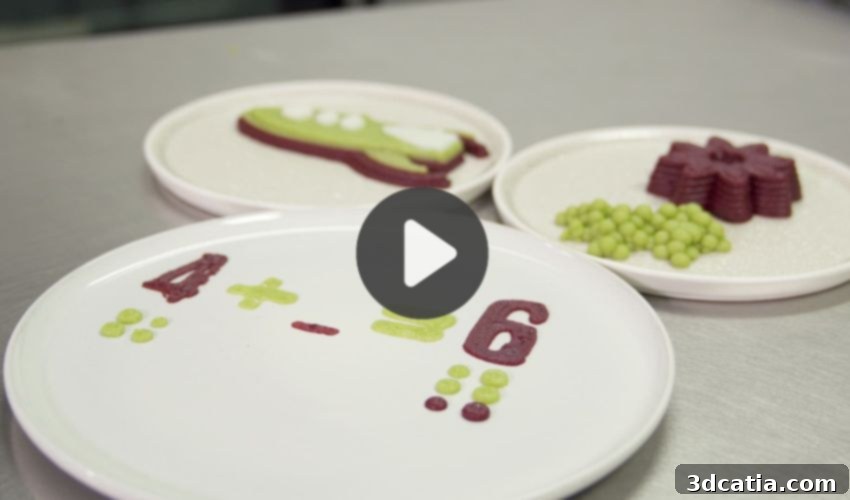
In a truly pioneering breakthrough that promises to redefine dietary approaches, Australian researchers have successfully harnessed the precision and versatility of 3D printing technology to revolutionize the way we approach fruit and vegetable consumption. This innovative development is not just about convenience; it’s a strategic solution designed to address significant nutritional challenges across a broad spectrum of demographics. From elderly individuals residing in care facilities who often struggle with chewing or swallowing, to young children with notoriously selective palates, and even military personnel requiring robust and compact nutrition in demanding environments, this approach offers tailored solutions. The potential to enhance nutrient intake and overall well-being across such diverse groups is immense.
By ingeniously applying advanced 3D printing technology, these dedicated researchers have achieved the creation of compact, highly palatable, and nutritionally dense meals that far surpass conventional food preparation methods. This groundbreaking technique not only presents a novel and exciting solution to increase the daily intake of essential fruits and vegetables, but it also signifies a major leap forward in the ongoing evolution of food innovation and personalized nutrition. The meticulous integration of 3D printing in crafting these small yet powerful nutrient-packed meals beautifully exemplifies the synergy between culinary science and cutting-edge engineering. This convergence is paving the way for an entirely new era in personalized, highly nourishing, and accessible food solutions, hinting at a future where our food can be custom-printed to meet individual dietary needs and preferences with unparalleled precision.
Top 2: Revisiting the Terran-1 3D Printed Rocket Launch
Earlier this year, the aerospace industry, and indeed the entire world, witnessed a truly remarkable demonstration of the cutting-edge potential inherent in 3D printing technology. This captivating event centered around the Terran-1 rocket, developed by Relativity Space, an audacious company committed to revolutionizing space launch. What made this achievement so extraordinary was the fact that a significant portion of this rocket, including its engines and primary structures, was fabricated through the innovative process of 3D printing. This advanced manufacturing technique showcased its unparalleled prowess by crafting crucial, complex components that are traditionally forged or machined, dramatically reducing part counts and manufacturing lead times.
The launch of the Terran-1 rocket, while ultimately deemed “semi-successful” in reaching orbit, was a monumental feat in itself. Simply lifting off and traversing a significant portion of its intended trajectory with so many 3D printed components underscored the viability and robustness of this manufacturing approach for critical aerospace applications. This accomplishment sent powerful reverberations throughout the aerospace industry, not only highlighting the remarkable strides made in merging 3D printing with space exploration but also setting a new benchmark for what’s possible. The implications extend far beyond manufacturing efficiency; they touch upon the future of in-situ resource utilization, potential for on-demand spacecraft production, and even the vision of printing rockets directly on other celestial bodies. For those eager to refresh their memory on the intricate details and the sophisticated process that went into crafting the pioneering Terran-1 3D printed rocket, the video below offers a compelling and educational journey behind this historic event.
Top 3: All About Polymers For 3D Printing
In the latest insightful installment of our popular “3D Explained” series, we take a deep dive into the fascinating and incredibly diverse world of polymers, specifically tailored for their applications in 3D printing. Following our previous episode, which provided a foundational overview of conventional 3D printing materials, this video expands our exploration significantly. It plunges into the intricate realm of engineering and high-performance polymer materials, all condensed into a concise yet highly informative 4-minute timeframe. Understanding the properties and applications of these advanced materials is paramount for anyone looking to push the boundaries of additive manufacturing, from hobbyists to industrial designers.
Polymers are the backbone of much of today’s 3D printing, offering an unparalleled range of properties, from flexibility and elasticity to incredible strength and chemical resistance. This segment is designed to illuminate the techniques behind effectively 3D printing robust plastic components using these specialized polymers. You’ll gain a clearer understanding of why certain materials are chosen for specific applications – for instance, how engineering polymers like ABS or Nylon provide the durability needed for functional prototypes and end-use parts, or how high-performance polymers such as PEEK or ULTEM are indispensable for demanding industries like aerospace and medical, thanks to their exceptional thermal stability and mechanical strength. As we look ahead, you can anticipate the upcoming final episode of this illuminating series, which will further round out your knowledge of 3D printing materials. But for now, immerse yourself in this essential guide to polymers and enhance your understanding of material science in additive manufacturing!
Top 4: Top 5 3D Printers in 2023
Are you currently navigating the market with the aim of acquiring a new 3D printer? Before you finalize any decision, it’s absolutely crucial to watch this comprehensive video! The world of 3D printing is a rapidly expanding and evolving field, presenting an astonishing array of options for prospective buyers, each with unique features, capabilities, and price points. This guide is designed to help you make an informed choice, whether you’re taking your first steps into additive manufacturing or looking to upgrade your existing setup.
For experienced users, this video offers invaluable insights into enhancing your skills and expanding your creative potential with a new, more advanced model, perhaps one that offers larger build volumes, multi-material capabilities, or superior print resolution. If you’re a beginner, preparing to unlock your creativity and craft exciting projects like custom toys, intricate models, functional stands, practical hooks, or bespoke parts, the video will guide you through accessible and user-friendly options. It highlights how you can start exploring the magic of 3D printing with a reliable printer often available for under $250, and sometimes even incredibly affordable models priced under $200. However, for those aspiring to more advanced capabilities such as significantly larger build volumes, exceptionally higher resolution for fine details, or considerably faster printing speeds to boost productivity, a slightly higher budget investment might be necessary. This comprehensive video offers more essential tips like these, along with a detailed explanation of some of the best 3D printers available on the market today, ensuring you choose the perfect machine to match your needs and ambitions.
Top 5: New 3D Printed Gripper Without Electronics
In a significant leap forward for robotic technology, researchers from the esteemed University of California San Diego (UCSD) have unveiled a noteworthy application of 3D printing within the increasingly vital realm of soft robotics. Soft robotics, characterized by its use of flexible, compliant materials, has seen an exponential rise in utility, particularly for tasks demanding intricate human interaction, delicate handling of fragile objects, or operation in unpredictable environments where traditional rigid robots might pose risks. This innovation addresses many of the limitations of conventional robotics, offering a safer and more adaptable alternative.
In a collaborative effort with BASF, a global leader in chemical manufacturing, the UCSD team has engineered a revolutionary 3D printed soft robotic gripper that operates with remarkable efficiency entirely without the need for electronics. This ingenious device possesses the ability to autonomously pick up, securely hold, and then precisely release objects, leveraging only built-in gravity and sophisticated touch sensors. The gripper’s innovative design is particularly remarkable for its capacity to “remember” when it has grasped an object, initiating a controlled release only upon detecting a shift in the object’s weight or position, mimicking a natural, intuitive interaction. Furthermore, the unique 3D printing process employed in its creation, which involves continuous tracing by the printer nozzle, elegantly circumvents common issues like stiffness and leakage that have plagued previous iterations of 3D printed soft robots. This novel application not only underscores the burgeoning synergy between advanced 3D printing techniques and the evolving field of soft robotics but also paves the way for advanced, highly functional designs with profound practical applications across industrial manufacturing, healthcare, exploration, and other fields. The groundbreaking research, published in the prestigious journal Science Robotics, undeniably reflects a promising and exciting advancement in the seamless fusion of 3D printing and the next generation of robotics.
We hope you enjoyed this week’s dive into the fascinating world of additive manufacturing. Which of these Top 5 videos captivated your attention the most this week? We invite you to share your thoughts and preferences in a comment below, or connect with us and join the conversation on our LinkedIn, Facebook, and Twitter pages! Don’t forget to sign up for our free weekly Newsletter here, ensuring the very latest 3D printing news, insights, and innovations are delivered straight to your inbox every week. You can also find all our compelling videos and much more exclusive content on our dedicated YouTube channel. Stay connected, stay informed, and keep exploring the endless possibilities of 3D printing!
*Cover photo credit: Edith Cowan University