
The Future is Now: Top 5 Breakthroughs in Additive Manufacturing and 3D Printing Innovation
Welcome to our weekly showcase of groundbreaking advancements in additive manufacturing. Each week, we curate a selection of the most compelling videos that highlight how the 3D printing industry is profoundly shaping various aspects of our society and pushing the boundaries of what’s possible. From revolutionary product launches to humanitarian initiatives and individual ingenuity, these stories demonstrate the immense versatility and impact of additive manufacturing technology.
This week’s collection is particularly exciting, featuring a diverse range of innovations and applications across numerous sectors. We delve into Formlabs’ highly anticipated new product, explore the construction of the world’s first-ever 3D printed school, witness a teenage inventor’s impressive creation, uncover critical medical training solutions, and examine advanced metal printing techniques. These videos offer a glimpse into the cutting edge of additive manufacturing innovations, illustrating how they are driving progress in design, production, education, healthcare, and beyond. For an even deeper dive into the world of 3D printing applications, be sure to visit our dedicated YouTube channel. We hope you find these stories inspiring and enjoy exploring the incredible potential of 3D printing technology.
Top 1: Formlabs Unleashes the Fuse 1, Redefining Desktop SLS 3D Printing
In a move set to democratize advanced 3D printing technologies, Formlabs, a leader in accessible desktop 3D printers, recently unveiled their highly anticipated new Selective Laser Sintering (SLS) system, the Fuse 1. This groundbreaking desktop SLS printer was a major highlight at our ADDITIV event, signaling a significant shift in the additive manufacturing market. Historically, SLS technology, renowned for its ability to produce strong, functional parts with excellent mechanical properties and geometric freedom, has been largely confined to large industrial environments. The prohibitive costs, complex operational requirements, and significant space demands of traditional SLS systems made them inaccessible for many businesses and smaller-scale operations.
The Formlabs Fuse 1 aims to shatter these barriers, emerging as an affordable and remarkably compact SLS 3D printer solution. Priced from an attractive $18,499, the Fuse 1 is poised to open up the world of industrial-grade SLS 3D printing to a much wider audience. Max Lobovsky, CEO and co-founder of Formlabs, expressed his vision for the machine, stating that it will empower companies with more modest budgets to finally “benefit from the design freedom and high productivity SLS 3D printing provides.” This accessibility means that more designers, engineers, and manufacturers can leverage SLS for rapid prototyping, functional part production, and even end-use parts, without the massive investment previously required.
Beyond its accessible price point, the Fuse 1 is designed for a seamless and user-friendly experience. The machine itself integrates innovative Surface Armor technology, which helps create optimal surface finish and part quality. Crucially, the Fuse 1 is not just a standalone printer; it is part of a comprehensive and integrated workflow designed by Formlabs. This ecosystem includes Formlabs’ intuitive print preparation software, Preform, which allows users to easily set up prints and manage jobs. Additionally, the system features the Fuse Sift, a dedicated powder recovery station that efficiently manages and reclaims unused powder, significantly reducing material waste and operational costs. This holistic approach ensures that users can achieve consistent, high-quality results from initial design to final part, making advanced industrial 3D printing more manageable than ever before. The Fuse 1 truly represents a pivotal moment in making sophisticated additive manufacturing accessible to the masses, fostering innovation across countless industries.
Top 2: Unveiling Direct Metal Laser Sintering (DMLS) in Space and Defense
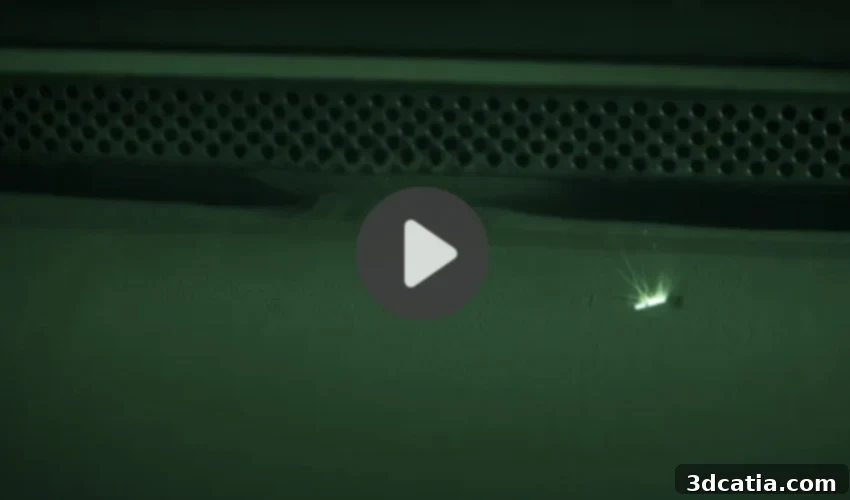
Delving into the realm of high-performance metal 3D printing, our second video highlights the sophisticated application of Direct Metal Laser Sintering (DMLS) by Northrop Grumman Corporation. As a formidable global entity specializing in advanced space and defense technologies, Northrop Grumman consistently pushes the boundaries of engineering and manufacturing. Their adoption of DMLS underscores the critical role that additive manufacturing plays in aerospace and defense sectors, where precision, material integrity, and complex geometries are paramount.
In the insightful video, JT Wojtowicz, a Manufacturing Engineer at Northrop Grumman, provides a clear explanation of the DMLS process. DMLS is a powerful laser sintering technology that enables the creation of robust, high-density metal parts layer by layer directly from fine metal powders. Unlike traditional manufacturing methods that rely on subtractive processes, DMLS builds parts additively, meaning material is only added where needed, resulting in less waste and the ability to produce highly intricate designs that would be impossible to achieve otherwise. This method is particularly valued for its capacity to produce components with superior mechanical properties, often comparable to or exceeding those of conventionally manufactured parts.
Northrop Grumman’s specific application involves the use of high-quality aluminum powder combined with a powerful 400-watt laser. Aluminum is an excellent choice for aerospace components due to its lightweight nature and strength, making it ideal for parts that require high performance without adding excessive weight. The DMLS process allows Northrop Grumman to fabricate custom components for satellites, aircraft, and defense systems, optimizing designs for thermal management, structural integrity, and reduced assembly time. This translates into lighter, more efficient, and more reliable components, directly enhancing the performance and capabilities of their advanced systems. The ability to rapidly prototype and produce complex, flight-ready metal parts on demand represents a significant strategic advantage in the fast-paced defense industry. Discover more about how this pioneering company is harnessing the power of DMLS technology to innovate below:
Top 3: Constructing the Future – The World’s First 3D Printed School
While our weekly compilations have previously showcased innovative 3D printed buildings, including the first 3D printed residential building, this particular project ventures into truly uncharted and inspiring territory: the construction of the world’s first 3D printed school. This pioneering initiative is the brainchild of ThinkingHuts, a visionary non-profit organization established by Maggie Grout at the remarkably young age of 15. Her fundamental intention was powerfully simple yet globally significant: to drastically enhance access to education for underserved communities worldwide.
The global crisis of inadequate access to education represents a formidable challenge, one that has been exacerbated by recent global events, including the pandemic. Traditional school construction methods are often slow, expensive, and resource-intensive, making it difficult to keep pace with the demand in rapidly growing or remote populations. 3D printing in construction offers a revolutionary alternative, promising speed, cost-efficiency, and design flexibility that can overcome these obstacles. ThinkingHuts leverages these advantages, aiming to provide a rapid and scalable solution to bridge the educational infrastructure gap.
To bring this ambitious project to fruition, ThinkingHuts forged strategic partnerships with leading innovators in the field. Collaborating with Hyperion Robotics, renowned for their expertise in robotic construction, and Studio Mortazavi for architectural design, they are transforming the landscape of educational facility development. Beyond merely building structures, the core mission extends to empowering local communities. ThinkingHuts not only constructs sustainable and durable 3D printed schools in areas critically lacking educational infrastructure but also invests in teaching community members how to operate and maintain the large-scale 3D printers. This approach fosters local ownership, creates new skill sets, and ensures the long-term viability and impact of these educational hubs. This project truly embodies the transformative potential of sustainable 3D printing to address pressing humanitarian needs and create lasting change.
Top 4: Teenage Engineering Marvel: 3D Printed Functioning Speedboat Drive
Our fourth feature is a testament to the incredible power of individual innovation and the accessibility of 3D printing for rapid prototyping. Luca Dalbosco, a truly talented 16-year-old, captivated the engineering community by successfully designing and building a fully functioning speedboat drive in a mere few weeks. This project not only showcases Luca’s remarkable aptitude but also highlights how desktop 3D printing tools, combined with industrial-grade services, can accelerate product development and turn ambitious ideas into tangible realities.
Luca initially utilized his personal FDM (Fused Deposition Modeling) 3D printer at home to prototype many components of the speedboat drive. FDM is an excellent starting point for iterative design and concept validation due to its affordability and ease of use. However, as the project progressed from conceptual models to functional parts requiring high mechanical integrity, Luca encountered a common limitation: some of the final components printed with FDM lacked the critical stability, strength, and durability required for a high-stress application like a speedboat drive. For parts that would endure significant torque, water exposure, and vibrations, a more robust additive manufacturing material and process were necessary.
Recognizing the need for industrial-grade quality, Luca astutely identified Selective Laser Sintering (SLS) as the ideal technology to provide the superior material properties he required. SLS is known for producing strong, isotropic parts with excellent surface finish and complex geometries, making it perfect for functional prototypes and end-use components. Demonstrating initiative beyond his years, Luca reached out to Sintratec, a prominent manufacturer of professional SLS 3D printers. Impressed by his project and potential, Sintratec not only sponsored Luca but also 3D printed the crucial SLS components for his speedboat drive using their advanced Sintratec S2 system. This collaboration allowed Luca to leverage the benefits of industrial SLS 3D printing – including high-strength nylon parts – to achieve a fully functional and reliable final product. This story serves as a powerful example of how combining personal passion with professional 3D printing services can lead to remarkable engineering feats, regardless of age. Witness the impressive speedboat drive in action below!
Top 5: Biomodex Innovations – Advancing Surgical Training with 3D Printing
The final entry in our list underscores the profound and rapidly expanding influence of additive manufacturing within the medical field. Over the past decade, medical 3D printing has transitioned from a niche technology to an indispensable tool, revolutionizing everything from prosthetics and implants to personalized surgical guides and anatomical models. Among the myriad applications, one of the most critical and impactful uses of 3D printing in healthcare is in the development of highly realistic medical training equipment. This is precisely where Biomodex, a pioneer in the sector, has carved out its expertise and made significant strides.
Biomodex specializes in creating patient-specific, biomechanically realistic organ models for surgical simulation and medical training. Their advanced 3D printing technologies allow them to replicate human anatomy with unparalleled accuracy, capturing the intricate details and tactile feedback essential for effective surgical practice. This innovative approach moves beyond traditional cadaveric or synthetic models, offering surgeons and medical professionals the opportunity to rehearse complex procedures on models that perfectly mimic specific patient pathologies. Such realistic rehearsal significantly enhances surgical proficiency, reduces procedural risks, and ultimately improves patient outcomes. Biomodex has indeed come a long way since its early days, having been recognized as our “start-up of the month” back in April 2017, a testament to their consistent innovation.
Recently, Biomodex has substantially expanded its comprehensive offerings, particularly in the critical areas of neurovascular and cardiovascular interventions. Their portfolio now includes advanced patient-specific rehearsal solutions that allow surgeons to pre-plan and practice intricate procedures, minimizing surprises in the operating room. This expansion further solidifies their position at the forefront of 3D printed medical models for physician training. In the featured video, Biomodex proudly introduces their cutting-edge echo-guided transseptal puncture training solution. This particular innovation provides a realistic simulation environment for a challenging cardiovascular procedure, allowing cardiologists to perfect their technique in a risk-free setting. By continuing to develop such high-fidelity training tools, Biomodex is playing a pivotal role in ensuring that medical professionals are equipped with the best possible preparation, ultimately contributing to safer and more effective patient care across the globe. This highlights the indispensable value of patient-specific 3D printing in shaping the future of medicine.
As we conclude this exploration of the latest advancements in additive manufacturing, it’s clear that the applications and innovations are as diverse as they are impactful. From revolutionizing industrial production with accessible SLS 3D printers to pushing the boundaries of engineering in space and defense, providing sustainable educational infrastructure, fostering young talent, and enhancing critical medical training, 3D printing continues to redefine possibilities across every sector.
Each video presented today offers a unique perspective on how this transformative technology is not just changing industries but also addressing global challenges and empowering individuals. The speed at which 3D printing technology is evolving means that every week brings new breakthroughs and inspiring stories. We are passionate about sharing these developments and fostering a community that is as excited about the future of digital manufacturing as we are.
We’d love to hear your thoughts! What did you find most impressive in this week’s top 5 videos? Which innovation sparked your imagination the most, or which application do you think will have the greatest impact? Share your favorite pick and your insights with us in the comments section below. You can also join the conversation and connect with our vibrant community on our Facebook and Twitter pages, where we regularly post updates and engage with enthusiasts and professionals alike. To ensure you never miss out on the cutting-edge developments, exclusive interviews, and all the latest news from the dynamic 3D industry, don’t forget to sign up for our free weekly newsletter, delivered straight to your inbox every Sunday. Stay informed, stay inspired, and keep exploring the endless potential of additive manufacturing!